When I first started writing, I was a pantser writer (that means I wrote by the
seat-of-my-pants…no planning or plotting), but the more stories I created and
the longer they became, I had to morph into a hybrid writer where I would have
to write a high-level outline and then I could sit down and write my books.
I recently ran across the concept of visual plotting aka storyboarding on
Rachel Vincent’s
blog** and the idea really appealed to me for a couple of
reasons:
1) Because I’m a very visual person
2) Because when you write bulleted items down in an outline format on paper and
you print it out to read it away from your computer, you aren’t given the
freedom to “mess” with the order of events/scenes(how and when they occur) as
easily.
So I thought I’d give this concept a whirl for my current manuscript
Insurrection (the second book in my Scions Silhouette Nocturne trilogy).
Supplies needed:
1) Dry erase board big enough to hold a LOT of sticky notes.
2) Different colored post it notes to represent different aspects of your
story, ie Main plot, main subplot, secondary plot, minor subplot and of course
the romance.
3) Dry erase markers. (I tried to match mine to the sticky notes, which I’ll
tell you why below)
Basically what you’re trying to do is take high-level ideas and put them on
sticky notes in a one-liner format. As ideas/new scenes come to you, keep
writing them down on the appropriate colored post it notes and then plunk them
on your erasable marker board in no particular order. Once you have as many as
you can think of, start placing your ideas/scenes on the board in the order
that makes the most sense for them to happen in your story. After you have
placed all of them, you might get an idea to move a scene earlier or later and
that in turn might spur new ideas or scenes or plot twists for your story…to
which you’ll jot down on a new post it.
In my mind, this kind of plotting helps for two reasons: 1) It’s more flexible
and 2) It lets you see if your story is balanced or where you might need to add
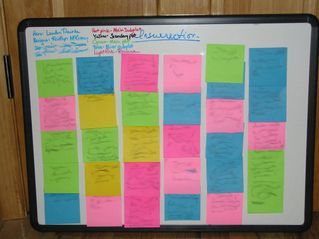
more elements for a better balance. For instance, if you look at my storyboard
at the bottom of this post, you’ll see that I don’t have any light pink post
its at the end. Light pink post its represent the romance aspects of my story.
Yep, I haven’t figured out yet exactly how I want the story to end. Also, since
I have yellow at the beginning but nothing near the end, I can tell I need to
make sure I carry my secondary plot further into the story. I have ideas for
both additional light pinks and yellow posts its, and those I could either jot
down on a few post its and keep them to the side until I decide which one I
want to use OR I could use my markers and write out the different ending ideas
on the board off to the side. That’s why the coordinated markers might come in
handy.
Rachel’s example helped her formulate her synopsis, which I think is the BEST
use of this storyboard…ie, high-level plotting. That’s exactly what each of
those post it notes represent…plot points, twists, romantic scenes, etc that
will happen in the story—and that’s exactly how you write a synopsis…at a high
level.
Will Insurrection follow this outline? Some of it will (hence the reason I’ve
blurred out the writing. NO SPOILERS! ), but it does give me a very loose road
map and a place to “play with” ideas and tweak my story as I’m moving along.
For a great tool with many functions such as:
1) Helping you get out of a plotting rut
2) Helping you write up a synopsis when you haven’t written the rest of the
story yet…ie, selling on proposal
3) Helping you tweak your novel as you’re writing it
Give storyboarding a try and see what you think.
Post its color-coded legend (also pilfered from Rachel** )
Green: Main plot
Hot pink: Main subplot
Yellow: Secondary plot
Blue: Minor subplot
Light Pink: Romance
Tip:
I wrote on the back of my post it pads what each color represented.
Then if I forgot while I was plotting which color went with what, I just
flipped over the pad to remind myself. That should come in handy since it might
be a month or two before I use the pads again for the “next” story plotting.
** Giving kudos and credit where it’s due.
3 comments posted.
Thanks for passing along the idea! I am always interested in how published writers come up with their ideas and how they move from the idea stage to published work.
(Michelle Howell-Martin 7:10am October 28, 2007)
Thanks for this post. This looks like a great plotting method. I can't wait to try it!
(Carol Burge 9:42pm January 2, 2008)



 © 2003-2026