Regina Kyle | Aaron Sorkin's 5 Tips to Writing Dialogue
#Giveaway Win TRIPLE TIME
Hello, Fresh Fiction readers! This is my first time on the Fresh Fiction blog,
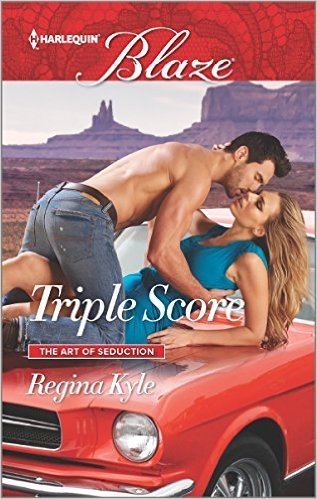
and I’m super excited to be here. I’m celebrating the release of TRIPLE SCORE, but it’s a
bit bittersweet, as it’s the final book in my Art of Seduction series and my
final book for Harlequin Blaze.
I’ve loved writing for Blaze. I like the sexual tension. I like the heat when
that tension explodes. But most of all, I like the snappy dialogue.
Yep, dialogue’s my jam. I live for lively banter, witty repartee, the perfect
parting remark. My idol is Aaron Sorkin, who wrote masterpieces like TV’s West Wing and Newsroom and movies
Moneyball and The American
President. His dialogue sparkles. It’s musical, reflective, funny,
smart. Like this gem from The Social Network:
Lawyer: Mr. Zuckerberg, do I have your full attention?
Mark Zuckerberg: No.
Lawyer: Do you think I deserve it?
Mark Zuckerberg: What?
Lawyer: Do you think I deserve your full attention?
Mark Zuckerberg: I had to swear an oath before we began this deposition, and I
don't want to perjure myself, so I have a legal obligation to say no.
Lawyer: Okay - no. You don't think I deserve your attention.
Mark Zuckerberg: I think if your clients want to sit on my shoulders and call
themselves tall, they have the right to give it a try - but there's no
requirement that I enjoy sitting here listening to people lie. You have part of
my attention - you have the minimum amount. The rest of my attention is back at
the offices of Facebook, where my colleagues and I are doing things that no one
in this room, including and especially your clients, are intellectually or
creatively capable of doing. [pause] Did I adequately answer your condescending
question?
Brilliant, right? So I thought I’d share with you five lessons I learned on
writing dialogue from the great Mr. Sorkin:
Dialogue isn’t conversation. Conversation is boring. It’s the
mundane, inane stuff we talk about every day. Dialogue either moves the plot
forward or reveals something important about the characters.
Realistic is different from real. This kind of goes along with the
first point. In real life, our speech is filled with “ums” and “ers” and false
starts and stops. That doesn’t mean you can’t use some for emphasis, like to
show a character is nervous or hesitant. Just use them sparingly, and for good
reason. And my personal pet peeve: writers who avoid using contractions in
dialogue. That’s how we speak, folks. Use ’em.
Think about who’s talking. Men speak differently from women (usually
less, sexist, I know, but true nonetheless). Cowboys speak different from CEOs,
20-somethings differently from 60-somethings. If you’re writing a character type
that’s new to you, go hang out where you’d find similar folks. Listen to them.
Or if you can’t do that, go on line, watch some YouTube videos. There’s a wealth
of information on the world wide web.
Write the spoken words first, then worry about the actions and tags.
I find my dialogue flows more realistically when I write it first like a script
or a screenplay, just the dialogue. Then I go back and add in actions or tags to
help identify who’s talking. And where I can, I like to use actions rather than
tags to keep things moving and show how my characters are feeling rather than
tell.
Read it aloud. Again, like a script or a screenplay, read the
dialogue bits out loud. You’ll be surprised how quickly you can spot the
sections that don’t trip over the tongue the right way.
That’s just five quick points. I could wax on forever about the lessons Mr.
Sorkin has taught me. Fortunately for you, I won’t. But I’ve got to admit that I
get a little thrill whenever a reviewer praises my “witty, intelligent” banter
because I know it means I’m that tiniest bit closer to emulating the master.
GIVEAWAY: What author’s dialogue makes you smile? One commenter will get
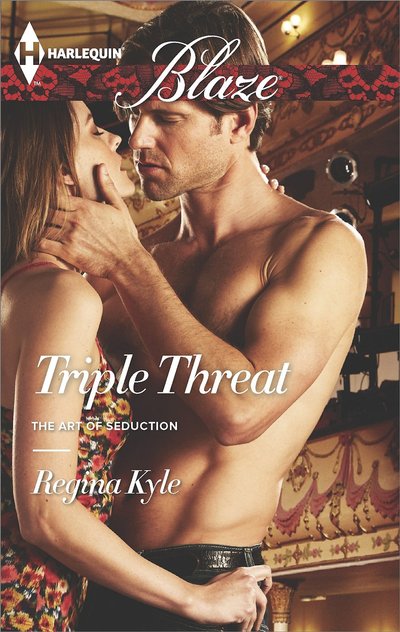
a copy of TRIPLE TIME, the second book in the Art of Seduction series.
Regina Kyle knew she was destined to be an author when she won a writing
contest at age ten with a touching tale about a squirrel and a nut pie. By day,
she writes dry legal briefs, representing the state in criminal appeals. At
night, she writes steamy romance with heart and humor.
A lover of all
things theatrical, Regina lives on the Connecticut coast with her husband,
teenage daughter and two melodramatic cats. When she’s not writing, she’s most
likely singing, reading, cooking or watching bad reality television. She’s a
member of Romance Writers of America and of her local RWA chapter.
Prima ballerina Noelle Nelson needs to recover from her injury and return to
the stage. She won't consider failure…or be distracted by baseball's resident
bad boy, Jace Monroe. His tattoos, wicked smile and deliciously athletic body
might drive her crazy, but a media frenzy is the last thing this good girl
needs.
Jace is sick with fear that his own injury will never heal, but he's not
about to let anyone notice, especially the gorgeous blonde dancer he loves to
infuriate. He's pushing himself past his physical capacity, putting his future
at risk. Still, when it comes to making a play for Noelle, Jace is in scoring
position—and he's not going to back down!
There are a few different authors that truly entertain me with the dialogue that they create for their characters... to me if a book can make me feel something, it is a winner. (Colleen Conklin 7:31pm July 23, 2016)
Dialogue is what makes the book/authors do me. You are absolutely spot on re reading aloud to verify the flow! Thanks for your thoughts! :) (Kathleen Bylsma 11:09pm July 23, 2016)
For me it always depend on the story and the way the characters interact conversationally. Kate Angell, Jill Shalvis, Kristan Higgins, & Robyn Carr are among the masters at this. (Eileen Aberman-Wells 12:22pm July 24, 2016)
Not a book author, but TV's Amy Sherman Palladino is awesome. (Samantha Tennant 12:58pm July 24, 2016)
One of my favorite authors of great dialog is Sandra Hill. Her characters make me laugh, cry and, above all, keep reading. She can touch your heart strings one minute and have you laughing out loud the next. To me, that's what makes the story. (Sharon Mitchell 3:57am July 24, 2016)
I loved Kristan Higgins' dialogue! She makes me smile! (Amy Higgison 10:20am July 24, 2016)
I like your dialogue ...nope not a suck up lol but you exhibit humor and I love to laugh always been that way someone that can make me smile in their writing and in there interaction with their readers is a jewel lightens the load of the day that is for sure ...hugs and love (Cindy Woolcott 12:55pm July 24, 2016)
Louise Penny's dialogue makes me smile. Not because it's funny so much, but because it's like poetry to my ears. I also love to read Kristan Higgins Facebook posts, because they crack me up. That's how I got into her books. (Connie Williamson 12:39pm July 25, 2016)
I have a few authors I really enjoy like Jill Shalvis and Penny Reid. Their dialogue is always witty, funny and engaging. (Ada H. 6:31am July 25, 2016)
I can't think of anything off the top of my head, however I do think that dialogue really makes stories move forward. (Lily Shah 2:50pm July 25, 2016)
Sometimes the dialogue is what sells the books , so it has to be good and you want more of what you have already read . (Joan Thrasher 10:14am July 26, 2016)
I like when you can easily get into the character such as Evanovich's Stephanie Plum series. Her characters are easy to follow & always provide a smile & a laugh. (Teresa Miller 9:18pm July 27, 2016)
I know you will think I'm crazy but I love the dialogue of the Black Dagger Brotherhood by JR Ward. They are so crazy and funny!!! (Bonnie Capuano 10:26am July 28, 2016)
Sandra Hill. I like you #1 & 2 points especially. (Laura Gullickson 8:53pm July 28, 2016)












 © 2003-2026