Great news! The newest book in the Saxon Series will be out next year AND the
first book's adaptation, THE LOST KINGDOM, has already entered into production.
BBC will air the Matthew MacFayden (PRIDE AND PREJUDICE) drama in 2015, but
until then catch up with Bernard Cornwell, author of THE EMPTY THRONE, in a
exciting new Q&A.
THE EMPTY THRONE is out on e-book, print, and audio on Tuesday, January 6th.
Q.: You have now written eight books in the Saxon Tales series. How
many more are planned? What is next in store for the characters?
I wish I knew! I can't plan a book, let alone a series, so every new tale is an
adventure. I've always thought the joy of reading a book is ‘to see what
happens', and that's also the pleasure of writing one. I usually have no idea
what will happen in the next chapter, and the only way to find out is to write
it! That said, there are one or two obvious pointers in the books so far –
Uhtred will regain Bebbanburg and a new country, called England, will emerge
from the long wars. Essentially the Saxon series is about that; the creation of
a nation. Americans have a precise birthdate, July 4
th 1776, but the
English have no such luxury and are strangely ignorant about how their nation
was formed.
Q.: When you start out writing a history-based series, do you know where the
chronicle will go, or does each novel take shape as you write it?
I wish I could plan a novel; it would probably make life a lot easier. It seems
to me there are two basic methods of novel writing; those who plan their books
meticulously and have this wonderful outline to flesh out, and those like me who
just start and stagger on till the story is told. I think it was E.L. Doctorow
who said that writing a novel is like driving at night down an unfamiliar
country road and you can only see as far ahead as your rather dim headlights
allow. That's me. Dim. I reached the last chapter of
THE EMPTY THRONE and
genuinely had no idea what would happen, but was delighted when I found out!
Q.: Unlike in your Sharpe or Starbuck series, here you
are writing about a historical period that is much less documented. How do you
conduct your research?
Read, read, read, then read some more. Research takes a lifetime of reading. I
suppose you soak yourself in a period until it exists in the imagination.
Q.: Is this lack of historical data a handicap or does it free you as a
writer of fiction?
It's wonderfully liberating! I love the shadowed parts of history that have no
explanations because that gives me the freedom to fill in the gaps. For instance
we know that someone called Uhtred was the lord of Bebbanburg in the
9
thCentury, and we know he was Saxon even though all the land about
him was ruled by the Danes, but beyond that nothing! So how did he keep his
land? The true answer, probably, is that he collaborated, but that's dull so I
can invent other explanations.
Q.: One of the seminal questions at the heart of THE EMPTY THRONE is will
Athelflaed, sister to King Edward of Wessex, widow of Æthelred, become Queen? Do
you think history would have been different if she had been Queen?
She was effectually the Queen of Mercia, so no, I don't think history would have
been different. She ruled Mercia very successfully, but always in concert with
her brother who was the King of Wessex. History might have been different if she
had started a dynasty, but her only child was a daughter who appears to have
inherited none of her mother's abilities. I think the sad thing about Æthelflaed
is that she's been forgotten. She took a crucial lead in the creation of England
and deserves to be remembered for that.
Q.: One of the themes in the early books was Uhtred of Bebbanburg's
resistance of Alfred's Christianity. Now that Alfred is dead, does religion
still play a role in this new book?
Probably! The wars that ravaged Britain in the ninth and tenth centuries were
not just about land and who should rule, but were also religious. The Danes and
the Norsemen were, by and large, pagan, the Saxons (and Angles) were Christian,
and the Christians undoubtedly saw their struggle as a crusade. They were doing
God's work! In the end, of course, Christianity prevailed and that did not stop
the wars, but they were not to know that. And Uhtred, stubborn as he is, will
not abandon his paganism so yes, the religious themes will continue!
Q.: The Saxon Tales,
like most of your fifty-plus books – from the Sharpe books and the Nathaniel Starbuck
Chronicles to your stand-alone novels – are centered on war and set on
the battlefield. What attracts you to viewing history through the lens of war?
War is a wonderful background for any adventure story, mainly because history
provides you with a ready-made background of mayhem and conflict. What interests
me more is the character's reaction to war. Every society has a moral basis, and
almost all condemn murder and manslaughter (‘Thou shalt not kill'), but those
moral constraints are lifted by wartime and men (mostly men) are encouraged to
flout this basic rule. So how do they react? Some misuse the freedom it offers,
other have a more nuanced reaction, and that offers enormous scope for storytelling.
Q.: It was recently announced that the Saxon Tales will be
adapted for television by BBC America. How far into the series will the
adaptation go?
I have no idea! I guess I depends how successful the first series is.
Q.: Are you involved in the adaptation and filming?
Not even slightly, nor do I want to be. I worked in television for a decade, as
a producer of News and Current Affairs, and I learned that I know nothing about
producing television drama, so I stay well away. Leave it to the experts! If
they want me to be a cheerleader for them then I'll happily get out the
pom-poms, but other than that? Nothing.
Q.: You are soon publishing your first non-fiction book, WATERLOO. Did you find it
different writing history as non-fiction rather than fiction? How so?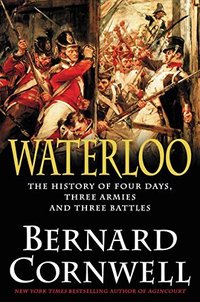
The biggest difference was not having to devise a plot! Plot drives a novel and
the hardest thing about writing a novel is discovering that plot, but that
burden is entirely taken away. The book still needed shaping, but the story of
Waterloo is so compelling that essentially it shapes itself – it all takes
place in a very short time (the campaign is just four days), and in a very small
space (the battlefield was very restricted) and it has compelling major
characters; Napoleon and the Duke of Wellington who were acknowledged as the two
greatest soldiers of the age, but who had never fought against each other. The
story of Waterloo has everything, even an amazing cliff-hanging ending. So the
‘plot' was handed to me on a plate by history, so the hard work was to discover
memoirs, diaries and letters that conveyed the real horror of that dreadful day,
and I wanted those eye-witness accounts to come from all sides, French,
Prussian, Dutch and British, so there was an enormous amount of research and
editing to do. I love the book, but am not sure I want to write any more
non-fiction!
No comments posted.





 © 2003-2026