Writers talk a lot about being “haunted” by an idea. We’re melodramatic that way. Most of the time we mean we’re obsessed by some memory from our childhood, or a line from a David Bowie song, or the glimpse of an elderly man weeping by the side of the road, or… you get the idea.
For over a decade I’ve been haunted by a pair of sisters who first showed up as side-characters in a novel, and then wouldn’t go away. They weren’t scary, soul-scarring specters—more like a pair of annoying poltergeists who toss dishes around until you get out of their house, or in my case, give them their own book.
If you’re a creative person—hell, if you’re a person—you have to learn to pay attention to those recurring thoughts, those persistent ideas. That’s where the juice is. If those thoughts are troubling, by all means go into therapy, but if they’re interesting, you owe it to yourself to give them your time and energy.
My advice is to follow the weird idea, flesh it out, and make it come alive. Not because it will make you a better person (it won’t) or fulfill you as an artist (artists don’t get fulfilled, because then they’d stop). Do it because it’s fun.
Ruth and Isabel first appeared ten years ago in my book HARRISON SQUARED, a YA Lovecraftian adventure about goings on in a strange New England town. Harrison’s the new boy at school. One of his classmates is Ruth, who’s shy, polite, and slightly stressed out. That stress comes from being the sister of Isabel, a haunted doll who suffers no fools, speaks truth to morons, and is comfortable proposing murder as a solution to any problem.
Ruth and Isabel were my favorite characters to write dialogue for. They’re a classic Catskills ventriloquist act; dummies are the id, sitting on the lap of the superego. And in the tradition of haunted doll stories, you never know exactly how serious Isabel is when she muses about death and destruction.
I went on to write another book about Harrison, this time as an adult who enters group therapy to deal with all the crazy stuff that happened to him as a teenager. (Can you tell I’m a fan of therapy?) Ruth and Isabel didn’t appear, but I kept thinking about them, and what they were like as adults. Or more precisely, what was it like for Ruth to grow up, but Isabel to be trapped in her porcelain body?
Oh, and I’d never explained how they were sisters—because I didn’t know myself. What was that about?
Every story I’ve written starts with this feeling that there’s more to uncover. My second novel was inspired by Bowie’s “Oh You Pretty Things” and feeling like there was an entire novel in that song. Other books grew out of my love of comics, or wondering about the secrets my grandmother hid, or SFnal questions like, What if we found out we’ve been living in a simulation, but none of us got superpowers like Neo?
Writing THE PORCELAIN SISTERS was one of the most enjoyable experiences of my professional life. My job was to let Ruth and Isabel banter, fight, and worry about each other, as sisters do. I also got to discover, alongside them, why their witchy mother created Isabel and abandoned the family, why their befuddled, normie father lied to them for years, and why the girls are still in danger. The only way to find the answers was to write the book.
I mean this literally. Just imagining the answers doesn’t work for me. Even putting them in a journal fails to do the trick. The only way I can know what happened is to write the story—to sort through a thousand possibilities, make the choices that feel right, and fuss over the words that make the world vivid in the reader’s mind. This is why relying on AI to make these choices makes it impossible to become an artist. It’s the work that makes the artwork.
Sometime around sixth grade I realized that my dream was to be a writer. I didn’t know what that meant, exactly; I had a vague image of myself standing in front of a bookshelf, holding a pipe. Dreaming, though, didn’t make me sit down and finish a single story. I did it because some ideas were so persistent they wouldn’t leave me alone—and giving in to them turned out to be an entertaining way to spend a life.
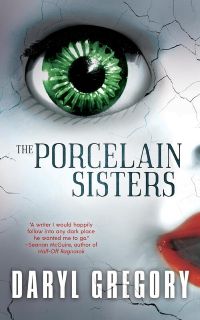
A shy young woman and her deeply unpleasant—and literally porcelain—sister fight for their inheritance, taking on an impossible array of enemies, including a chain‑smoking demon crow, an unkillable assassin, and a secret clan of French sorceresses. In his newest adventure from the world of Harrison the Monster Detective, Daryl Gregory (Spoonbenders) takes us on a dizzying yet poignant romp through the horrors of sisterhood.
Ruth Winslow is trying to save up enough money to finish college while looking after her sister, Isabel—who happens to be a haunted doll. When an accident severely damages Isabel’s porcelain body, the sisters have to find the only woman who can fix her, the fearsome witch known as La Fabricante: the Dollmaker.
The sisters head to Marseille, where they take on Le Clan: Chiffon, a red‑headed, unkillable assassin; a collection of angry, haunted dolls; plus a pair of demons—one a cigarette‑smoking crow, the other a black cat—and their human familiars.
Along the way, the sisters learn that they’ve been lied to their entire lives. Their mother wasn’t just a homemaker who died in a car accident, she was a legendary enforcer in the Le Clan des Sorcières.
While Ruth has to come out of her shell and deal with her own latent powers, Isabel has to grow up in a body that can’t grow. Together they’ll have to outwit and outfight everyone to claim their birthright.
Horror | Coming of Age | Fantasy Dark [ Tachyon Publications, On Sale: October 27, 2026, Trade Paperback / e-Book, ISBN: 9781616964719 / ]

Daryl Gregory is an award-winning writer whose most recent books include the Appalachian horror novel, Revelator, out from Knopf in August 2021, and the novella The Album of Dr. Moreau. His novel Spoonbenders was a Nebula, Locus, and World Fantasy Award finalist, and his novella We Are All Completely Fine won the World Fantasy and the Shirley Jackson awards. The SF novel Afterparty was an NPR and Kirkus best book of the year and a finalist for the Lambda Literary award. His other novels are the Crawford-Award-winning Pandemonium, The Devil’s Alphabet,Harrison Squared, and Raising Stony Mayhall. His short stories have been nominated for the Hugo and other awards, and many are collected in Unpossible and Other Stories, aPublishers Weekly best book of the year. His comics work includesthe Planet of the Apes and Dracula: The Company of Monsters series (co-written with Kurt Busiek). When there’s not a pandemic on, he also teaches writing and is a regular instructor at the Viable Paradise Writing Workshop.
No comments posted.









 © 2003-2026