Excerpted from DARK MESSIAH by Sara Z. Carson:
The first thing I noticed, when the doors opened, was his hair. It was cartoonishly blue-black, greased into a flawless pompadour.
Next, his sunglasses.
He looked seven feet tall, larger and more gorgeous than everyone around him. Majestic, a miracle.
He waited in the entranceway, the band started up, and we all stood, as we were supposed to.
Dad energetically strutted down the center aisle, shaking hands and hugging members as they cheered, raised their hands, and stomped their feet. An infectious sense of belonging took hold, charging the air; each breath I took in and then exhaled made my entire body tingle.
It felt as though my whole life had led to that moment, that everything before it was a lie.
If I told you the song was “What a Friend We Have in Jesus” but instead everyone sang, “What a Friend We Have in Father,” would you believe me?
Could I possibly believe myself, saying it now?
What a friend we have in Father, all our sins and griefs to bear. What a privilege to carry everything to Dad in prayer.
O what peace we often forfeit, o what needless pain we bear, all because we do not carry everything to Dad in prayer.
It didn’t feel sacrilegious surrounded by what seemed like a thousand people singing it, swaying along in ecstasy.
It felt right.
He seemed to look at each of us individually through almost opaque black plastic lenses. When he arrived at the giant altar, he shrugged off an orderly tweed jacket with woven leather buttons and patches on the elbows. His wife, whose name was Sharon but who we would call Mother, set it aside and draped a heavy-looking ivory-and-purple robe, rimmed in gold thread, over him.
Mother wasn’t quite beautiful, but she was symmetrical and attractive in an elfin way, her yellow hair in a neat but unfashionable updo.
The crowd went silent as he took to the altar.
He greeted us: “Let us be one in everlasting peace and love.”
After his regal entrance, everyone knew what to do: They applauded, and I followed.
Dad immediately took to the podium, raising his hand to silence everyone.
“I have heard many of you say you have seen God.”
His voice was a seductive tenor. His words rolled over us, filling the room. If I had looked around I would have seen how everyone waited for his next words, enchanted. I was waiting, too.
“We’ve all heard those people in authority claim to be moral, clean, utterly incapable of deceit, or of violence, faithfully following the commandments—they say they shall not lie, or cheat, or steal, or commit adultery. But they are liars. We know they lie as they declare their purity and recklessly deceive while harming those who are most in need.”
A chorus of several amens, marked and defiant, from every pocket of the room followed.
He paused each time this happened, absorbing the power of the faithful.
“I have seen them deceive, claiming they care about God’s people.
God has revealed their deceit to me.”
No amens followed, just a hushed silence.
“God will deliver to us the wicked. We must not concern ourselves with them. They will be handled. But remember what he says to you, from Zephaniah, ‘God rejoices over you with gladness, quiets you with his love, and exults over you with singing.’ God led you to me. He loves you. And I love you. All you need to do is to be holy in your hearts and minds. No man can truly know their God without a clean heart and upright mind. No unclean man will inherit the new order. God has called you to rid yourselves of this old way of being, the exploited traditions of the greedy establishment. Let them drop like the dead weight of a carcass. I know some of you still smoke and drink, you still fornicate. And yet you say you are devoted to him. To us, your family. My children, you are not, unless you let God lead you away from the vices that separate you from his path to freedom.”
The amens returned. His words were a tangle of ideas, and strung together they felt strange and unfamiliar. He talked about Christian socialists, about having a clean heart, about being born anew.
Giving up everything, even though my own mother sat there with her partner in fornication, who shared occasional cocktails and less occasional cigarettes.
Let us be one in everlasting peace. Atoning and cleansing. I struggled to grasp the ideas as the pronouncements continued at a dramatic clip, and the people kept shouting “amen” and “hallelujah.”
“If you want to inherit the new earth, then you will free yourself from the debilitating limitations of the flesh. You will not allow your money to abet the cause of such terrible honky systems as the tobacco industry.”
I felt myself involuntarily flinch at the base word “honky,” one I’d never before heard in church. I glanced at my mother and she was rapt, unblinking as she watched him. Vice fueled Faye’s family fortune.
“When you are tested, no one but God will be able to come to you. When you stand before the courts and are oppressed by the capitalist system, no one will stand with you except God. If you reject me when I speak the truth, you have rejected the Father and the Son.”
The congregation knew when to be still, and they were again as he left the words “the Son” dangling in the air.
Dad prowled gracefully, and he stood erect and but ever so slightly stooping to pull us in.
I felt a strange desire to follow him and when he gazed in my direction, it is as though he could see all of me. I had witnessed the pretenders to generosity, the looks as my mother red-facedly returned to our pew at St. Peter’s after Father Dillon tilted his head to urge her to move along that Sunday morning, how most of Faye’s friends chose my father, Trip, and Trip’s family, over her friendship. Media money triumphs over colonial tobacco money.
All of them, not real Christians.
“The Word is now thee,” Dad continued. “The Word is God. ‘In the beginning was the Word and the Word was with God and the Word was
God.’ It is inside each of you. Even as close as the breath you breathe. This congregation, this church … we have the power to have total God consciousness. You recognize his power with every moment of your lives, not only when we are here on Sunday, but every time you’re in the presence of the people’s mission. You know God is abundant.”
Several enthusiastic “Amen, Dads” followed this.
He gave a hearty pause before his voice dropped intimately. “Many of you here today were abandoned by false friends, pretenders. God never left you, but the hypocrites who speak of godliness while turning their backs on those who are most in need of love, of compassion, of help … they did. These imperious vessels of man’s laws, who judge and who believe they have the right to say who goes in and who goes out, they do not understand God, but only pretend to know his will.”
The only sound now was the whirl of the ceiling fans, the speakers and microphone tempted by feedback. “There are many who will judge you in the name of God. But not here. We welcome all. We serve all. We don’t care what you did before you came here. You are loved here.”
He always knew who was with him on any given day, and he knew what we needed to hear.
This was for us.
There we were, willing to hear exactly what we needed.
My fears had been singularly addressed. I felt as if there was God, and something to believe in and belong to and trust, all of it washing over me, reaching into the very core of my being and radiating outward. The warm-blooded sincerity of all of it cut through the walls of my teenage bullshit. I wasn’t complicated, but I wanted to believe my tangle of nerves and thoughts and experiences and entire being were deeply unique. I wanted to believe that Dad’s understanding of me was informed by divinity, not just by his being a preternaturally astute judge of what fears and insecurities could push each of us into desperate corners.
I shared a glance with my mother. She smiled at me with her whole face, and I felt myself smiling back at her, a first in a long time. Her cheeks were rosy.
I believed everything.
I knew she felt the same way.
The time flew by. Dad spoke about how Catholics had abandoned apostolic communalism so they could instead create centers of land wealth to satisfy their own material desires.
It was easy to drift in my mind to the lush green campus of Sacred Heart—with its exquisite chapel and track and tennis court and pool and embossed Bibles and stables of horses—and see now all the artifice. How it did nothing in pursuit of a better world. How the well-appointed beauty failed to protect us from the cruelty of our teachers. How we never looked outward.
As he seemed to be winding down the sermon, Dad talked about a candidate for city board, Wade Parsons, who wanted to push him out of the city.
“Wade doesn’t know what he’s up against. It’s all of you, your passion, your love, your insistence on building a better world. He sees me as the only blockade. But he cannot stop you.”
As he went silent, there was more singing and clapping. The band performed a rousing cover of Sly and the Family Stone’s “Everyday People,” which had everyone dancing.
Dad exited through the main aisle to loud cheering and even more amens.
Miriam approached me immediately after the service, putting her body between me and my mother, who was exiting the pew.
She glowed with delight. “What did you think?”
I don’t know what I told her, but I was, for the moment, hopeful.
Excerpted from DARK MESSIAH © 2026 by Sara Z. Carson. Reprinted with permission from Navigator Books. All rights reserved.
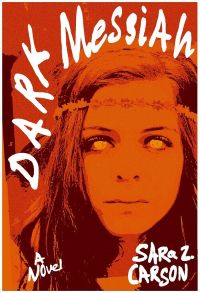
A riveting debut novel telling the story of a teenage girl and her mother caught in the web of a sinister cult leader whose optimistic vision of hope descends into apocalyptic horror in the jungles of South America.
In 1975 San Francisco, 15‑year‑old Nell’s world has been ripped apart by her younger sister’s sudden, tragic death and her parents’ subsequent divorce. As her mother desperately reaches out for solace from any quarter—new hobbies, new philosophies, new relationships—a boyfriend leads her into the cult of a charismatic man known as Father. His message of peace and healing proves irresistible, and soon Nell and her mother join his mysterious Church of the People.
As they are drawn increasingly into the vortex of the Church, the community comes to consume their lives, and Nell’s concerns begin to build. She becomes enrolled in the school they operate, is intimidated into adopting their ways of dressing and acting, and is removed from her home.
At the same time, the dangers lurking in the cult’s shadows emerge: threats, physical abuse, and the sudden disappearances of members to Father’s new “utopian” community deep in the jungles of South America. When Nell is secreted there alongside their fellow followers, they come under Father’s power as never before—with horrific and devastating consequences.
By turns sensitive and shocking, powerful and poignant, Dark Messiah is a story of a girl becoming a woman as her life is stolen from her—and a mesmerizing debut from a new voice in contemporary fiction.
Thriller Psychological | Thriller Historical [ Navigator Books, On Sale: September 22, 2026, Hardcover / e-Book, ISBN: 9798994998038 / eISBN: 9798337212036 ]

Sara Z. Carson is a public relations professional who lives with her family in Brooklyn. This is her first book.
No comments posted.











 © 2003-2026