Imagine stepping into a town where the future arrived decades ahead of its time.
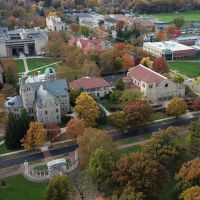
You stroll beneath towering trees, passing brick buildings where students still hurry to class. Today they carry backpacks instead of leather satchels, coffee cups instead of slates, but Oberlin, Ohio, still feels like a place where ideas matter.
At first glance, it seems like another charming college town. Look a little closer, though, and you'll discover that from the 1830s through the 1880s, Oberlin was one of the most radical communities in nineteenth-century America, a place that dared to imagine a different future.
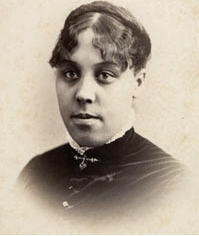
Every town has stories, Oberlin's are extraordinary. The more time I spent walking these streets while researching my novel, The Ladies Hall, the more I realized my story wasn't simply about three remarkable women: Mary Church Terrell, Anna Julia Cooper, and Ida Gibbs Hunt. It was also about a town courageous enough to nurture them. Sometimes the most memorable journeys don't take us across oceans. They take us into the past, where we meet the people and places that changed America's future.
So, let's begin our walk. Welcome to the town that proudly claims it helped ignite the events leading to the American Civil War.
Long before the nation erupted into conflict, Oberlin had established itself as a center of abolitionist thought and action. It served as an important stop on the Underground Railroad, and in 1858 the town made national headlines during the Oberlin-Wellington Rescue, when local residents and college students joined forces to prevent the capture and return of John Price, a freedom seeker who had been arrested under the Fugitive Slave Act. Their defiance challenged federal authority and became one of the defining acts of resistance before the Civil War.
As you wander through Oberlin in the 1880s, imagine church bells echoing across town while students from every corner of the country hurry toward their classes. Some are the children of formerly enslaved parents. Others are young women carrying Latin and Greek textbooks at a time when many colleges still questioned whether women belonged in higher education. Professors debate abolition and women's rights. Conversations about equality spill from classrooms into dining rooms and front porches. This was not the typical American college town.
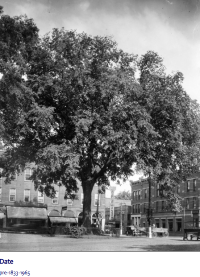
Our walk takes us down Professor Street, along Main Street, and toward College Park, the green space now known as Tappan Square.
There, you might pause beneath the legendary Elm. In 1833, when Oberlin's founders, John J. Shipherd and Philo P. Stewart, selected the site for the new college, legend says they noticed a tiny American elm sapling no more than five inches thick. They tied their horses nearby, knelt in prayer to dedicate the grounds, and spared the smallest tree from the axe. That little sapling grew into a magnificent landmark that shaded generations of students, becoming a living symbol of the college's belief that great things often begin humbly.
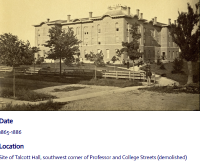
From Tappan Square, we cross Professor Street to one of my favorite places in Oberlin's history: Ladies Hall. The three-story brick residence stood at the corner of Professor and College Streets. Its first floor housed parlors, offices, reading rooms, dining rooms, and meeting spaces for the women's literary societies. Upstairs, dormitory rooms accommodated one hundred young women who had traveled from across the country in pursuit of an education.
This building gave my novel its title. The Ladies Hall was far more than a dormitory. It was where lifelong friendships were forged. Young women left families hundreds of miles away to build new lives together. They studied late into the night, debated ideas, laughed until the lights went out, comforted one another through homesickness, and dreamed of futures that society often insisted were impossible.
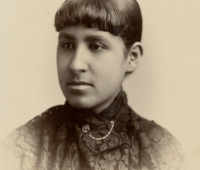
Among them were three young women who would later help reshape American history. Mary Church Terrell arrived determined to excel. Anna Julia Cooper possessed one of the sharpest intellects of her generation. Ida Gibbs Hunt matched academic excellence with determination and grace. Long before they became nationally recognized advocates for civil rights, education, and women's equality, they were simply students sharing classrooms, meals, and conversations inside Ladies Hall.
As progressive as Oberlin was, it wasn't free from the contradictions of nineteenth-century America. On Sundays, many white residents worshipped at First Church on North Main Street, while many Black residents attended Second Church on West College Street. Even in a community committed to abolition and educational opportunity, racial divisions remained. Equality was an aspiration, something still striving to be achieved.
Yet Oberlin College remained extraordinary for its classrooms. Black and white students learned together. Women studied subjects traditionally reserved for men, including Greek, Latin, philosophy, and advanced mathematics. Friendships crossed racial lines, ideas challenged convention, and education became a powerful tool for social change. It was this remarkable environment that shaped the young women at the heart of The Ladies Hall and inspired me to tell their story.
Walking through Oberlin today, it's easy to admire its beautiful streets, historic buildings, and peaceful campus. But once you know the stories beneath your feet, every corner feels different. You're no longer simply visiting a college town. You're walking through a place that dared to imagine a more equal America, and, in many ways, helped bring it into being.
Narrator: Angel Pean
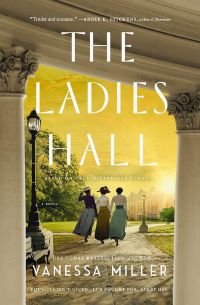
A Novel of Three Women Who Refused to Be Silenced
The lives of real heroes prove this truth: equality is won when we rise together.
1880s, Ohio. When Mary and Anna enter the Bachelor of Arts program, also known as the "gentlemen's course" of study, at Oberlin College, they have little in common other than the color of their skin and their passion for education.
While Mary was raised in luxury, attending presidential inaugurations with her wealthy father, Anna is a schoolteacher, likely the daughter of her enslaved mother's former owner, and works a second job to pay for her room and board. But despite their differences, both women share strength, ambition, and a deep yearning for change. If they can bridge the gaps between them, they just might build a lasting legacy.
From its earliest days in the 1830s, Oberlin College admitted men and women, white and Black students. Though the doors are officially open, school policy cannot change the hearts of classmates who refuse to see a woman, and especially a Black woman, excel. Despite constantly being forced to prove themselves, the women triumphantly overcome every obstacle and push through their pain. And as the world evolves around them, Mary and Anna persevere to build a legacy of success and excellence.
Based on the real lives of Mary Church Terrell, Anna Julia Cooper, and Ida Gibbs Hunt, The Ladies Hall is a mirror into times of great change--where progress and new possibilities are met with violence and resistance . . . but hope always rises. And it rises still.
The Ladies Hall is an ideal choice for book clubs eager to explore the intersections of race, gender, and resilience in American history. Miller's richly researched narrative sparks meaningful conversation about equality, allyship, and the personal cost of progress--themes that resonate just as powerfully today as they did in the 1880s. An included discussion guide helps groups dig deeper into the legacy these remarkable women left behind.
Multicultural African-American | Women's Fiction Historical [ Thomas Nelson, On Sale: August 11, 2026, Hardcover / e-Book, ISBN: 9781400351114 / eISBN: 9781400351121 ]
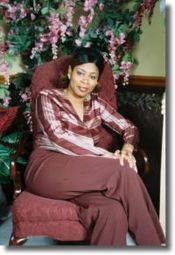
Vanessa Miller of Dayton, Ohio, is a best-selling author, playwright, and motivational speaker. Her stage productions include: Get You Some Business, Don’t Turn Your Back on God, and Can’t You Hear Them Crying. Vanessa is currently in the process of turning the novels in the Rain Series into stage productions. Vanessa is a dedicated Christian and devoted mother. She graduated from Capital University with a degree in Organizational Communication. In 2007, Vanessa was ordained by her church as an exhorter.
No comments posted.











 © 2003-2026