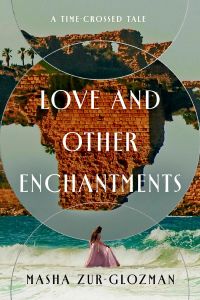
LOVE AND OTHER ENCHANTMENTS is a time-crossed love story that bridges two worlds: the present day and the 13th-century Crusader Kingdom of Jerusalem, where a hidden spring becomes a passage between centuries. While writing it, I spent years immersed in medieval chronicles, illuminated manuscripts, historical research, and music both ancient and modern. The songs below shaped the novel in different ways - some appear in its pages, while others helped create its emotional landscape or inspired the journey that eventually led me to write it.
The Outlander Theme - The Skye Boat Song
About fifteen years ago, I wrote the opening paragraph of a novel for a special newspaper project. I already knew it would involve time travel, echoes between worlds, and the Crusader Kingdom of Jerusalem. Then life happened. I was raising two children, working as a cultural journalist, book critic, translator, and editor. The novel drifted to the back of a drawer.
Then, during a rare quiet week in the winter of 2016, I decided to try a television series I'd been hearing about: Outlander. I was instantly hooked. I devoured the first season and became mildly insufferable about it. I listened to the theme song several times a day. Needless to say, I fell completely for Jamie Fraser.
One of my favorite memories from that period has nothing to do with writing. At the height of my Outlander obsession, I finally went to a dental appointment I had postponed for years. In the middle of our conversation, I suddenly heard the Outlander theme song. It turned out to be my dentist's ringtone. There we were: a sixty-something Russian immigrant dentist and a thirty-nine-year-old journalist obsessed with time travel and historical romance, united by exactly the same television series. I was considerably calmer for the rest of the appointment.
Most importantly, Outlander reignited an old dream. It reminded me that the time-travel novel I had been carrying around for years was still waiting to be written. Love and Other Enchantments is very different from Outlander in many ways, but I still owe that series a grateful bow.
"Dame, merci" — Thibaut of Champagne
One of the historical figures who strode into the story very early was Thibaut of Champagne: king, crusader, diplomat, and troubadour. Known as “the Troubadour King,” he wrote dozens of songs, including crusade songs, love lyrics, and pastoral poetry.
One of the songs he wrote, "Dame, merci", quickly became one of my favorite pieces of medieval music. Like many works of courtly love, it is built on longing, obstacles, and impossible desire - the fuel that powers so many romances, medieval and modern alike.
What I especially love is its sense of playfulness. Thibaut laments the brevity of life and the tragedy of love ending at death, only for his beloved to tease him for sounding so dramatic when he looks perfectly healthy.
Several ensembles specializing in medieval music have recorded the song, and I spent countless hours listening to it while writing and researching. Eventually, it insisted on becoming part of the novel itself. The combination of historical testimony, imagination, and art still moves me every time I hear it.
"Let Love In" — Nick Cave & The Bad Seeds
Early in the novel, my heroine, Idit, and her husband, Halimi, have a rare child-free weekend. Their daughter is away with her grandparents. As they settle into the afternoon, Halimi puts on Let Love In, unaware that before long a mysterious spring - and a handful of magic mushrooms - will send Idit's life in an entirely unexpected direction.
Nick Cave has been one of my musical heroes since my youth. I've listened to him for decades, and somehow every few years I discover something new in his songs. Few artists understand as well as he does how to transform darkness, grief, obsession, and longing into something strangely beautiful.
That is also one of the questions at the heart of LOVE AND OTHER ENCHANTMENTS. Romantic love is dazzling, but long-term love contains shadows too: disappointment, illusion, jealousy, betrayal, forgiveness, and the stubborn decision to keep loving anyway.
For me, Let Love In captures all of that complexity.
"Scarborough Fair" — Aurora's Version
I grew up listening to Simon & Garfunkel. Their music was always playing somewhere in our house, and Scarborough Fair was the song that affected me most deeply.
There has always been something uncanny about it for me. Perhaps it's because the song itself traveled through centuries of oral tradition before reaching us. Listening to it feels a little like receiving a message from another age.
In the novel, Idit hears distant singing just before she reaches the hidden spring that allows her to cross between centuries. The voices belong to Jean d'Ibelin and Thibaut, sitting beneath a carob tree composing songs together. It felt perfectly natural to me that a modern woman hearing medieval pastoral music from afar might assume she was hearing some strange version of Scarborough Fair.
I chose Aurora's version because I love both her music and her ability to make old songs feel newly enchanted. The accompanying video is also filled with visual echoes of the medieval aesthetic that inspired so much of the novel.
Now, the song has gained another layer of meaning for me. Almost every evening, my husband plays it on the ukulele while I sing along.
"Born to Die" — Lana Del Rey
This song appears in the second half of the novel. By that point, Halimi has a lover named Nina. Idit knows about the relationship, and although they have spoken about it openly, she is suffering terribly. When Nina sends Halimi Born to Die over WhatsApp, Idit sees the message and becomes obsessed with it. She spends days analyzing the lyrics, the video, and every possible hidden meaning. Eventually she begins to suspect she may be projecting far more onto the song than Nina ever intended.
The funny thing is that when I started writing the novel, I barely knew Lana Del Rey's music. I had dismissed her - rather unfairly - as a hipster phenomenon and nothing more. While creating Nina, I tried to imagine what kind of music she would love, and Lana seemed like a plausible answer. So I started listening.
And promptly became a fan. I ended up exploring her entire discography, and for several years Summertime Sadness was my ringtone. But Born to Die - my first encounter with Lana's music - remained Nina's song.
There is something irresistible about it: sweetness and surrender wrapped around a core of danger.
The Rooster Troubadour from Disney's Robin Hood
Disney's Robin Hood has always been one of my favorite animated films. When I was writing LOVE AND OTHER ENCHANTMENTS, I was constantly searching for visual representations of the Middle Ages. Historical accuracy wasn't always what fascinated me most. What fascinated me was seeing how each era imagines the medieval world.
The film's storyteller is, appropriately enough, a troubadour rooster. The opening sequence unfolds like a living illuminated manuscript, full of movement, music, and delight.
The film also found its way directly into the novel. Lily, Idit's young daughter, is slightly obsessed with Robin Hood - the way many children become obsessed with a single movie and insist on watching it again and again. Through Lily, medieval imagery keeps slipping into Idit's everyday life.
I still think the rooster troubadour is one of Disney's most charming acts of cultural translation: a reminder that stories, symbols, and songs never truly stay in one century. They simply change shape and continue traveling forward.
Narrator: Abigail Revasch
A Time-Crossed Tale
Idit, a polyglot and literary translator, falls in love with Halimi, a magnetic and philandering magazine editor. Idit, who cannot handle his indiscretions, proposes an open marriage to try and save what they've built. In the midst of a full-blown marital crisis, they take their daughter Lily and leave Tel Aviv, moving to the small seaside town of Atlit. One hot day while on a walk, Idit stumbles upon an ancient spring near the ruins of a Crusader fortress. When she bends down to drink the cool water, an old, found copper coin that she wears as a pendant dips into the spring—and suddenly she is thrust back in time—right into the arms of Jean d’Ibelin, a handsome French Crusader knight.
She's traveled to the year 1240, the year of one of the most successful crusades in history. The noble Sir Jean—with his chiseled face and amber eyes—becomes entranced by Idit, the exotic visitor from the future. As her relationship with Sir Jean starts to deepen, Idit begins to regularly visit the distant past. Their delicate affair unfolds in parallel with the story of her relationship with Halimi, with whom she shares a beloved daughter, Lily. In the end, Idit must decide what love means to her.
Romance Historical [ Union Square & Co., On Sale: July 7, 2026, Trade Paperback / e-Book / audiobook, ISBN: 9781454961475 / eISBN: 9781454961482 ]
Masha Zur-Glozman is a writer, filmmaker, graphic designer, and journalist based in Tel Aviv. She is the visual editor for Israeli newspaper Haaretz’s website, after writing and editing for their cultural supplement for a decade. Zur-Glozman was also a book critic for more than fifteen years for Haaretz and various Israeli newspapers. This novel, her debut, won the Israeli Geffen prize of speculative fiction in 2020 and the Ministry of Culture prize for debuts. With her husband, Yonatan, Zur-Glozman produced two documentary films: Amos Oz: The Nature of Dreams and Magia Russica, which were screened in multiple festivals around the globe and broadcasted internationally.
No comments posted.




 © 2003-2026