What is the title of your latest release?
CROSSING THE BRONX
What’s the “elevator pitch” for your new book?
CROSSING THE BRONX is an historical literary novel - a modern retelling of the Jacob and Esau story from Genesis - set primarily in the 1950s in The Bronx. The narrative that propels the story forward concerns the destruction of a neighborhood in the guise of progress. The brothers - Jay and Eric - are on opposite sides of a bitter struggle that pits those in power against the defenseless people of a local community. Their fractious relationship speaks to the issues of how families split apart, and whether or not the pieces can ever be put back together.
How did you decide where your book was going to take place?
I’ve always been fascinated by the story of how the decision was made to construct the Cross Bronx Expressway by utterly destroying a neighborhood in The Bronx. The hubris of officials and power brokers to create a gash in the fabric of the City without consideration of the impact on housing, stores, schools, parks - the community - of Tremont was the epitome of post-World War II civic engineering at its worst. I could think of no better setting for what I wanted to write about.
Would you hang out with your heroine in real life?
Francesca Casterella - a street-smart young woman who forms a deep relationship with Jay - is quick-witted, sharp with the tongue, and perceptive. She can separate the wheat from the chaff as well as anyone could imagine. Although she is a purely fictional character, she has qualities that I admired from observing and being around a number of women whom I knew when I was young. The bottom line: I would have been thrilled to have had the opportunity to spend time with someone like Francesca.
What are three words that describe your hero?
Incisive, tenacious, clever.
What’s something you learned while writing this book?
Two things. The first deals with the effects of the construction of the expressway on the Tremont neighborhood. I had known that homes, stores, and people were displaced, but I wasn’t familiar with the vast scale of the destruction and the profound impact it had on 40,000 residents, whose lives were upended. The second gets to the heart of the novel; to wit, how to make sure that the narrative focuses less on the crimes and payoffs, and more on the manner in which people stand up against the powers that be, and in the process learn to overcome great odds, demonstrate the human spirit to overcome failure, and to recognize one’s foibles.
Do you edit as you draft or wait until you are totally done?
I edit constantly “on the go”, writing and rewriting non-stop, never going far ahead, but always going back when something new requires an adjustment to earlier characters or passages.
What’s your favorite foodie indulgence?
As a snack or for dessert: yogurt with fruit and granola.
Describe your writing space/office!
My office is on the third floor of my house and overlooks acres of trees; because the backyard slopes down, it’s as if I’m in a tree house. Adjacent to the office is what I call the “conference room”, a place where I have another Mac hooked up to a large screen that not only gives me a perspective on what I’ve written, but also serves as a second place to make editorial changes.
Who is an author you admire?
Philip Roth. I’ll never understand how he didn’t receive the Nobel Prize for literature. My favorite Roth books - THE PLOT AGAINST AMERICA, THE HUMAN STAIN, and PATRIMONY are three masterpieces of American literature.
Is there a book that changed your life?
In a word, “no”. However, the following books made strong impressions on me at various times in my life: the aforementioned THE PLOT AGAINST AMERICA, TEAM OF RIVALS by Doris Kearns Goodwin, A BRIGHT SHINING LIE by Neil Sheehan, THE AMAZING ADVENTURES OF KAVALIER & CLAY by Michael Chabon, FOR WHOM THE BELL TOLLS by Ernest Hemingway, THE RED TENT by Anita Diamont, and THE ADVENTURES OF HUCKELBERRY FINN by Mark Twain.
Tell us about when you got “the call.” (when you found out your book was going to be published). Or, for indie authors, when you decided to self-publish.
I’m going to slightly modify the question, if I may! “Tell us about the time you received the first pre-publication blurb and how you reacted.” I sent the final manuscript to a dozen authors (some of whom write novels, others write non-fiction including memoirs). Honestly, I had no idea what anyone’s reaction would be. More than half were women. The first blurb I received was from an award-winning author of a memoir. In part, she wrote, “What is fascinating are the descriptions and dialogue of the women in the story…What is beautiful about David Hirshberg’s women is that they are so three-dimensional, so believable, and written with empathy and love, which is remarkable given that the author is a man.” I had a tremendous feeling of accomplishment reading this first review, as it signaled to me that the novel would appeal to both men and women.
What’s your favorite genre to read?
Literary fiction.
What’s your favorite movie?
Pulp Fiction - The Usual Suspects is a close second.
What is your favorite season?
Fall. I live in the northeast, and I find that when the weather begins to cool, it’s the perfect time of the year. The landscape is still lush, the days are beginning to get shorter, the sweaters and light jackets are put on, and the “holiday season” begins to come into view.
How do you like to celebrate your birthday?
With a few good friends at the house for an evening of great food and camaraderie.
What’s a recent tv show/movie/book/podcast you highly recommend?
There are three TV shows I think are superb: Teheran, Slow Horses, and The Morning Show; all are on Apple TV+. I don’t have favorites among recent movies or podcasts.
What’s your favorite type of cuisine?
Mediterranean/Greek.
What do you do when you have free time?
I don’t have a lot of free time, as I am Chairman and CEO of a biotech drug development company. But I spend free time reading, exercising, and playing with my two sporting dogs.
What can readers expect from you next?
I’m working on two screenplays - one based on Crossing the Bronx and the other based on Jacobo’s Rainbow. I can say that the difference between writing a novel and writing a screenplay is as distinct as night and day.
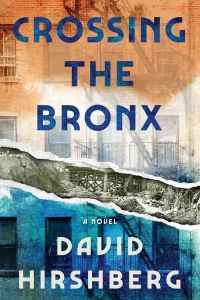
Crossing the Bronx is an historical literary novel set primarily in the 1950s in The Bronx. It is a modern retelling of the Jacob and Esau story from Genesis. The narrative that propels the story forward concerns the destruction of a neighborhood in the guise of progress. Jay and Eric, the sons of Ike (an Italian Jew), and Rebekeh, (a Mountain Jew), are estranged-as are their parents-and find themselves on opposite sides of a bitter struggle that pits those in power against the defenseless people of a local community.
Eric has aligned himself with his father Ike, who by day is a cop-and at other times works surreptitiously for a mobbed-up construction company engaged in major projects transforming New York City-while his younger brother Jay is allied with his mother and with a neighborhood group fighting to preserve its very soul. Their fractious relationship speaks to the issues of how families split apart, and whether or not the pieces can ever be put back together.
In addition to sustained tension-filled action, Crossing the Bronx is a story of romance, commitments, beliefs, and triumphs over adversities (lies, theft, murder, concealment, prejudice). Through vivid descriptions, perceptive insights, humor and sensitivity, the reader identifies with the characters who come to life in a realistic fashion to illustrate who we are, how we behave, and what causes us to change.
The novel is fast-paced, with uncompromising realism, reflecting the unrelenting tension between antagonists and the anxieties that overwhelm those without power. The underbelly of the criminal and political world is evidenced by brutality, rapaciousness, and a never-ending desire to seek retribution. A love story between Jay and his girlfriend Francesca counter-balances the grimness to show how some people can overcome the odds stacked against them by their birth and places of origin. Smart, savvy women (Francesca, Rebekah, Francesca's grandmother "Nonna Ebrea"-who thinks she is descended from Conversos-and Jay's therapist Dr. Leah Silverman) provide a strong counterbalance to the lies, thefts, beatings, concealments, murders, and prejudice evidenced by the men.
It is populated by colorful Italian, Irish, Black, Puerto Rican, and Jewish characters from a variety of different backgrounds; the novel sparkles with dialogue that is representative of their respective cultures.
The book can be read on three levels: (1) The story of what it was like to have lived through the Depression and World War II era, and into the one that emerged after 1945-a society that was being altered almost unknowingly into something that would turn out to be significantly different in terms of social activism and ethnic politics; (2) A metaphor for what is going on in cities today, in terms of the conflicts between 'ordinary people' and powerful politicians and business interests; and (3) How a Jewish family emerges from dysfunction to find its way despite daunting implacable obstacles in its way.
Historical [ Fig Tree Books, On Sale: June 2, 2026, Paperback / e-Book, ISBN: 9781941493397 / eISBN: 9781941493410 ]

David Hirshberg is the pseudonym for an entrepreneur who prefers to keep his business activities separate from his writing endeavors. As an author, he adopted the first name of his father-in-law and the last name of his maternal grandfather, as a tribute to their impact on his life. His first novel, the #1 Amazon bestseller My Mother’s Son, was published in 2018 and won nine awards. His second novel, Jacobo’s Rainbow, published in 2021, was also the winner of nine literary awards. Reviewers have compared Hirshberg’s writing to Michael Chabon’s and Saul Bellow’s, among others.
No comments posted.







 © 2003-2026