In this scene from WHAT WE ARE SEEKING, the main character, John Maraintha, is learning how to garden when he first meets one of his alien neighbors.
Excerpt from WHAT WE ARE SEEKING by Cameron Reed:
The work had to be done on the knees and bending down, which was hard on the back. Yet it
was satisfying to pull at the base of a stem, using a firm and steady tension so as not to break
the roots, until they came free of the branching passages they hid in and he held the plant whole
in his hand. Once he had managed this a few times, Ru moved to the opposite corner of the bed
to weed, and together they finished more quickly than he had expected. Then she showed him
where to plant black-eyed peas, at the corner of each cluster of corn seedlings; the corn, she
said, would support them as they grew and they would nourish it by fortifying the soil. A third
sister, to be planted later, would shade the ground with her broad leaves to cool it. In this way an
arrangement of seeds would grow into the shape of a story—a very old one; Ru said it came all
the way from Earth. He could have thought about it pleasantly for another hour or two of work,
except that their activities had drawn the attention of the basket-man, who came toward them
with a slow four-footed gait. Sudharma followed, matching his pace, staying close without
crowding. Could a basket-man perceive his gentleness? Could it see how in his every
movement he was the embodiment of calm? Would a basket-man be soothed?
“Let him smell you if he wants to. I will make the introductions.”
The basket-man approached John first. The muscles in his arms moved smoothly as he walked;
his claws, folded back so that they didn’t touch the ground, were thick and sharp. It was
frightening to think of what those muscles and those claws could do together. He drew close to
John and reared up on his hind legs. Lifting his long head, he put his mouth close to John’s face
and took in air with three soft gasps. He stayed close, considering, and John smelled his fur and
his breath: wood and hot iron and flowers and rich soil newly tilled and the scent of a man at the
end of a day’s work.
“John,” Sudharma pronounced; and with his face still close enough that John could feel the
breath against his cheek, the basket-man repeated “John.” Though equally high in pitch, his
voice had a more resonant quality than that of the basket-man in the video. So like humans,
they had individual voices. Or maybe it was only that recordings could not reproduce the
eeriness of that timbre, suspended undecidably between old woman and young boy.
He sat down on his haunches. For the first time he looked into John’s eyes—briefly, as you
might peek at something forbidden. Then he turned away. He glanced at Ru, and seemed to
consider whether he would go to her. This took most of a minute. Then, moving slowly and
deliberately, he walked over and put his face as close to hers as he had to John’s. After thinking
a while longer, he carefully sniffed each hand too. Ru bore up under this investigation with good
humor.
The basket-man learned Ru’s name, then moved off a little way. Finally John could approach
Sudharma. He still felt he owed him an apology for last night, but they could hardly discuss the
matter in front of Ru. So he only said, “I brought you lunch, but I’m afraid it will be cold. I didn’t
like to interrupt.”
“Thank you, John.” Sudharma’s voice was kind; John felt he was forgiven. “I realize now I’m
very hungry, but I don’t want to eat in front of the basket-man—at this stage he might be
confused by foods with more than one ingredient.” A clinking sound caught his attention: the
basket-man was trying to pry the cover off one of the dishes with his claws. “I see I have no
choice, which is a relief to my stomach.”
He drew the basket-man’s attention and removed the cover. The basket-man sniffed the outside
of the dish first, and after some contemplation, spoke the word “John.” Then he put his mouth
above the curry, sucked in air, and thought, his eyelids half-shut. Basket-men ate only one
vegetable, and that one uncooked; what would he make of its complexity? Finally he spoke a
single word: “corn.” The stir-fry, after more deliberation, he identified as “squash.” The roti he
considered but said nothing. This inspection being complete, he allowed Sudharma to eat
unbothered, but he watched every bite closely. Now he knew that humans could eat many
foods, and not only the provisions made by their own mothers’ bodies. His stance and
expression betrayed no reaction to this news, or at least none that a human could discern.
Excerpted from WHAT WE ARE SEEKING by Cameron Reed. © 2026 by Cameron Reed, used with permission from.
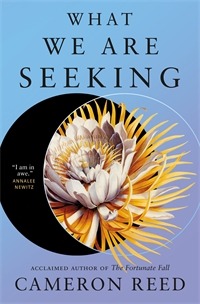
From Cameron Reed, the acclaimed author of The Fortunate Fall, comes a soaring novel of queer hope and transformation, perfect for readers of Ann Leckie and Amal El-Mohtar.
On the planet Scythia, plants give birth to insects and trees can drag you to your death. Artificial monsters stalk the desert, and alien basket-men have wandered into town.
John Maraintha has been abandoned here, light-years from the peaceful forests that he loves.
The desert is harsh and the people in thrall to a barbaric custom called marriage.
He must find some way to make a life here.
But on Scythia, survival means transformation—and not everyone is willing to change.
At the Publisher's request, this title is being sold without Digital Rights Management Software (DRM) applied.
Science Fiction | Fantasy [ Tor Books, On Sale: April 7, 2026, Hardcover / e-Book, ISBN: 9781250364739 / eISBN: 9781250364746 ]
Cameron Reed is a science fiction writer and the winner of the 1998 Otherwise Award (then the James Tiptree, Jr. Award). She is an avid dragonfly-watcher, a moderately skilled insect photographer, and a hopeless birder. After a long and complicated path through gender, she has come to rest as a nonbinary trans woman and uses the pronouns she or they. She lives with her found family in an old duplex full of books and cats.
No comments posted.








 © 2003-2026