Matlock House, April 1804
Smythe opened the double doors. “My lord.”
The countess glanced at the earl; he extended his arm. She rested her hand upon his forearm and stepped forward. Fitzwilliam held up both his arms. Phoebe on his right; his left belonged to Ellie.
“Thankfully, we are not three,” Ellie whispered.
“Brother would need a third arm,” Phoebe said.
Ellie made a small sound and hid it at once.
A throat clearing—their mother’s—silenced them.
They entered the dining room. The earl seated the countess. Fitzwilliam seated his sisters, then sat between them. The round table was a novelty—Lady Matlock’s scheme, Lord Matlock’s constant rebuke.
The first course—soup—was served, then the footmen withdrew and left the table to family.
Ellie leant forward at once, eyes bright with excitement. “Will you truly see Paris first?”
Phoebe answered for him. “He will see Calais first. Then he will stare at the road as if it has offended him.”
Fitzwilliam lifted his gaze to her. “If it does, I shall forgive it.”
Ellie’s spoon paused halfway to her mouth. “Then Paris?”
Phoebe’s eyes lit. “He will. He must. Everyone goes.”
“Not everyone,” Lady Matlock said, quiet.
Phoebe turned at once, eager. “But we have read of it, Mama. The gardens. The galleries.”
Lord Matlock cut his meat, unhurried. “Paris contains many things. Your brother will choose what he means to notice.”
Fitzwilliam looked down at Ellie. “What do you want to know of it?”
Ellie’s cheeks warmed. Her eyes dropped to the soup. “Whether it truly smells as the books say.”
Phoebe gave a delighted sound. “Ellie!”
Fitzwilliam’s mouth moved—not quite a smile. “If it does, I shall forgive that as well.”
Phoebe set her spoon down with ceremony. “You must write to us.”
Lady Matlock inclined her head. “Richard will include a paragraph in his letters, specific to his sisters.”
Matlock looked up. “My dear—”
Her knife sounded against the china. The girls stiffened.
“Of course, your brother will write to you.” He patted his lips with his napkin. Then his brow.
“I shall,” Fitzwilliam said.
Phoebe lifted her chin. “You must tell us if French ladies truly speak as swiftly as they do in novels.”
Fitzwilliam pressed his lips together.
“Yes, you must,” Ellie said.
“Novels speak swiftly?” he asked. “I begin to suspect your novels are misbehaved.”
Phoebe lifted her chin. “Écrivez avec exactitude.”
Ellie added, soft and sure, “Un paragraphe, comme vous l’avez promis.”
“Comme vous le désirez.”
Footmen reappeared. The soup was replaced by dark meat.
Phoebe’s eyes gleamed. “Ente,” she said.
Ellie added, “Gans.”
Fitzwilliam relaxed back. “Ihr habt etwas über Geflügel gelernt?”
Phoebe leant forward, caught Ellie’s eye. She shook her head.
“Library,” he said. “Mrs Barbauld.”
“Brother,” Phoebe said. “We read novels.”
“Yes,” Ellie said. “Novels.”
“As you should,” Lord Matlock replied. He glanced at Lady Matlock.
She nodded, then turned to Fitzwilliam. “I would have been pleased had you the time to see Florence.”
“He has not the time to—”
Cutlery hit porcelain. The earl’s mouth remained open, though silent.
No one moved. Footmen appeared, then stilled.
Lady Matlock nodded. Service was restored.
Syllabubs were placed. Glasses were refreshed.
Phoebe lifted her spoon. “Citron.”
Ellie glanced at her sister, lowered her chin. Her spoon remained on the table. Fitzwilliam leant close to her ear. “Zitrone,” he whispered.
She lifted her spoon, took a sampling. “Zitrone,” she announced.
Lady Matlock looked at him and smiled.
She rose.
The earl rose at once. Fitzwilliam rose as well.
Lady Matlock turned to her husband. “My lord—your study. You said you had business waiting.”
Lord Matlock blinked. “Did I?”
She inclined her head. “You did.” She paused. “Most urgently.”
His father stared at his mother a moment, nodded once, and departed.
The door closed.
“Richard?”
He hastened to her side. Offered his arm. She gripped his upper arm, squeezed, and glanced over her shoulder.
“Daughters.”
Fitzwilliam escorted the countess through the doors into the withdrawing parlour, Phoebe and Ellie reciting animal names in German.
Excerpted from BEFORE THE STORM by Barry S. Richman. © 2026 by Barry S. Richman, used with permission from.
Matlock Fitzwilliams #1
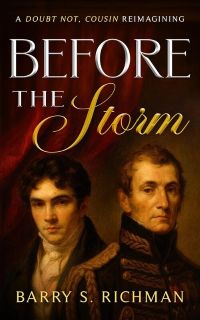
A Doubt Not Cousin Saga: Colonel Fitzwilliam
He is a cavalry officer the kingdom relies upon—and does not question.
Men like him are not born. They are made.
Before reputation.
Before legend.
Before the name Richard Fitzwilliam becomes synonymous with precision and fortitude.
Before the Storm is the untold history of the second son of Matlock—the spare.
Fitzwilliam is marked early by a constitution that does not register pain as it should. What others feel, he notes only in passing. What begins as peculiarity becomes utility.
Sent across a Europe tightening toward war, Fitzwilliam moves through Paris, Berlin, and Vienna under constant appraisal--by diplomats, by soldiers, by men who recognise the hand of the state at work and intend to refine it further. Each encounter reveals fragments of where he is being led—and what has been prepared for him there.
This is not the story of a hero’s rise.
It records the trials an extraordinary man endures to learn where his limits lie—and whether they bind him at all.
Cold, controlled, and unflinching, Before the Storm is a psychological historical novel about loyalty, state power, and the deliberate manufacture of force—told entirely from Fitzwilliam’s singular perspective, where silence instructs, and restraint is never mercy.
From Paris to Berlin to Vienna, Fitzwilliam is tested not by what he feels—but by what he does not.
If a man does not feel pain, does he fear anything?
Author’s Note
The author recommends reading Doubt Not, Cousin to fully experience Before the Storm. Although this novel stands alone, it presents Colonel Fitzwilliam’s perspective and leads directly into the sequel, After the Fall.
Historical [ Independent, On Sale: April 10, 2026, e-Book, / ]

Barry S. Richman is a military veteran whose work explores character, restraint, and moral consequence within the Regency world of Jane Austen. His lifelong engagement with Pride and Prejudice began unexpectedly in 2003, while recuperating at home after a routine medical procedure. What began as a single rereading soon became a sustained immersion; he has yet to put Austen’s world down.
Over the next two decades, Richman read thousands of Pride and Prejudice variations, developing a deep familiarity with the canon and its many interpretive traditions. His wife—whom he fondly calls his own “Jane Bennet”—watched him finish novels at a remarkable pace and eventually suggested that he write one himself. For years, he dismissed the idea, citing time, work, and responsibility. Circumstances, however, had other plans.
During the upheaval of the COVID pandemic, Richman and his wife made a decisive change in direction, restructuring their lives and long-term plans. The period proved formative, sharpening his focus on endurance, adaptation, and the quiet consequences of disruption—concerns that would come to shape his work.
Writing became both discipline and refuge. Richman began asking the questions that had long preoccupied him as a reader: What if the canon bent differently? What happens before the moment Austen shows us? What is owed, and what is endured, in silence?
From those questions emerged a sustained engagement with Austen’s world, approached not as pastiche but as serious historical and moral inquiry. Richman’s work focuses on what precedes the familiar moments of the canon, and on the private reckonings that shape character long before they are seen.
Barry S. Richman divides his time between his beloved abla’s home in Florida and his retirement home in southwestern Turkey, with his wife of more than thirty years. Together, they continue to build a life shaped by curiosity, movement, and the enduring power of Austen’s world.
No comments posted.








 © 2003-2026