A tour of old Shanghai - as told by Caroline Stanton from THE FOURTH PRINCESS by Janie Chang:
The sun rose and Shanghai’s waterfront came into view. I leaned against the ship’s railing and shivered with anticipation. Somehow I just knew this city would transform my life, far more than becoming Mrs. Thomas Stanton, far more than surviving a railway disaster. It was 1911, we were young and rich, and it seemed to me that anything was possible in Shanghai, the Paris of the East.
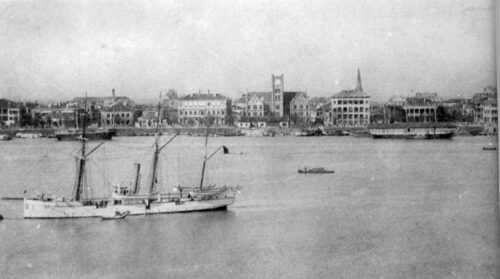
A view of The Bund from the water, Shanghai. 1900. Courtesy: VirtualShanghai.net
We stepped off the gangplank and entered chaos. Porters vied to carry our luggage, horse carts belonging to hotels waited patiently for guests, and my ears caught words shouted out in a dozen languages. Disembarking passengers called out to their families on the wharf, sailors elbowed their way through the crowd, while red-turbaned Sikh police kept beggars and vendors away from the arrivals area.
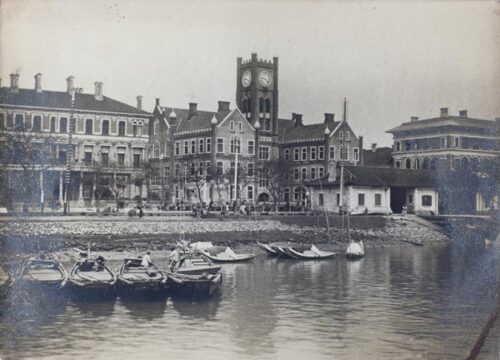
1900. Customs house on The Bund, Shanghai. Courtesy Univ. of Bristol
Mason Burnett, Thomas’ uncle, was waiting for us and we hurried into his luxurious carriage as a cold winter rain began falling. His coachman directed porters to load our luggage into a large horse cart that would follow behind the carriage. Almost as soon as the horses began trotting the men began talking business, but I didn’t mind. I was in Shanghai!
If it had been warmer, I would’ve been leaning out the carriage window as the horses pulled us through its streets. I had never seen such a mix of conveyances: motor cars and horse-drawn carriages shared the road with rickshaws, trams, and donkey carts. I couldn’t see any traffic lanes; people simply made their way along the street in whichever direction suited them, and between warning shouts, horns, and bells, vehicles somehow pressed along without mishap.
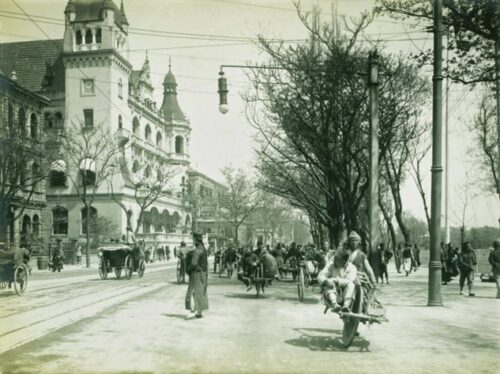
Shanghai street scene, 1910. Rickshaws, wheelbarrows, horse carriages. Courtesy arcinfo.ch
The street along the waterfront, The Bund, was lined with banks and commercial buildings as grand as anything in New York or London. There was little in their architecture to suggest we were in China. The streets and sidewalks, however, made it clear this was not New York. Chinese workers pushed loads lashed to very curious wheelbarrows of a sort I’d never seen before: a single wheel at the centre, the barrow’s platform on either side of the wheel stacked with every sort of cargo, from vegetables to human passengers who sat with legs dangling over the side. Nor had I ever seen workers with bamboo poles balanced across one or both shoulders, heavy baskets hanging from the ends, men and poles nearly bent over from the load, but somehow they still threaded their way deftly through the crowds.
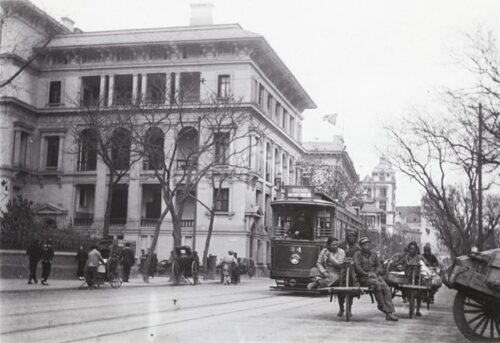
Shanghai street scene, 1910. Rickshaws, wheelbarrows, tram. Courtesy Univ. of Bristol
Uncle Mason paused his conversation long enough to inform me that we were driving through an area called the French Concession. I was now getting used to the sight of Chinese buildings and shops alongside Western-style stores. I saw a jeweler, a perfume store, and countless bakeries, diners, and nightclubs. Delicious smells tickled my nose, some familiar, others strange and tempting.
I leaned back against the carriage seat with a contented sigh. Yes, Shanghai was exactly what I needed to leave the past behind.

A Gothic Novel of Old Shanghai
From the internationally bestselling author of The Porcelain Moon comes a haunting Gothic novel set in 1911 China. Two young women living in a crumbling, once-grand Shanghai mansion face danger as secrets of their pasts come to light, even as the mansion’s own secret threatens the present.
Shanghai, 1911. Lisan Liu is elated when she is hired as secretary to wealthy American Caroline Stanton, the new mistress of Lennox Manor on the outskirts of Shanghai’s International Settlement. However, the Manor has a dark past due to a previous owner’s suicide, and soon Lisan’s childhood nightmares resurface with more intensity and meld with haunted visions of a woman in red. Adding to her unease is the young gardener, Yao, who both entices and disturbs her.
Newly married Caroline looks forward to life in China with her husband, Thomas, away from the shadows of another earlier tragedy. But an unwelcome guest, Andrew Grey, attends her party and claims to know secrets she can’t afford to have exposed. At the same party, the notorious princess Masako Kyo approaches Lisan with questions about the young woman’s family that the orphaned Lisan can’t answer.
As Caroline struggles with Grey’s extortion and Thomas’s mysterious illness, Lisan’s future is upended when she learns the truth about her past, and why her identity has been hidden all these years. All the while, strange incidents accelerate, driving Lisan to doubt her sanity as Lennox Manor seems unwilling to release her until she fulfills demands from beyond the grave.
Audiobook Narrators- Katharine Chin, Saskia Maarleveld, Caroline Hewitt.
Women's Fiction Psychological [ William Morrow Paperbacks, On Sale: February 10, 2026, Trade Paperback / e-Book / audiobook, ISBN: 9780063308121 / eISBN: 9780063308138 ]

Born in Taiwan, Janie Chang spent part of her childhood in the Philippines, Iran, and Thailand. She has a degree in computer science and is a graduate of the Writer’s Studio Program at Simon Fraser University.
No comments posted.
















 © 2003-2026