The catastrophe of World War I caused huge societal changes all over the world. In this month’s selection of stories, we witness the turmoil in Russia, two sisters’ journey from Australia to Gallipoli to the Western Front, and fictionalized stories of two real people, one a nurse who developed procedures for treating the sick that are still followed today, the other a flawed politician at the height of British power.
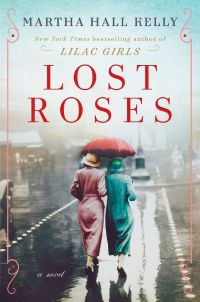
We begin with two friends, one American, the other Russian, who meet in Paris in Martha Hall Kelly’s LOST ROSES. Despite rumors of war in early 1914, Eliza Ferriday is delighted to visit her friend Sofya Streshnayya, a cousin of the Romanovs, in St. Petersburg. But her tour is cut short when war is declared and the Russian rulers begin to lose control. Sofya flees with her family to their country estate, while Eliza escapes back to New York. Thinking to avoid revolution, Sofya’s family unwittingly brings it into their home when they hire local peasant Varinka to care for Sofya’s young son Max, for Varinka’s mother’s apprentice is a Red party member who seeks the destruction of all the Russian nobility. When revolutionaries take over the Streshnayya estate, Varinka flees with Max, determined to save the boy by claiming him as her own. And when Sofya’s letters cease, a worried Eliza, who has been helping refugee White Russian women in New York, is terrified for her friend. Set against the rich backdrop of a Russia transitioning from imperial rule to revolution, the three women do everything they can to help their friends and family survive the caldron of war and the radical changes in society.

In THE DAUGHTERS OF MARS by Thomas Keneally, we have two sisters, both nurses and initially estranged, who are drawn closer by their shared experiences through the tragedies of war. While Sally Dorrance practices nursing close to home in New South Wales, her sister Naomi chooses big city life in Sydney. Their paths converge when Naomi returns to assist her sister through her mother’s final illness, then the two volunteer as army nurses and are sent to serve on a hospital ship treating wounded in Gallipoli. After their ship is sunk, with Gallipoli abandoned, they move on to work in France at two different hospitals near the Western Front. Coping with the horrors of battle wounds, impossible work situations, the uncertainty of falling in love with a soldier and a medical and army bureaucracy that often discounts the worth of women, their sisterly bond is strengthened and enriched. Kenneally’s richly detailed story lets us experience the war through the eyes of the Dorrance sisters and their brave band of fellow nurses.
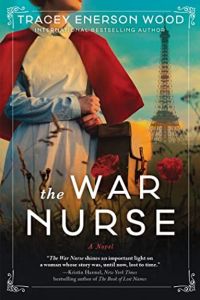
We meet a medical innovator in THE WAR NURSE by Tracey Enerson Wood. Born into a privileged family, Julia Stimson wants to be a doctor; stymied of that goal by her family and society’s resistance, she settles for becoming a nurse. After developing acknowledged expertise in her field, she is offered the position as Superintendent of Nurses in charge of the sixty-four nurses she is to recruit to help the embattled British medical services, arriving months before US troops are ready to head overseas. At British Base Hospital 12 in Rouen, France, she confronts primitive conditions, overcrowded wards, horrific wounds and erratic support. If this weren’t enough, her hospital is soon further taxed by the arrival of hordes of soldiers suffering a mysterious respiratory illness that kills—and spreads—with amazing speed. Rather than follow standard practice, using her skilled observations and experience, Stimson risks her career to establish new systems of organization to stretch the nursing coverage and new methods of isolation and treatment to save both her battle-wounded charges and those suffering from what is eventually identified as a novel form of influenza—a disease that will go on to kill over five million people worldwide. A pioneer in changing nursing from a job done by amateurs with little training to a well-organized service employing scientific methods and maintaining high standards, Stimson’s story both informative and inspirational.

We finish with a look at the war from a different and much more detached perspective. PRECIPICE by Robert Harris gives us a richly woven tapestry of World War I on the Home Front through the eyes of Prime Minister H.H. Asquith—during a period in which the politician was conducting an affair with Venetia Stanley, a clever, beautiful aristocrat less than half his age. In the novel, a fictious young Scotland Yard detective is trying to track leaks of secret documents; in real life, over the course of their three-year affair, the infatuated Prime Minister wrote more than 700 letters to Venetia, many of them revealing sensitive and top-secret material. Harris includes excerpts from many of Asquith’s letters (Venetia’s replies were destroyed,) detailing both a fanatic but doomed love and how Venetia’s sense of patriotism and desire to help lessen the burden carried by her “Prime” enabled the affair. Along the way, we have vignettes of other war leaders - Winston Churchill, Lord Kitchner—and are given insights into the origins of the war, the difficulties of conducting it and the agonies of trench warfare for which neither side had been prepared. Harris paints a vivid picture of upper-class British society on the brink, framing it within an intense, scandalous affair all the more fascinating for being real.
Ready to delve into stories of a cataclysmic event that drastically altered the structure of society around the world? Settle into your favorite chair and enjoy!

Real, intense, passionate historical romance
Award-winning romance author Julia Justiss, who has written more than thirty historical novels and novellas set in the English Regency and the American West, just completed her first contemporary series set in the fictional Hill Country town of Whiskey River, Texas.
No comments posted.












 © 2003-2026