Last December 25, a stranger reminded me why I’d wanted to write this book. “Merry Christmas!” he called to my wife and me, as we were taking our morning walk around the neighborhood.
Instinctively, I replied, “Thanks, but it’s not our holiday.”
He said, “Chanukah is over.”
Startled that he knew the word or what I was referring to, I approached him, thinking to explain. “No, Chanukah starts tonight.”
“It’s over,” he repeated, in a tone that said we were too. And he made an odd, aggressive-looking gesture, putting his palms together and rotating his arms vigorously, back and forth around his body.
Only then did I notice he was wearing a desert-style military helmet, white pants with blue camouflage markings, and a military belt with pouches, as for ammunition. Belatedly, I wondered whether he was armed, and how we’d extricate ourselves from this confrontation.
“I wish you peace,” he said, almost spitting the word. “May a hundred hallelujahs follow you.”
My wife and I walked away, dazed and upset. After I’d calmed down, I thought of TO SAVE A LIFE, which my publisher was editing just then, and felt a little better. This bigot had shouted me down, but I’d speak in print.
Ever since a few years ago, when I’d decided to write a book on a Jewish theme, I’d had vague wishes to respond to the anti-Jewish feeling that had reemerged from the shadows after a period of restraint. But my offering would take a modest form; nothing I write will make a dent in hatred that has existed for thousands of years.
Still, I believe that American Jews, especially now, are craving stories in which they see themselves credibly portrayed. What a comfort to be seen, to be understood—and, if I can provide that, how satisfying and worthwhile. How satisfying, too, if I could give my non-Jewish readers a glimpse of what it means to be Jewish.
Authenticity matters, as I’m reminded whenever I pick up a novel depicting Jews only as victims, and two-dimensional victims, at that. They may answer to names like Cohen or Levy but seem culturally like everyone else, and their personal traits relate only to their victimhood. In writing To Save a Life, I resolved to show my characters performing rituals they consider central to their lives and holding a worldview that bears a Jewish stamp, because that’s meaningful to them. At the same time, like anyone else, they have virtues and flaws and prejudices, suffer pain and make sacrifices, but also experience joy and desire and thrill to laughter and love.
As a novelist, I put this in a historical framework because I’m fascinated by where we came from, which influences who we are today. I also think it’s easier to step back and see ourselves more clearly in the context of the past, especially when it comes to large issues. For American Jews, assimilation has always pitted identity against adaptation and conformity; no era demonstrates that better than the early 1900s, when hundreds of thousands of Jewish immigrants arrived, the vast majority of them highly observant. Those circumstances let me explore assimilation in powerful ways. But I’m only partly observant myself, so to write authentically, I have to pay close attention to traditions I don’t share.
I welcome that. In writing historical fiction, I re-create how past generations viewed the world. Suggestions of their outlook emerge in headlines and fashion, but what I’m looking for runs much deeper—so deep that no one living back then would have needed to explain it. Portraying that mindset faithfully and subtly requires viewing the era through a contemporary lens and conveying that to a modern reader smoothly, without making it obvious. That’s hard to do, but when I think I’ve gotten it right, I feel pretty jazzed.
Deciding what made people tick back when may involve common sense or psychological detective work based on the thinnest clues. For instance, when I read that some Eastern European Jews emigrated to what they called “the land of Columbus” in part because they’d never been chosen to read the Torah in synagogue, that made me think. Was it piety that drove them? I doubted that; so many Jews believed America was Godless and feared to lose their identity there.
Rather, these men were cobblers or carpenters or tailors who resented how the wealthy merchants always got the synagogue honors. The snub made the artisans feel like second-class citizens, so the hope of achieving equality influenced their decision to emigrate. But I sensed there was even more, and when I read that they believed that Americans respected hard work, even if a man labored with his hands, I finally understood. These immigrants were looking for dignity, not just equality or a better standard of living. What a powerful idea, given that upward mobility happened rarely in their native lands, and that not having to work meant higher status.
My research tells me that mores and prejudices of the past differ from ours mostly in how they’re expressed, which I think would surprise some people. But whatever I find, I don’t like to pull punches or “protect” my characters, hoping my readers will like them. I have to tell my stories straight up, and if I can’t, I won’t bother. I’d have done a poor job if I couldn’t depict a hero or heroine with flaws, or a complex villain who fervently believes in what he does and is true to his own lights.
That’s what I’ve tried to do with TO SAVE A LIFE, and why I had such fun writing it.
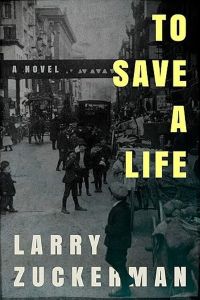
In 1909, Malka Kaminsky steals her dowry to flee Russia and an arranged marriage, arriving in New York hungry for freedom. Drawn into the hustle of the Golden Land, Malka joins a sweatshop strike and is nearly beaten by thugs, but a stranger and fellow Russian Jew, Yaakov Rogovin, rescues her. Malka doesn't thank him, refusing to acknowledge her debt, but when chance brings Yaakov to her Sabbath table, they laugh and trade warm glances-only to deny their mutual attraction. After all, they carry deep scars from Russia, where admitting to desires always led to heartache. But as they strive to become entrepreneurs-Yaakov as a musician, Malka as a dressmaker-they hope that independence will show them how to live unafraid, despite the past. And they will need that lesson soon, because when Malka's fiancé arrives, determined to reclaim her, she seeks Yaakov's help, neither of them aware what fighting for their dreams will cost.
Historical [Cennan Books of Cynren Press, On Sale: October 21, 2025, Trade Paperback / e-Book, ISBN: 9781947976566 / ]

Larry Zuckerman's grandparents spoke Yiddish around him whenever they wished to protect their privacy-and their impassioned, expressive tone made him want to know what he was missing. In paying homage to their generation and mother tongue, To Save a Life expresses his love for other times and places. His previous novel, Lonely Are the Brave (Cennan, 2023), portrays a World War I hero turned at-home father in a Washington State logging town. Larry's nonfiction includes The Potato: How the Humble Spud Rescued the Western World, which was excerpted in the New York Times and won an award in the United Kingdom, and The Rape of Belgium: The Untold Story of World War I, which reflects his fascination with that tragic era. He has appeared on NPR's Morning Edition with Renée Montagne and delivered a keynote address at the 2009 World Potato Congress in Christchurch, New Zealand. He lives in Seattle.
No comments posted.






 © 2003-2026