MURDER BY THE BOOK is a story about art, literature…and murder. But more than that, it’s a story about how our passions help us find meaning even when the world feels unknowable. As a writer and English professor, books have long been my passion. Words have been my hope, my solace, my future, and my past. And there’s no better accompaniment for words, of course, than music.
This list is eclectic, sincere, referential, a little odd, probably over-analyzed, and—like my book—a peek into my brain, which is, itself, all those things.
“Riverside” by Agnes Obel
Both of the main characters in Murder by the Book are searching for something that goes beyond just the solution to a crime. Emma Reilly, a literature professor, is searching for a sense of belonging. Ian Carter, a homicide detective, is searching for a sense of hope. Riverside, with its moody piano and restless lyrics, captures that sense of longing for something more, something bigger. The speaker goes again and again to the riverside looking for peace, for freedom, for community—but every time she finds disappointment, crying out in the chorus, “Oh, my god, I see how everything is torn in the river deep, and I don’t know why I go the way, down by the riverside.”
“Barbie Girl (Cover)” by Scala & Kolacny Brothers
“Barbie Girl” probably seems an odd choice for the soundtrack to a murder mystery if you’re only familiar with the upbeat satire of the Aqua version. This melancholy choral cover reshapes the song into something sad and stirring. Sung in soft, ethereal tones, the lyrics “make me walk, make me talk, do whatever you please” become a chilling indictment of female objectification rather than offering the fun frivolity of the original. In my novel, Emma has to grapple with a similar re-contextualizing of the familiar when murder victims are posed as famous literary heroines like Ophelia and the Lady of Shalott. In much the same way, this eerie re-imagining of “Barbie Girl” now shadows the song I danced to with my friends like a double-exposed photo, the dark challenging the light.
“The Lady of Shalott” by Loreena McKennitt
This one might be a little on the nose, considering the Tennyson poem that provides the lyrics is a major plot point in Murder by the Book, but without this song, the book might not exist. I fell in love with McKennitt’s music, and this song specifically, when I was a nerdy misfit in high school, an experience that definitely informed my main character, Emma’s, own background. In a lot of ways, Emma’s journey echoes that of The Lady of Shalott—trapped in her tower, living through the stories she invents. Like the legendary lady, Emma has to decide whether to stay safe but separate or to risk everything to see the truth.
“Solitude” by Billie Holliday
If “The Lady of Shalott” is Emma’s song, then this is Ian’s. He’s known as a by-the-books cop, but beneath the surface, he’s struggling with his place in the world just as much as Emma. When I picture him, he’s drinking scotch and listening to jazz, embodying the figure of Phillip Marlowe, the chivalric PI that he’d secretly rather be. Haunted by an incident in his past, Emma’s entry into his world forces him to face the fact that not everything is as clear-cut as it seems. Holliday’s aching declaration, “in my solitude you taunt me with memories that never die,” would—ironically—make Ian feel a little less alone.
“Red Right Hand” by Nick Cave and the Bad Seeds
As she tries to solve the murders, Emma seeks the help of her friends and colleagues, including art professor Rory Tamblyn. Together, they use their specific areas of expertise to “read” and understand the detailed crime scenes. Rory’s theory is that the killer is drawing on postmodernism, a movement in art and literature where artists create new works that knowingly remake and comment on that which came before. If you’ve ever heard (or used) the word meta to talk about a book or movie, that’s postmodernism. One of the best-known examples of this is the original Scream movie with its infamous list of rules about how horror movies work. “Red Right Hand” plays a key role in its soundtrack, a self-assured and self-aware moment of darkness. Rory would hate me using this as an example, rather than, say, Andy Warhol, but I can’t resist including the song, if only for the Paradise Lost allusion. After all, mixing murder and obscure literary references is kind of my thing.
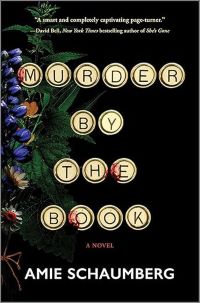
Two dead students. A coded reference to Shakespeare. And the promise of darker things to come.
Near a small college campus, a student is found strangled in an abandoned barn on the outskirts of town. She's been posed to look like a painting of Ophelia from Shakespeare's Hamlet, the scene taunting the police with a message they don't understand. Detective Ian Carter is known as a straitlaced cop, but seeing the girl's body leaves him shaken and uncertain of where to turn—until a chance meeting with a charmingly awkward literature professor ends with her accidentally seeing, and solving, a clue left by the killer.
Professor Emma Reilly knows that the books she loves might hold the key to unraveling the killer's crimes now that a second murder has been discovered, with the victim posed as the Lady of Shalott this time. However, when the murderer strikes too close to home and kills a third student, one from Emma’s classes, she realizes that the safety of her insular life might be nothing more than an illusion. She must find the strength to confront a killer who is turning the stories she loves into lurid scenes of death.
Amie Schaumberg has crafted a smart, thrilling and utterly compelling mystery that will have you trying to figure out whodunit right up until the end.
Fiction Literary | Mystery Cozy [Mira Books, On Sale: August 19, 2025, Hardcover / e-Book, ISBN: 9780778387503 / eISBN: 9780369762696]

An avid reader from a young age, Amie’s writing draws on her experiences as a literary scholar, teacher, and lifelong book nerd. From the moment she discovered Jane Eyre at the age of thirteen, words have been the driving force of her passions and pursuits. She read her way from rural Montana to the libraries of the University of Notre Dame and now teaches literature and composition at a small college in Washington. She is proudly neurodivergent. Amie can usually be found with her two dogs and two cats, working her way through an infinite To-Be-Read pile.
No comments posted.






 © 2003-2026