You could say Lucille Ball was my babysitter.
Growing up as an only child, I had to find ways to entertain myself, and I often turned to stories. Books, movies, TV shows—I devoured them all. One particular favorite was I Love Lucy. There was so much to adore: the slapstick comedy, the friendship, the marriage. It was a perfect comfort show. My parents could always count on Nick at Nite to keep me occupied for a while when a Lucy marathon was on.
I don’t live too far from Jamestown, New York, where Lucille Ball was born and where the Lucy-Desi Museum is, and I remember being so excited to visit the museum, only for it to be where I learned Lucy and Desi had divorced. (I blame not knowing sooner on my age and lack of online research capability at the time.)
It was probably more heartbreaking for me than it should have been—blame my age again, since most of the stories I consumed back then gave me a far too idealistic notion of romance—but I loved knowing they were a couple on- and off-screen. I’m not the only one: How often does the public wonder if the co-stars of their favorite TV show or movie are dating in real life? It’s all over gossip magazines and websites. We love the idea that the chemistry we see doesn’t end when the director yells, “Cut!”
While Lucy and Desi had a lot of chemistry, they also had a lot of problems. In the 1950s, they were on top of the world career-wise with a show that millions of Americans loved. So what is a couple to do when their marriage is tied up with their career? When ending a marriage means disappointing their fans? According to an interview Lucy gave with Barbara Walters, these were the worries she worked through before divorcing. They’re also the ones I considered while brainstorming the premise of THE ONE AND ONLY VIVIAN STONE.
Like Lucy, my main character, Vivian, is a comedian who meets a handsome and charismatic man on the set of a movie. For Lucy and Desi, that movie was Too Many Girls. For Vivian and Kit, it’s a romantic comedy called Sunday Circus. In both cases, their chemistry leads to a whirlwind romance and eventually to working on a sitcom together. While gossip magazines speculated about their relationship, no one at the time knew for sure what went on behind closed doors.
Consider the timeframe: In the 1950s, the divorce rate was low, partly because ending a marriage was seen as a failure. This was especially true for women. Self-help books suggested that they were in charge of fixing their marriages and to consider what they could do differently to prevent their husbands from drinking, cheating, and being abusive, while also laying out the question of how they might have caused those things in the first place. Yikes.
On top of that, we have the old studio system, where misogyny and rules were the norm. Did you know the studio could tell their stars what to wear? Decide on their stage names and backstories? Who they could and couldn’t date? Some had their marriages arranged for them, while others were punished for getting married, depending on how the studio thought it would affect the star’s image (and, therefore, their value at the box office).
While Lucy and Desi were an inspiration for this book, one thing I knew I needed—something I found in Lucy and so many other Hollywood actresses I’d researched about—was a strong woman as my main character. The kind of woman who works hard for what she wants. A woman who stands up for other women. One who will fight for what she believes in, even if it means ruffling feathers. A woman who won’t let setbacks keep her from getting on her feet again.
Those are the kind of women I am inspired by and the kind of women I like to write.
Of course, it doesn’t hurt if they’re funny too.
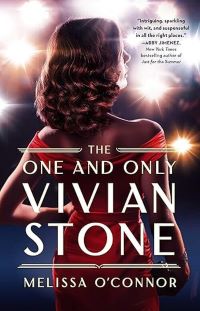
The Seven Husbands of Evelyn Hugo meets Fiona Davis in this enchanting novel about a pair of estranged lovers reconnecting over mysterious tapes found in an attic and the old Hollywood secret hidden within them.
After her grandmother’s death, thirty-year-old Margot DuBois returns to her childhood home to sort through the attic of things left behind and comes across a set of eight unlabeled cassette tapes. Unable to use the damaged tape player, she calls in a favor from a long-lost ex, Leo, and they strike a deal: he’ll fix the player if he can hear what’s on the tapes. When they finally manage to listen, the two are shocked to hear the voice of old Hollywood film star Vivian Stone. Why did Margot’s grandmother have these tapes and where did they come from?
As they continue to listen, Vivian’s story unfolds from her early auditions for major studios, to meeting her costar-turned-husband Kit, to the struggles of being a woman in Hollywood. Margot is inspired by Vivian’s tenacity and courage to keep fighting for the life she wants but everything changes when she finally uncovers Vivian’s ties to her family in this moving exploration of how it’s never too late to start over.
Fiction | Historical [Gallery Books, On Sale: July 22, 2025, Paperback / e-Book , ISBN: 9781668074831 / eISBN: 9781668074848]
About Melissa O'Connor
Melissa O’Connor became obsessed with stories involving family secrets, betrayal, and forbidden love after being given a box of used V.C. Andrews books at age ten. She lives in Buffalo, New York, where she can usually be found cheering on her kids’ hockey teams and sneaking words on the page between games. THE ONE AND ONLY VIVIAN STONE is her debut novel.
No comments posted.









 © 2003-2026