For this month’s selections, we look at stories all set in the post-World War I era—but with characters from widely varying locales and positions in Society. However, in each one, the main characters must confront difficult and often dangerous circumstances.
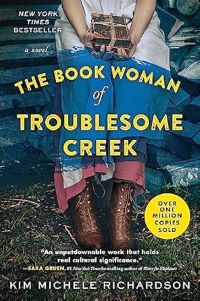
Beginning in the US among humble folk, we have THE BOOKWOMAN’S DAUGHTER by Kim Michele Richardson. Adopted daughter of THE BOOKWOMAN OF TROUBLESOME CREEK, Honey Lovett knows the dangers of growing up “Blue,” inheritor of a genetic condition that makes the skin appear blue—and under Kentucky law, classifies the individual as “colored.” Since marriage between coloreds and whites is forbidden, Honey’s adoptive parents have been breaking the law most of her life. As her story begins, her parents are caught and imprisoned, and at age 16, Honey is subject to being forced into a work prison until she turns 21. Evading pursuit, Honey takes refuge with her mother’s old friend Miss Loretta—and takes up her mother’s packhorse library route, continuing to deliver books to remote corners of the Appalachians. Aided by her protective mule, Junia, and befriended by Pearl, another independent mountain girl who mans the forest fire station, Honey fights to keep her independence and build a rich and satisfying life among the mountain people. Richardson’s story explores a beautiful and little-known area and era of America.
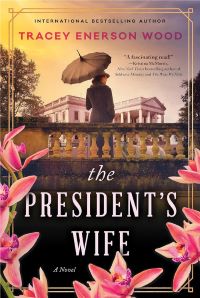
We remain in the US but catapult to the opposite end of the societal spectrum, from poverty to ultimate power with THE PRESIDENT’S WIFE by Tracey Enerson Wood. Widowed socialite and successful businesswoman Edith Bolling isn’t interested in remarrying, preferring independence and travel. But, charmed by President Woodrow Wilson, she accepts his proposal—and then must deal with the life-in-fishbowl existence of being First Lady. Not to be cowed, Edith continues to counsel and assist her husband, becoming one of his chief advisors. While she is accompanying him in Europe for the signing of the Versailles Treaty that ends World War I, Wilson suffers a health crisis that catapults Edith into a vital and secret role. Determined to protect her husband’s legacy and move his proposals forward, Edith hides her husband’s disability from the public and the press, working behind the scenes with his ministers and becoming in essence de facto President. Loyal protector and preserver of Wilson’s heritage or arrogant interloper usurping a role that shouldn’t have been hers? Wood’s meticulously researched account creates a vivid picture of the tumultuous politics of the post-World-War I world.
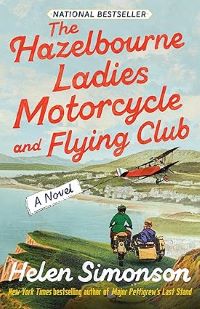
We skip across the pond to England with the next selection, THE HAZELBOURNE LADIES’ MOTORCYCLE AND FLYING CLUB by Helen Simonson. Instead of taking on new roles, another set of women are struggling to hang on to occupations they filled during the war and from which they are now being replaced by returning soldiers. Constance Haverhill, dismissed from her estate agent position, finds a new position as a lady’s companion to an old family friend who is convalescing at a seaside hotel. After helping baronet’s daughter Poppy Wirral avoid an embarrassing situation at the hotel, the two become friends. Poppy, a motorcycle dispatch rider during the war who has also lost her job, has formed a taxi and delivery company to employ other displaced women—and begun a ladies’ motorcycle club with plans to add flying lessons. She and her friends welcome Constance, encouraging her to become more independent and introducing her to Poppy’s brother, an injured former fighter pilot who’s withdrawn from life. Simonson’s novel crafts vivid pictures of how the life of high society and ordinary people, so greatly altered by the war, continues evolving during the post-war period, even as Constance must change and adapt to a new life.
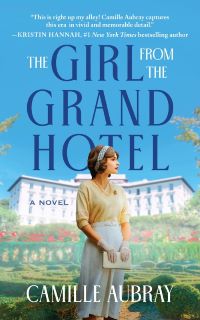
We finish up in a glamourous locale whose charm and peace are being threatened by the disputes presaging World War II in THE GIRL FROM THE GRAND HOTEL by Camille Aubray. Both Society’s wealthiest and Hollywood’s most illustrious gather at the Grand Hotel on the Cote d’Azur for the very first Cannes Film Festival. Fleeing a dead-end job and a broken heart, Annabel Faucon escapes from New York to work for her uncle, the Grand Hotel’s manager. He tasks Annabel with keeping an eye on booze-inclined screenwriter F. Scott Fitzgerald and movie icons Jack Cabot and his actress fiancée Téa Marlo. Arriving to join this mix of glitteri and movie stars are some of Hitler’s Nazi insiders. Troubled by the Nazi views she observes, Annabel finds herself drawn into a world of spies, danger and intrigue even as she falls for Jack. Inspired by true events and featuring appearances by such luminaries as Marlene Dietrich, James Cagney, and Mae West along with its fictional stars, Aubray’s novel vividly recounts the beginning of a film festival that’s become a cultural icon against the backdrop of a world on the brink of war.
The protagonists of each of this month’s stories face circumstances that challenge their views of themselves and the world and force them to call on courage and initiative to persevere, despite what “traditional roles” demand of them. Come along and enjoy their journeys!

Real, intense, passionate historical romance
Award-winning romance author Julia Justiss, who has written more than thirty historical novels and novellas set in the English Regency and the American West, just completed her first contemporary series set in the fictional Hill Country town of Whiskey River, Texas.
A voracious reader who began jotting down plot ideas for Nancy Drew novels in her third grade spiral, Julia has published poetry and worked as a business journalist.
She and her husband live in East Texas, where she continues to craft the stories she loves. Check her website for details about her books, chat with her on social media, and follow her on Bookbub and Amazon to receive notices about her latest releases.
No comments posted.











 © 2003-2026