1--What is the title of your latest release?
Life / Insurance
2--What’s the “elevator pitch” for your new book?
This spare novella is about a collage artist piecing together a life, a composer unable to talk, and an interrogation into art and existence in New York City.
3--How did you decide where your book was going to take place?
I always like my stories to take place in some sort of vaguely recognizable setting but nothing too identifiable. This novella takes place mostly in a hospital room, and one of the characters is confined to bed. But I had no desire to make the hospital room appear realistic. I am always aiming for a generic sort of space so that the attention is on the language and mental shifts of the character, not on the dramatic action in a specific setting.
4--Would you hang out with your protagonist in real life?
I like to think of my protagonist as a mind, not really a person. So the answer is no! I would rather hang out with someone fun.
5--What are three words that describe your protagonist?
Questing, questioning, collating
6--What’s something you learned while writing this book?
I learned that it takes a long time to write a short book. I kept adding things to it, then subtracting. From first idea to finished book was probably 10 years.
7--Do you edit as you draft or wait until you are totally done?
Both and all the time. I spent most of my life as a book editor, and there is always editing to be done. Also, I love editing and deleting, probably more than writing. So I am always willing to do that.
8--What’s your favorite foodie indulgence?
fish tacos, if I can get a good one from California
9--Describe your writing space/office!
I write on my sofa with a laptop and a yellow legal pad for when I need to work out ideas on paper. Even if I rarely use them, I have to have a legal pad and blue pen beside me.
10--Who is an author you admire?
There are so many, but the main ones are probably Joyce, Beckett, Camus, Nabokov, Hemingway, Wallace Stevens. I love writers who try to tap into the music behind language and who write to express an idea. I don’t care about characters in fiction—only the ideas.
11--Is there a book that changed your life?
There are hundreds. But one important one would be The Stranger (Camus). His use of the novel form to articulate a philosophy was so mind-opening to me as a teenager. And then the philosophy that he articulated (his happy existentialism) was so wonderful to discover. How did people live before Camus? I have no idea.
12--Tell us about when you got “the call.” (when you found out your book was going to be published)/Or, for indie authors, when you decided to self-publish.
I think I got an email rather than a call. Which was great because it gives you time to think about what just happened. After you know your book is going to be out in the world, your whole relationship to it changes, and you can no longer keep working on it. It’s a thing on its own now. So “the call” is both exciting and a little bit sad.
13--What’s your favorite genre to read?
I read a ton of biographies, mostly of visual artists, and all sorts of slightly experimental fiction by authors who play with form or language (César Aira or Enrique Vila-Matas are two of my favorites).
14--What’s your favorite movie?
Maybe “Man on Wire,” the documentary (although it feels like fiction) about Philippe Petit’s high-wire walk between the Twin Towers in New York City.
15--What is your favorite season?
Fall: I love the feeling of going back to school and learning something. I read recently somewhere that the antidote to sadness is learning something, which sounds right.
16--How do you like to celebrate your birthday?
One thing I always do is bake myself a cake. You can’t depend on other people to do that, and besides, I’m a really good baker.
17--What’s a recent tv show/movie/book/podcast you highly recommend?
I have a couple of sort-of recent TV shows that I loved: “The Detectorists” is a British comedy about two guys with metal detectors looking for treasure. It manages to be simultaneously sad and uplifting and hilarious. And another show that I feel didn’t get enough attention when it came out: “Years and Years” (2019, HBO). It’s a family drama set in a dystopian near future, and now that future feels right here.
18--What’s your favorite type of cuisine?
Maybe Japanese? I like the attention to presentation.
19--What do you do when you have free time?
Answer: I make jewelry and take classes around New York. (You can learn how to make anything in New York.) I’ve been to bookbinding classes, glassblowing classes, knitting classes, and more. My favorite place is the Jewelry Center at the 92nd Street Y.
20--What can readers expect from you next?
After writing three novellas, I’m really trying to write something longer, at least a short novel! But a novella is a beautiful thing, and I might have to do it again.
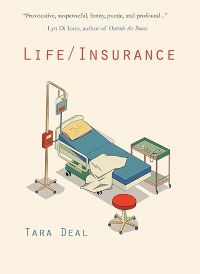
The narrator of this spare novella is a collage artist trying to piece together a life. Her husband is a composer who is unable to talk. Even so, she keeps asking him questions, trying to figure out what he can remember, what he did, what he wants, what he means. But then she, in turn, is interrogated by the authorities, who want to know what happened here. Everyone waits for answers. How to compensate for this disaster? What are the chances of survival? Is there solace in converting life into language? What to believe? In prose that is sometimes suspenseful, sometimes meditative, sometimes provocative, LIFE / INSURANCE is a portrait of an artist confronting the problems of existence, knowledge, language, and New York City.
Women's Fiction Psychological [Regal House Publishing, On Sale: December 10, 2024, Paperback / e-Book, ISBN: 9781646034901 / ]
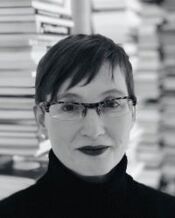
Tara Deal is the author of the award-winning novellas That Night Alive (Miami University Press) and Palms Are Not Trees After All (Texas Review Press). She lives in New York City.
No comments posted.






 © 2003-2026