Poor Neanderthals. No matter how many wonderful things we learn about them, they
remain our lesser predecessors, dismissed as stupid and coarse.
The problem began with their discovery. In 1856, workers in the Neander Valley
near Dusseldorf, Germany came across a skull that looked human, except it had a
prominent brow ridge, large eye sockets, and a flattened cranium. Thick
fossilized bones were discovered nearby. After the Neander valley find,
scientists realized similar bones had already been uncovered in Belgium and
Gibraltar. Anglo-Irish geologist William King suggested the name Homo
neanderthalensis and declared Neanderthals incapable of complex thought.
Historical context
In 1859 (only three years after the Neander valley find), Charles Darwin
published his book On the Origin of Species through Natural Selection.
He pointed out that more young are born each year than can survive. Those with
an advantage, something that allowed them to be more successful in their
environment, were more likely to survive and reproduce. In 1871, Darwin
published The Descent of Man, his treatise on human evolution, in which
he argued that all life forms, including people, evolved from simpler ones. He
used the metaphor of the tree. While a tree may have many branches that grow
from the same roots, some survive and grow while others shrivel and die. He
suggested that far back in time, apes and humans shared a common ancestor. Some,
like the Neanderthals, did not thrive.
In the public imagination, those two works combined in the simplified format of
“Survival of the Fittest.” Or “Only the strong survive.” That provided a reason
that Homo sapiens survived and Homo neanderthalensis didn’t: we were clearly
better, stronger, brighter, more inventive, more adaptive, and definitely
prettier. Or so it seemed.
The Boule image
In 1908, after the discovery of the skeleton of an old Neanderthal man, along
with remains of wooly rhinoceros, reindeer, ibex, hyena, bison, and wild horse
at La Chapelle aux Saints, Marcelline Boule, a French paleontologist, concluded
that the Neanderthal was brutish and stooped. The illustration he had made by
Frantisek Kupka (pictured below) shows a hairy gorilla-like figure.
All of this makes sense, I suppose, given the rise of “Survival of the Fittest”
theories and the search for “The Missing Link.” The public loved it. The
powerful but brutish ape-man appears in Arthur Conan Doyle’s 1912 story, “The
Lost World,” and later in H. G. Wells’ 1921 story “The Grisly Folk,” in which
Neanderthals are hideous, primitive cannibals.
The most famous personification of the brutish ape-man is King Kong,
who was described as “neither beast nor man.” The original film (1933) sets up
Kong as the King of Beasts on Skull Island, an island lost in time, where
dinosaurs still roam. Kong is captured and taken to New York, where he’s
exhibited as the Eighth Wonder of the World. Things do not go well, and Kong
winds up being shot down by airplanes as he climbs to the top of the Empire
State Building in an attempt to abduct (or protect) Ann Darrow, a white woman in
a filmy dress.
Boule’s theories about Neanderthals and the terrible illustration that
accompanied them still stick in the public mind, even in the face of
contradictions. Recent studies have shown that Neanderthals had a robust build
and a larger brain than Homo sapiens. A 2007 study of the Neanderthal genome in
several individuals, led by Carles Laleuza-Fox and published in
Science, suggested that Neanderthals had varied skin pigmentation and
eye color, just as modern humans do.
And no language
Even worse, Neanderthals were said to have no language. But the fact is the
Neanderthal hyoid bone, which was used as evidence of their lack of language is,
according to new research, “virtually indistinguishable” from our own. A study
published in PLOS ONE showed that Neanderthals used their vocal tract
the same way modern humans do.
So what is true about Neanderthals?
They spread out over an enormous area, from North Africa around the entire
Mediterranean up to the ice sheets that covered northern Europe. They arrived
sometime around 250,000 years ago, though some sources say “proto-Neanderthals”
arrived far earlier – up to 600,000 years ago.
They are closely related to modern humans, differing in DNA by only 0.12%.
They co-existed with modern humans for 2500 to 5000 years, depending on the
location, and interbred with them. Most of us carry between 1% and 4% of
Neanderthal DNA, though the parts we share vary.
They started making stone tools about 300,000 years ago. By 170,000 years ago,
they had a sophisticated tool set.
They made art and music. The Divje Babe flute, found in Slovenia, is at least
43,000 years old and perhaps closer to 80,000 years old.
They practiced burial rituals and apparently cared for their wounded.
They lived in social communities and built buildings and watercraft, probably
crossing the Mediterranean Sea as early as 110,000 years ago.
They were skilled hunters, able to bring down deer, reindeer, ibex, even aurochs.
They dried fresh meat and cooked their vegetables.
They painted on cave walls and used personal adornment, including an eagle talon
necklace.
Perhaps it’s time we gave the Neanderthals an image makeover. They certainly
deserve it.
Kathleen Flanagan Rollins: retired English professor turned novelist,
fascinated by all things ancient but especially the earliest explorers who
discovered, quite literally, brand new worlds
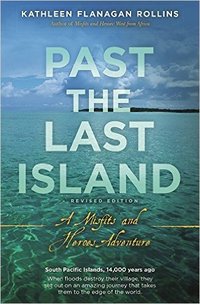
The South Pacific Islands, 14,000 years ago – crossroads of cultures from
Asia to Australia
After their island is ravaged by tidal flooding, some
villagers turn to a brutal leader for protection, but others flee by night,
taking to the open sea in a quest to find a new life. They meet others along the
way, people driven to find whatever lies beyond the edge of the world.
On the great open sea, they enter a world still ruled by spirits, a place of
wonders where beauty and danger live side by side. Some give their life to the
journey.















 © 2003-2026