Kensington Zebra
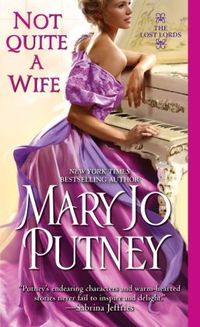
Featuring: James, Lord Kirkland; Laurel Herbert
352 pages ISBN: 1420127160 EAN: 9781420127164 Kindle: B00IUPCL0Y Mass Market Paperback / e-Book Add to Wish List
Book six in The Lost Lords series, NOT QUITE A WIFE, deals with the sixth gentleman from a group of men who attended a school for troubled boys together in their childhood. These men formed lifelong bonds of friendship and loyalty. I liked the first three books in the series, but NOT QUITE A WIFE is not as elegantly crafted as some of Putney's previous works.
James is a Presbyterian man who owns and manages a shipping fleet, owns half a London gaming house, and is a ruthlessly effective spymaster during the Napoleonic Wars. He seems like a pretty good guy- I found him to be engaging, but did not fall in love with him. Laurel married James eleven years ago after a brief courtship. They had a year-long honeymoon during which they were blissfulliy happy. Then, a man broke into James' spymaster study to harm him, and James killed the crook in front of Laurel. Laurel fled London and James in horror and spends the next ten years separated from her husband, working with her Methodist minister-turned-physician brother running an infirmary and a shelter for abused women and children.
James is in Bristol when he is overcome by malarial fever, beaten by thieves, and left for dead in an alley. Two good Samaritans deliver him to Laurel's infirmary, where she is horrified to recognize her erstwhile husband. Brought back together by fate, their reunion has unexpected consequences, and now James and Laurel must try to build a new life that includes one another. As they are constructing that new life and trying to overcome their own prejudices, misunderstanding, and solitary habits, they are threatened by a lurking villain who threatens Laurel and someone dear to her.
The whole reason for the ten year estrangement felt overly contrived to me. I could not sympathize with Laurel's rigid point of view, and this immediately prejudiced me against her. The dialogue throughout the book feels stilted and artificial. There's a shadowy villain whose actions seem overblown and irrational. It even feels awfully heavy-handed about religion for a book that's not an inspirational romance.
Although this is book six in the series, it's not necessary to read the prior books before reading NOT QUITE A WIFE. There is a long segment in the book where all of the main characters from the previous five books come together at a dinner party, and we are treated to an exposition of who each character is and how they fell in love. This scene felt somewhat awkward, but it does serve to remind the reader of the previous heroes and heroines in the series, many of whom I enjoyed in their own previous books. I have been a longtime Putney fan, and I know she can craft a beautiful story. Based on her whole body of work, I will pick up the next book and hope it will be an improvement.
Marry in haste, repent at leisure!
James, Lord Kirkland, owns a shipping fleet, half a London
gaming house, and is a ruthlessly effective spymaster. He
is seldom self-indulgent…except when it comes to the
gentle,
indomitable beauty who was once his wife.
Laurel Herbert gave James her heart as an innocent young
girl—until she saw him perform an act of shocking violence
before her very eyes. That night she left the husband who
is far more than the fashionable lord he seems, and he let
her go without a word of protest.
Now, ten years later, a chance encounter turns passionate,
with consequences that cannot be ignored. But as they try
to rebuild what was broken, they must face common enemies
and a very uncommon love….
EXCERPT
Laurel. Kirkland gradually rose from darkness to
awareness,
drifting in a sea of well-being. He’d dreamed of his wife,
which wasn’t unusual, but most of the time, she vanished
when
he took her in his arms, leaving him aching with loneliness
and
frustration. This time he’d had one of his rare dreams of
satisfaction, and with a degree of realism that was
searing.
But consciousness would not be denied. He had a large
inventory of aches and pains, including a throbbing head.
What
had happened? And where was he?
Not a familiar place, he was sure of that, but he was
reasonably comfortable, lying on a firm but well-cushioned
bed
with clean-smelling sheets and covers. Memory rushed back.
Damn, he’d had a fever attack while walking through
Bristol,
and had been too weak to fend off attackers!
He recognized the scent of lavender, probably from the
sheets.
That must be why his thoughts of Laurel had been so vivid.
He’d sometimes called her his Lavender Lady because of the
scent she often wore.
Reluctantly opening his eyes, he saw a plain, light-colored
ceiling. Even that small effort was tiring.
“I see you’re awake.” The soothing female voice came from
his
right, and shocked him to his marrow.
He turned his head so quickly that he felt a wave of
dizziness.
Laurel sat in a chair by his bed, her lap full of mending.
Seeing her brought back a shocking array of sensual
memories
from his recent dream. Her taste, her scent, the silky
warmth
of her skin, the welcoming heat of her body . . .
His jaw clenched as he suppressed the passionate memories,
but
he couldn’t suppress the reality of her presence.
Even
after ten years, she was achingly familiar. Her glorious
bronze hair was loosely tied back and she was so beautiful
his
heart hurt. But she was no longer the girl he’d
married.
Her openness to him and to the world had vanished, replaced
by
cool distance. Surely her glorious warmth couldn’t be
entirely
gone, but it was no longer for him. His heart died a
little.
Yet she was still his wife. And God help him, he still
wanted
her. “I’m sorry, Laurel.” His voice was a hoarse whisper.
“You never wanted to see me again, yet here I am.”
She set her mending in the basket by her chair. “It’s
hardly
your fault, James. While you were suffering from fever,
you
were attacked by robbers not far from here. Two men who
attend
our chapel found you and brought you to the infirmary.”
While he tried to think of what to say to his long-
estranged
wife, he felt a soft bump on his left hip. He turned his
head
cautiously and found himself looking into the golden eyes
of a
large gray cat, which was curled up against his side. Its
thumping tail was what had caught his attention.
He blinked. “Is this the gray kitten you had me fish out
of
the pond all those years ago?”
“Yes, it’s Shadow. All grown up now. He makes himself
free of
the infirmary.”
Kirkland scratched the cat’s neck and was rewarded by a
rumbling purr. “He’s pretty substantial for a shadow.”
“He takes a deep interest in his food dish, but he’s a good
fellow. Patients who come here regularly look for him.”
She
laid a cool hand on Kirkland’s forehead. “The fever is
gone,
but you must be thirsty. Here, drink this. It will help
your
throat.”
She poured a drink from a stone jug into a mug, then slid
an
arm under his pillows and raised his head enough to hold
the
vessel to his lips. Her closeness was intoxicating.
Cutting off the thought, he sipped chicken broth, warm and
tasty. He hated being so weak, but that was always the
case
after a bout of fever. It helped keep him humble.
He finished the broth, then sagged back into his pillows.
His
body craved more rest, but he couldn’t bear to close his
eyes
on the miraculous sight of his wife. “How long have I been
here?”
“Since yesterday evening. I managed to get several cups of
Jesuit's bark tea down you and it seems to have cut off the
fever quickly. More broth?” When he shook his head, she
set
the mug down. “I assume you have anxious servants waiting
at a
local inn. Tell me which one and I’ll send word.”
“The Ostrich.” His eyes drifted shut, and he had to force
them
open. “Will Daniel be in later, or is he refusing to talk
to
me?”
“He’s away for a few days on a surgical tour in Wales.”
Kirkland’s brows furrowed. “A surgical tour?”
“Several times a year he visits areas where there are no
surgeons or physicians and provides care for those in
need,”
she explained.
“Daniel, the saint,” Kirkland murmured, unable to keep a
dry
note from his voice. “He was always interested in medicine
and
I knew he'd become a doctor, but how did he get there from
studying classics and theology at Oxford?”
Laurel regarded him coolly. “He always wanted to study
medicine, but my parents thought it too low an occupation.
They said that if he insisted on training for a profession
even
though he’d inherit the estate, he should enter the church,
and
he was not unwilling. He didn’t decide to study medicine
until
I left you and my parents refused to let me return home.
They
said I could go back to you or starve.”
Kirkland winced. “I didn’t know that. You should have
told
them I was to blame.”
“I did,” she said, her voice even cooler. “But you were an
earl, and therefore it was my duty to accept any little
eccentricities you might have. I was shameless, a disgrace
to
the family name, for leaving you.”
Kirkland’s head pounded even worse. “That’s why you and
Daniel
chose to set up your own household?”
She nodded. “He was furious with our parents. Since you
insisted on giving me a generous separation allowance, we
were
able to live comfortably while Daniel did his medical
training.” She made a gesture that included their
surroundings. “When he completed his studies, we bought
this
house and set up the infirmary. Later, we bought the house
directly behind this one and turned it into a sanctuary for
women and children escaping dangerously violent men. Zion
House.” Her eyes narrowed. “But surely an accomplished
spy
like you knew all that.”
“I kept track of where you lived, but no more,” he said
shortly. Thinking he might as well know the worst, he
asked,
“Does Daniel still hate me?”
She hesitated too long. “It is not in his nature to really
hate. But because he’s loyal to his little sister, he
holds
you responsible for . . . for . . .” She hesitated again.
“For ruining your life? He’s right to do so.” If not for
Kirkland, Laurel would have married a normal man and had a
real
home and children by now. Instead she was locked into
limbo,
not a maiden yet not quite a wife, sleeping alone and
childless. At least, he assumed she was sleeping alone.
Though he couldn’t bear the thought of her with another
man, he
couldn’t blame her if she’d found someone to warm her
nights.
“You didn’t ruin my life,” she said calmly. “Just set it
on a
new course, and not necessarily a worse one. The work I do
here matters, James. If I was merely a wife, my life would
be
narrower and shallower.”
It stung that she thought a life with him would have been
shallow, but at least she had moved beyond the wreckage of
their marriage without bitterness. She’d always had a gift
for
appreciating the moment rather than longing for what she
didn’t
have.
But though she might not hate him, an invisible wall
surrounded
her and made it clear that he should keep his distance.
Which
was easy because he didn’t have the strength to walk across
the
room.
Though his body craved more rest, he didn’t want their
conversation to end. “Do you still play the piano?”
“Of course.” She smiled with a touch of self-mockery.
“Even
serious-minded reformers like me need our pleasures. The
Broadwood piano you gave me is in the music room upstairs.
It
was quite a challenge getting it up there.”
His gaze touched her bare left hand and he wondered what
she’d
done with her wedding ring. “The Broadwood is a lovely
instrument, but I’m surprised that you kept anything I’d
given
you.”
“The tone is so wonderful that I couldn’t bear to part with
it.” She cocked her head. “Do you still play? Or do you
not
have time?”
“I play occasionally.” After Laurel left him, making music
was
his chief pleasure since it could be done alone and playing
never failed to soothe him. He’d improved greatly over the
years, but he’d never be as good as Laurel, who was truly
gifted. “I’m sorry your piano is out of listening range.
I’d
like you hear you play again.”
“I keep a small harp here in the infirmary,” she said, a
little
hesitant. “I can play that if you like.”
“I didn’t know you played the harp. I’d like very much to
hear
it.”
She set aside her mending and stood. “I’ll only be a
minute.
Unless you need something else?”
Only her. “Music is enough. Food for the soul, you know.”
She nodded agreement as she left the room. Luckily, she
returned before he drifted to sleep again. The harp in her
arms was small enough to carry easily and nestle in her lap
when she sat again. He studied the instrument as she tuned
it.
“I’ve not seen a harp like that before.”
“It belonged to an old Irish woman here in Bristol. I used
to
visit her every week or so. I’d take a basket of food and
Mrs.
Donovan would tell me wonderful stories. Because her
fingers
were too twisted to play the harp well, she taught me so I
could play for her.” Laurel’s fingers rippled over the
strings
as she checked the tuning. The small instrument had a
surprisingly deep, rich sound. “She asked me to play for
her
as she lay dying, and then left me the harp. It was her
most
treasured possession.”
Kirkland had married a saint. No wonder the marriage had
broken down so quickly when she realized how great a sinner
he
was.
But for now he had the unexpected gift of time with her.
It
might never come again, so he would savor every moment to
create new memories for the future. And the sweetest
memory of
all would be that dream of intimacy that had not really
happened. . . . She began to play a haunting Irish
tune, singing along in her soft, rich contralto.
The minstrel boy to the war is gone,
In the ranks of death you’ll find him;
His father’s sword he has girded on,
And his wild harp slung behind him. . . .
He closed his eyes, letting the music flow through him. In
the
liquid notes, he heard the sweet warmth that had been the
essence of Laurel when they’d first met. He was glad to
know
that warmth still existed under her cool, controlled
surface.
And for these few moments, he was privileged to enjoy it
once
more. . . .










 © 2003-2026