
Literary lover fiction
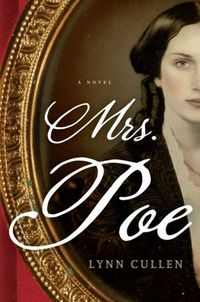
A vivid and compelling novel about a woman who becomes
entangled in an affair with Edgar Allan Poe—at the same time
she becomes the unwilling confidante of his much-younger wife.
It is 1845, and Frances Osgood is desperately trying to make
a living as a writer in New York; not an easy task for a
woman—especially one with two children and a philandering
portrait painter as her husband. As Frances tries to sell
her work, she finds that editors are only interested in
writing similar to that of the new renegade literary
sensation Edgar Allan Poe, whose poem, “The Raven” has
struck a public nerve.
She meets the handsome and mysterious Poe at a literary
party, and the two have an immediate connection. Poe wants
Frances to meet with his wife since she claims to be an
admirer of her poems, and Frances is curious to see the
woman whom Edgar married.
As Frances spends more and more time with the intriguing
couple, her intense attraction for Edgar brings her into
dangerous territory. And Mrs. Poe, who acts like an innocent
child, is actually more manipulative and threatening than
she appears. As Frances and Edgar’s passionate affair
escalates, Frances must decide whether she can walk away
before it’s too late...
Set amidst the fascinating world of New York’s literati,
this smart and sexy novel offers a unique view into the life
of one of history’s most unforgettable literary figures.
Excerpt Two weeks later, I was tucked beneath a thick buffalo robe,
riding downtown in Miss Fuller’s carriage. I had been too
nervous to enjoy the trip or to appreciate Miss Fuller’s
carriage, pulled by a clopping bay. That Miss Fuller was the
only woman in New York to support herself by writing, let
alone to have enough leftover to buy her own buggy, mattered
little to me at that moment. Why had I agreed to meet Poe?
And why would he want to meet me? He had already made and
broken an appointment the previous week. I had been relieved
by the cancellation, only to become agitated once more when
he set up a different date. As suddenly and inexplicably as
he had championed my poetry at the New York Society Library,
he could withdraw his support if I said something wrong. Who
knew what triggered the man’s tomahawk?
Miss Fuller jerked on the reins. “Here we are.” She looked
at me expectantly, as if I should climb out of her trim
little gig without her.
“Shouldn’t we wait for the doormen to take your reins?” I asked.
“Take my reins? Oh—did you think I was coming with you? No,
no, dear, I’m off to investigate a slum on Hester Street.
You really thought I was coming with you? I only meant that
I would take you
here. I thought your husband would appreciate my escorting
you since he is, as you say, out of town.”
“Would you rather I came with you to the slum?” I asked.
“And have you jilt Mr. Poe? I wouldn’t dare.” Miss Fuller
steadied her horse, then waved me toward the hotel. “Go on.
It will be good for your books.”
Reluctantly, I climbed out from under the heavy robe. I held
my breath as the carriage rattled away.
I found myself on the sidewalk before the hotel,
contemplating an immediate about-face up Broadway when I
felt someone’s presence behind me. Before I could move, a
man said, “Lord help the poor bears and beavers.”
I turned to find Mr. Poe, his black-lashed eyes trained upon
the building before us. Without a hello he said, “Davy
Crockett’s words, upon first seeing this pile.”
I hesitated. “Because of Mr. Astor’s fur trade?”
He continued as if I had not spoken. “But Crockett was
mistaken. It wasn’t the bears and the beavers that made
Astor’s fortune. It was the opium he bought from the Chinese.”
I looked at him in surprise. “Mr. Astor deals in opium?”
He kept his gaze upon the hotel. “Whenever you see this much
wealth, assume that someone dirtied his hands. Fortunes
don’t come to saints.”
“I’ve never thought of that.”
He gave me a sharp glance. “Really?”
I drew back, chastened.
“Mr. Astor prefers to be known for the slaughter of animals
rather than for his association with opiates. I wonder why
that is.” He lowered his sights to me. “Shall we enter, Mrs.
Osgood?”
So he did recognize me. I preceded him inside, into the hot
maw of the lobby. As we walked past impressive people
dressed in beautiful clothes, I felt low and insignificant,
a ne’er-do-well’s abandoned wife, although my gown was as
fine as anyone’s. What a sham I was.
I stopped to face him. “Congratulations on the success of
‘The Raven.’ ”
He frowned as if insulted.
“People love it. I hear talk of it everywhere I go.”
“‘People’ have no taste. Don’t tell me that you think it’s a
work of genius.”
Was this a trick? I scanned his dark-rimmed eyes for clues.
When I did not answer he said, “Thank you, Mrs. Osgood.
You’re the first honest woman I have met in New York.” He
shook his head.
“It is my luck that I will become famous for that piece.”
Still not sure that I shouldn’t be gushing, I switched to
safer ground. “May I ask what you are working on now?”
“A book on the material and spiritual universe.”
I laughed.
He watched me coolly.
“I’m sorry. I thought you were joking.”
“I never joke.”
“Of course not. Excuse me.”
“Although I wish I were. It will never sell.”
“Your work always sells,” I said lightly.
“Not any of my works with a true idea in them. People want
to be titillated or frightened. They don’t want to think.”
I smiled hesitantly. What did he want with me?
“This is why I singled out your poems in my lecture,” he
said. “They have real feeling in them, if one reads between
the lines.”
I could not help but be disarmed. “Thank you. I find that
the thoughts spoken between the lines are the most important
parts of a poem or story.”
“As in life.”
I reluctantly met his intense gaze. “Yes.”
“I am particularly taken with your poem, ‘Lenore’:
So when Love poured through thy pure heart his lightning,
On thy pale cheek the soft rose-hues awoke—
So when wild Passion, that timid heart frightening,
Poisoned the treasure, it trembled and broke!
I swallowed my surprise. “You memorized it.”
An elegant couple drifted by, he in succulent wool and she
in layers of costly lace. Mr. Poe frowned. “It spoke to me
somehow, and not just because I had written a poem with the
same title and had used the name in ‘The Raven.’ ”
“A coincidence.”
He stared at me.
I looked away. Why had Mr. Poe called this meeting? Surely
he had better things to do than to raise the hopes of an
unknown writer.
“You are probably wondering why I wished to meet you.”
I drew in a breath.
“Actually, it is on behalf of my wife.”
“Mrs. Poe?”
He frowned slightly at my unnecessary question. “She is a
great reader. I have taught her all of the classics. I like
to encourage her when she shows interest in good work, and
your poems, Mrs. Osgood,
delight her.”
I pictured the pretty woman-child I had seen at Miss Lynch’s
conversazione. I wondered if it was my poems for adults or
for children that she admired.
“Thank you for your kind words, Mr. Poe. I wish she were
here so that I could thank her, too.”
His expression hardened. “She has had bronchitis. Her
recovery has been long and difficult. There was no question
of her going out today.”
“I am sorry to hear that.”
“The few times she has ventured beyond our home have only
served to set her back.”
“I am truly very sorry.”
He glanced away, then glared as if I’d offended him. “You
will not hear her complain. She’s a brave, good girl. If I
could only take her to Jamaica or Bermuda or some such hot
clime, I’m certain she would become well.”
Why did they not go, then? With his success, surely he had
the money.
“I hope she gets well soon.”
His expression settled back into cool civility. “It is bold
of me to ask—we are perfect strangers, and you have
obligations to your husband and family—but might you come
visit her someday? I know
from looking into your eyes that you are a good person, and
kind, and that your gentle association might help her.”
That was why he wished to meet with me? Ashamed of my
disappointment, I exclaimed, “I should like very much to
meet her! Might I have the pleasure of visiting her at your
home?”
“Mrs. Osgood, you are too kind. Yes. Yes, we’d like that
very much.”
“When would you like me to come?”
“At your convenience.”
“Would next week suit you?”
“Name your day. Any day. I will arrange my schedule around you.”
“Monday? In the afternoon?” I saved my morning hours for
writing . . . writing, that is, what I hoped would be my
imitation of his work.
He bowed, as stiffly formal as if in a royal court. “We
would be so grateful.”
He gave me directions to his home on 154 Greenwich Street,
then bowing again, left me in Astor’s parlor with all the
frippery that bears and beavers and opium could buy.
Start Reading MRS. POE Now
Our Past Week of Fresh Picks
|








 © 2003-2026