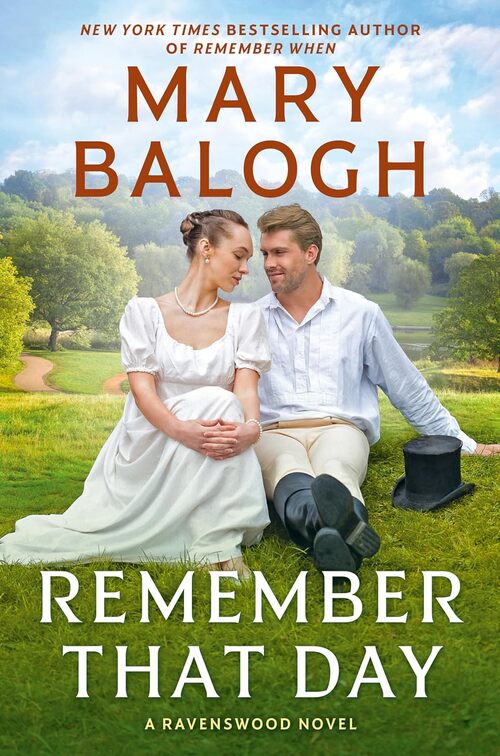
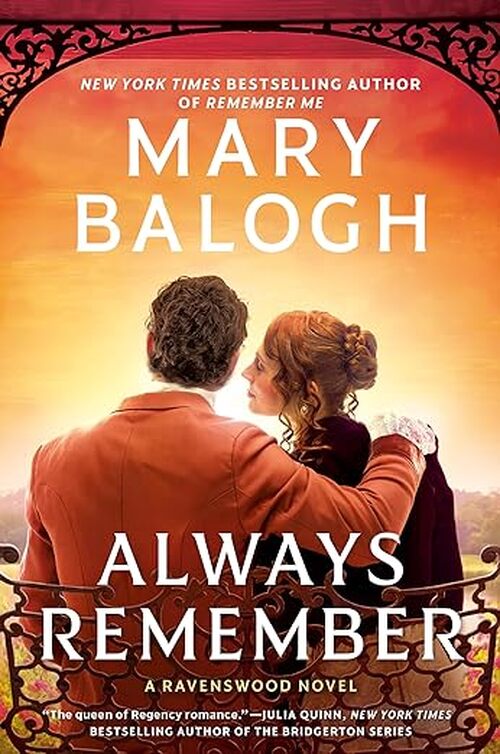
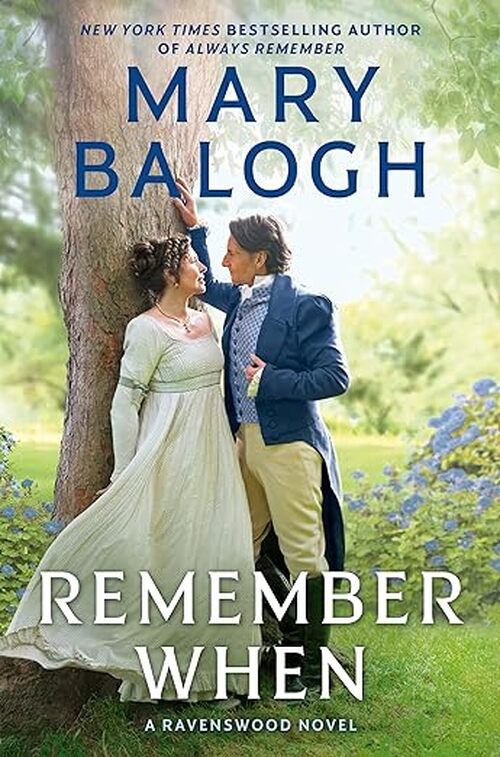
This is the fifth book in Grande Dame Mary Balogh’s Ravenswood series. This is the series centering around the family of the previous Earl of Stratton, Caleb Ware, who had been exposed to the ton for his clandestine affairs by his own son, Devlin. REMEMBER THE DAY starts out seeming to center on Owen Ware, but then the romantic focus flips over to Nicholas, the late Earl of Stratton’s second son.
Winifred Cunningham, the adopted daughter of a society
portrait painter, believes that her new best friend, Owen
Ware will soon ask for her hand in marriage. But when Owen
introduces Winifred to his elder brother Nicholas, the late
Earl of Stratton’s second son, the “slow burn of attraction”
between them heats up and threatens to engulf them.
Winifred and Nicholas are chalk and cheese, and it’s fun to
watch them rub along and figure out that they have more
reasons to come together than they do to disagree.
REMEMBER THE DAY brings together the Wares of Ravenswood and
the Westcotts. Caleb Ware and his wife Clarissa had five
children of their own, and Caleb had a sixth child born out
of wedlock. Clarissa, the Dowager Countess of Stratton,
also gets her own book in this series. The Westcotts had
their own series with ten prior books and a novella. Balogh
brings back almost all of these characters, including
children of previous couples, so there is an inordinate
amount of family members running about here. Balogh admits
in the Author’s Note at the beginning that maybe she bit off
more than she could chew in terms of her readers keeping
everyone straight. She does give a brief precis of each
character, spouse, and offspring at the beginning, but I
gave up trying to keep them all straight and just let them
jostle around in the story without worrying about where they
fit in. The problem with long-running series is that they
usually become unwieldy, and this is definitely true here.
Balogh’s later books all have a lot of introspection and
endless navel-gazing. I am growing frustrated with the
never-ending musing about what brings happiness. I do enjoy
when a romance shows growth of the characters throughout the
book, and I also enjoy emotional maturity in my heroes and
heroines. But Balogh tends to carry this too far, similar
to Anne Perry, author of both the Thomas and Charlotte Pitt
and William Monk series of historical detective fiction. I
stopped reading Perry because of her constant prosing, and
I’ve been threatening to stop reading Balogh for the same
reason.
Faithful Balogh readers may enjoy this long-winded revival
tour of the Wares and the Westcotts. Most readers would be
better served to simply start with Balogh’s earlier works,
which offer more robust romance and less internal monologue.
REMEMBER THE DAY is a lackluster example of Regency romance
from a previous reigning queen of romance.
No excerpt available.








 © 2003-2026