
Purchase
Haven, March 2026
Trade Paperback / e-Book / audiobook
A Good Man, January 2020
Trade Size / e-Book
Penguin Books
January 2020
On Sale: January 14, 2020
224 pages
ISBN: 0143134981
EAN: 9780143134985
Kindle: B07TCZPFYB
Trade Size / e-Book
Add to Wish List
Thriller Psychological | Women's Fiction Psychological
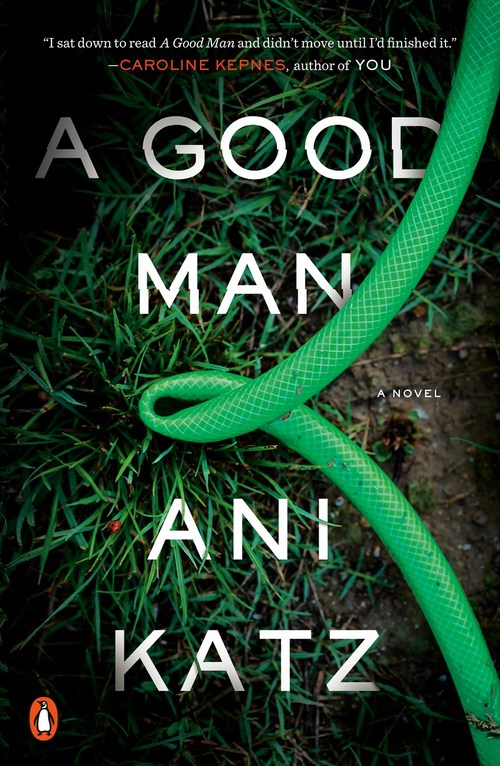
A dark and gripping novel of psychological suspense about a family man driven to unspeakable acts, in the vein of The Perfect Nanny and We Need to Talk About Kevin.
Thomas Martin was a devoted family man who had all the trappings of an enviable life: a beautiful wife and daughter, a well-appointed home on Long Island's north shore, a job at a prestigious Manhattan advertising firm. He was also a devoted son and brother, shielding the women in his orbit from the everyday brutalities of the world. But what happens when Thomas’s fragile ego is rocked? After committing a horrific deed — that he can never undo — Thomas grapples with his sense of self. Sometimes he casts himself as a victim and, at other times, a monster. All he ever did was try to be a good man, but maybe if he tells his version of the story, he might uncover how and why things unraveled so horribly.
More InformationConversation with Ani KatzIn A Good Man, the narrator Thomas Martin has the outward appearance of a man who tries to always do the right thing and sees himself as a protector, provider, and patriarch . . . and then his world unravels. What inspired this character?
I was originally inspired by a tragedy that happened in the extended family of a close friend several decades ago. I was also frustrated with what I’d begun to see as a trend in contemporary literature, where something shocking and gruesome happens, but a detached point of view without agency keeps the reader at a safe, voyeuristic distance. I wanted to subvert that storytelling trend in order to fully explore toxic masculinity and the dangers of outdated gender norms.
This is your debut novel. In addition to The Adversary by Emmanuel Carrère, were there any other true stories that inspired A Good Man (without giving away the ending)? Did you need to do any research to create Thomas’s world?
I read a good deal of relevant true crime, including Joe McGinniss’ Fatal Vision and Errol Morris’ A Wilderness of Error, which is a critique of McGinniss’ book. I also read a lot of longform journalism about various cases of men who had committed acts of violence against their families (Michael Finkel’s story in Esquire about Christian Longo is just one significant example). I also spent an uncomfortable amount of time on men’s rights blogs in order to absorb and better embody the highly regressive language these men employ to talk about women, marriage, and family.
As a woman was it difficult to write from the POV of a male narrator who ultimately commits unspeakable, violent acts? What do you want the reader to take away?
Writing from this point of view was not as difficult as I initially thought it would be, and in some ways it got easier as I got deeper into the writing process. The hardest part was when I first started drafting, when I felt I had to adopt a more obviously creepy, even monstrous voice, which was a struggle. But as I kept going, I realized that approach didn’t make any sense. Thomas works as a character because he’s so familiar—read a certain way, he’s actually quite relatable. The kind of mindset that he embodies is so pervasive, and the real effects of that mindset are so close to so many people’s (especially women’s) experiences, that as a writer it became easy to access. It was already in the air.
I want to discomfit and implicate my readers. I wanted the story to stay with them, make them feel uncomfortable, and prompt them to recognize their complicity in their consumption of stories about gender violence and murder.
The unreliable narrator is popular in psychological suspense today. Thomas Martin is about as unreliable as they come. How did Thomas’s unreliability create intrigue and how did those close to him influence his decision-making and contribute to his undoing?
I feel very strongly that this story needed to be told exactly this way, with this narrator. Thomas is an unreliable narrator, but what’s most important is that he has agency. By extension, the reader has their own agency—they have the choice to turn away, but I believe most of them will choose to stay.
There are a range of possible contributing factors to the undoing—an abusive childhood, anxiety about encroaching global terrors, a rigid self-concept that is impossible to uphold—but there can never be a smoking gun to fully explain what happened. His actions do however have a logic to them—it isn’t a logic that we like, but it is one, nonetheless.
The novel is largely set on Long Island. Why did you choose Long Island and was having a suburban setting important to building suspense and conflict in your book?
I grew up in Bay Shore, which is on the South Shore of Long Island. Suburban Long Island represents wildly different things to different people. It’s a place of both enormous wealth and serious poverty, sometimes side by side in the same town. It has long been idealized as a place that’s at an idyllic remove from the city, providing access without the attendant discomforts, but it can also be incredibly provincial and isolating. Many families settle there because the traditional white American view is that the suburbs are “safer” than the city, but Long Island has also been the site of brutal violence, like the Gilgo Beach murders of sex workers, as well as anti-immigrant hate crimes.
Thomas craves the kind of picture-perfect life that Long Island seems to promise, but there’s rot under the facade. Many, many authors have chosen the suburbs as the setting for domestic dread and horror (I’m particularly partial to Richard Yates on this front), but even though it’s by no means a new approach, I felt it suited this story.
Operas are referenced several times in A Good Man. What part did they play and what do they tell us about Thomas?
Thomas relies on his extensive knowledge of opera to gild the telling of his story. He’s able to cast himself as a cultured connoisseur, and the specific works that he references bolster his self-mythology, and self-aggrandizement. It’s a really fitting medium for this story; in many operas, the stakes are life-and-death, and the action barrels toward cathartic, often bloody conclusions.
Did you know at the beginning that the book’s ending was going to be shocking and violent or did you work that out as you wrote?
The details came later, but I knew from the very beginning that the ending had to be punctual. It was very important that I didn’t soften the blow, or leave room for any kind of redemption, which would have let the reader off the hook. However, while I felt very strongly that the resolution had to be shocking, I also knew that it couldn’t be gratuitous. Often, the most abject horror lies in the plain statement of facts.
| 







 © 2003-2026