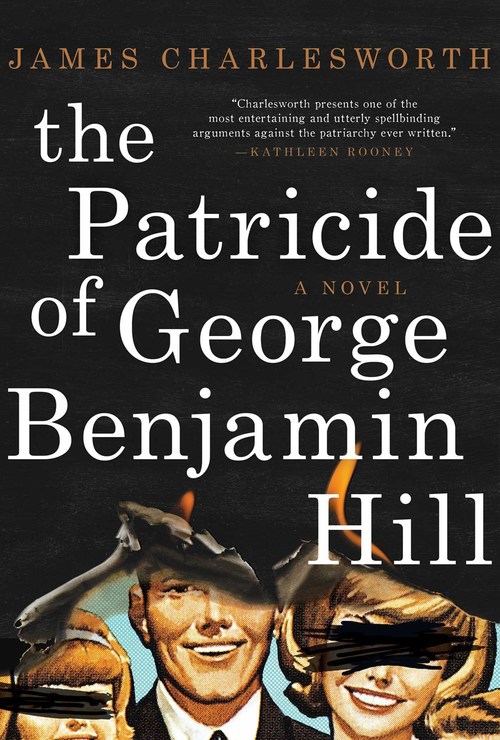
From being a poor dust bowl orphan from Oklahoma to earning fame and wealth beyond measure, George Benjamin Hill, through charm, charisma, luck and tenacity has achieved an American dream. But throughout his long life, he has left two broken families, and four children who gained very little from his father's life, and those four children hold their father in blame for the way their lives turned out, and ultimately, a dastardly plan of patricide is planned.
Spanning from 1930s to shortly after 9/11 in 2001, THE PATRICIDE OF GEORGE BENJAMIN HILL by James Charlesworth is a tale reminiscent of GINNY GALL by Charles Smith as the author bravely explores the psychological territory of how George's dreams, schemes and disregard for life has impacted his first and second wives as well as his three sons and one daughter. Moving from one character to another, James Charlesworth leaves no stone unturned as his five protagonists live and dream the life that brought nothing but failure and misery in all aspects.
Using words to build up vivid landscapes of California, Alaska and even Las Vegas as well as achieving in describing a remarkable history of these towns and places, THE PATRICIDE OF GEORGE BENJAMIN HILL by James Charleseworth is a fascinating tale that will need to be re-read multiple times in order to fully grasp the protagonists.
For a reader seeking to learn about the dark side of American dream as well as being a witness to how ambition can impact men, women and children, THE PATRICIDE OF GEORGE BENJAMIN HILL by James Charlesworth will be the perfect ride into how one man's psychology affected his family.
From a powerful new literary voice, a sweeping epic of
one family and the destructive power of the American
Dream
All their lives, the children of George Benjamin Hill have
fought to escape the shadow of their father, a dust-bowl
orphan, self-made millionaire in bedrock American
capitalism
(fast food and oil), and destroyer of two families on his
way to financial success.
Now, they are approaching middle age and ruin: A failed
ex-minor league ballplayer, divorced and mourning the death
of his daughter in Miami; a self-proclaimed CIA veteran,
off
his meds and deciphering conspiracies in Manhattan; a Las
Vegas showgirl turned old maid of The Strip, trying to stay
clean; and an Alaskan bush pilot, twice un-indicted for
manslaughter and recently thrown off his land by the
federal
government.
While their father takes his place at the center of a
national scandal, these estranged siblings find themselves
drawn from their four corners of the country, compelled
along crowded interstates by resentment and confusion,
converging on a 300-acre horse ranch outside Omaha for a
final confrontation with the father they never had.
Migrating from the suburban anonymity of 1950s San
Bernardino, to the frozen end of the world (Alaska circa
1976), and concluding in the background of one of the most
horrifying moments in American history, The Patricide of
George Benjamin Hill spans seventy years of life in
America, from the Great Depression to the age of corporate
greed and terrorism. It is a literary suspense novel about
the decline and consequence of patriarchal society. It is
also an intricate family saga of aspiration and betrayal.
EXCERPT
Four hours in, his plan nearly dies. A storm whites out the
sky above Icy Bay, obscuring the 18,000-foot glacial dump
of Mt. St. Elias. He has piloted his secondhand DHC Beaver
down from Fairbanks on a day that dawned brilliant with
autumn, the wilderness a thousand-hued carpet. Now the
system has stormed in from the southwest, roiling off the
Pacific and blooming silver on the ridgeline of the
Wrangell Mountains, the corridor of light from the
retrofitted headlamps illuminating the precipitation that
rattles the airframe and freezes on impact.
He is a veteran of this weather, has nearly twenty years of
bush experience—has piloted this battered vessel as far
north as Nome, as far south as Kodiak Island, has guided it
through storms like the end of the world to set it down on
strips of fireweed the size of city driveways, has logged
more hours than half the so-called pilots flying commercial
jets in the Lower 48. But today was the one day he had
wished for calm weather, had hoped for clear skies to give
him time to think.
From Juneau, he will catch a flight south to Seattle, from
there on to Las Vegas and then by car east to Omaha via
Denver. But first there is the process of selling his
plane. A potential buyer has responded to his
advertisements in the equipment trader and is meeting him
today at the airport. He has already sold his pickup truck,
his guns, his hunting and trapping equipment, has already
foregone every possession, including the cabin and parcel
of land straddling the Canadian border where he’d thought
he would spend the remainder of his life. Why has he done
this? He has done it at the behest of the calling that has
tormented him for the past three years. He has done it for
the money that will help him to procure the object that has
become his preoccupation, the motive that has led him to
track down and send letters to the three siblings he has
not seen in over twenty years, that has led him now—in the
year of his forty-first birthday—to be on his way to Omaha,
Nebraska, to find and confront the man he now refuses to
call Father.
It almost dies up here, in the turbulent solitude of
fifteen-thousand feet, impact ice in the air intake causing
the engine to run rough, a drop in manifold pressure. The
tachometer flickers as ice begins to form in the
carburetor. The engine coughs and then is silent. He lowers
the nose into the whine of wind and procession of cloud,
flaps at cruise to maintain air speed, opens the throttle
and primes with the wobble pump. Up ahead, invisible, is
the face of a mountain, a cliff side, a spectacular death.
If the restart fails, a dead engine landing is impossible.
He closes his eyes and waits for it, and then, against
every lesson life has taught him up to this point, the
engine crackles and returns. The lights of the instrument
panel dazzle. He reengages the controls and imagines he can
hear the landing gear scraping the frozen peaks of the
foothills.
The system passes and he is aloft in the blue dome over
Glacier Bay, the archipelago speckling the golden ocean, an
obscured face behind the grimy glass of this prop plane
that has served him for two decades. The sun is at his back
and showing purple on the snow-covered mountainside,
assuring him. Yes, you were saved today. You were saved
from certain destruction in order to finish what you have
started. As he radios in his descent, he watches the light
prism on the water and the tin rooftops of a salmon town
and the icy ridge above and whispers something inaudible.
Not a prayer—he doesn’t believe in God—but a pledge. To his
twin sister, to his half brothers, to his estranged mother.
And finally, to the man he refuses to call Father, the man
whose far-off mansion on the plains marks the X-spot of
this three-thousand-mile journey, the man whose life story
will always serve as preamble to his own.
It begins half a century earlier.
On a sun-dried day in January 1956—seventy-five degrees in
mid-winter, for there were no seasons here in San Berdoo,
in the arid valley that separated the city of the stars
from the desert—a twenty-four-year-old delivery boy named
George Hill (though he went by Georgie in those days)
arrived in his four-axle delivery truck in the sandlot out
back of the burger stand that was the last on his route
every Friday. He was sweating. He’d worked fifty hours this
week. He and his wife had had an argument the night before,
an argument centered around several small things and one
not-small thing. When the raised voices had proven
inadequate for conveying her feelings, she’d thrown a pot
at him and struck him in the face, which was why he had a
Band-Aid on his forehead, the skin beneath which was
itching and driving him crazy. Yet another thing that was
driving him crazy. His young son, GB, was turning five in
two weeks, and he was afraid he’d stopped loving him. Or
maybe he’d simply stopped loving his wife, the woman who
only six years previously had advanced to the final round
of the country’s most prestigious beauty pageant, whose
graceful promenades across the stage and runways at
Boardwalk Hall could not have predicted her proficiency in
pot throwing, and who’d told him, just months before, that
what he’d been dreading was true. She was pregnant again.
The first time he’d heard these words from Mary it had been
confirmation of his arrival. Until then, he’d been a
silent, restless boy, a directionless, insecure adolescent.
He had avoided mirrors throughout his youth, originally
because there were none to be found in the drafty
ramshackle homestead on the Oklahoma panhandle whose 160
acres of dying fields had formed the bleak backdrop of his
earliest years. Later because he couldn’t bear to look at
himself: despised his lank greasy hair and olive skin and
heavy brow. Hated his long arms and the unavoidable slouch
that was his father’s slouch, the slouch of an overworked
Okie raised up in spartan conditions on the great plains,
on plows and in sweltering stables, endless days of sweat
and sore muscles. In his siblings he had always detected
inheritances from their mother, her stern but gentle eyes,
her coarse but lively hair, her soft-spoken wisdom. But not
in Georgie. He was his father’s utterly graceless
offspring.
When they’d moved down here the summer the war ended, his
father had one message for Georgie: “Never be afraid,” he’d
told his young son, “to take a risk in life. You look at
all the successful people in the world, I’ll tell you one
thing they all have in common. They all had a chance to
take a risk or sit on their ass. And not a one of them
chose to sit on his ass. What do you think we did when we
saw that dust bowl rising up around us? Did we sit back on
our ass? No sir. We picked up and we moved on. And look at
us now.”
This in his used Packard on the way south from Bakersfield,
just the two of them, the rest of what had been a family of
seven eradicated on the trip west over Route 66 and in the
war in Europe. His father had heard of work in the newly
thriving city of San Bernardino, a dusty valley in the
center of a bowl at the foot of the mountains sharing the
name of the same saint. He’d heard there were all sorts of
jobs springing up for men willing to get up off their duff
and do it. Good, honest work for a solid wage. Not this
shady business on the grape farms, working like a slave for
wages little better than the Mexicans’. He’d come down a
week earlier and gotten them a place, had found a job
cleaning swimming pools. Came home and told Georgie it
wasn’t easy in this heat, wasn’t back breaking, though.
Wasn’t nothing he couldn’t handle. Went back the next day
and fell in the pool and drowned. Couldn’t swim. Was an
Okie through and through. Nobody had been around to hear
his splashing. The folks who owned the house had arrived
home the next day to find a figure in a starched white
uniform floating face down in their swimming pool. Had
called the cleaning company, who’d come over to pick out
the body.
They’d turned him over to orphan support, operated out of a
mission-style building near the Rancho Cucamonga line. Two
years spent prowling those crowded hallways, waiting in
line for stale food and lying in hard cots staring up at a
dark ceiling, four to a room. On his fifteenth birthday,
Georgie and a group of them had formed a solemn pact to
escape and set up on the outside, make some fast cash
robbing jewelry stores and maybe some trains. They’d
planned and executed a late-night liberation under cover of
the smog-laden LA stars, had climbed into the foothills of
the San Gabriel Mountains, living in the wilderness for all
of seventeen hours before one of their number was attacked
by a coyote and had to be taken back down to the city, had
to practically have his arm stitched back on, to hear him
talk. Their plans for escape fizzled. The boy who’d nearly
had his arm chewed off by the coyote was adopted within a
month, which touched off a brief smattering of self-injury.
It didn’t work. Georgie climbed up to the roof of the
orphanage and stood looking down at the pavement six
stories below, pictured himself executing a graceful dive
to splatter on the blacktop, saw his blood, brown and dust-
colored like the world he’d come from, the world he knew he
belonged to though he couldn’t stand even to imagine the
worthless, middle-of-nowhere people they’d been back then,
working like dogs on 160 acres, twelve hours a day—and for
what? An uncertain existence that could turn like a tornado
and did just that the year the rain stopped and the blowing
dust swept across the plain. What good was life if these
were the sort of decisions it left you with? Whether or not
to jump off the roof of a six-story orphanage, the last
surviving member of your family? And what about those folks
with the swimming pool? Those folks who could afford to
have a tub of however-many gallons of water in their
backyard. What was it that made one person like they were
and another person like Georgie’s father? It wasn’t
following a string of flyers a thousand miles west to grape
country. It wasn’t packing your bags and moving to some
upstart city outside LA. But if it wasn’t any of these
things, then what was it? Georgie saw the haze drift off
the desert breeze and thought he caught a glimpse of the
same stars he’d once seen so clearly back on the farm,
sitting on the back porch with his mama or off in the
fields on a retired plow with his older brother Carl and
little sister Debbie. He looked at the stars so long and
with such fervency that he forgot entirely what he’d come
up here to do, and when he remembered where he was and why
and had crept over to the edge of the roof and looked down,
it filled him with such fear that he had to fold his legs
up against his chest, had to wrap his arms around his knees
to stop trembling.













 © 2003-2026