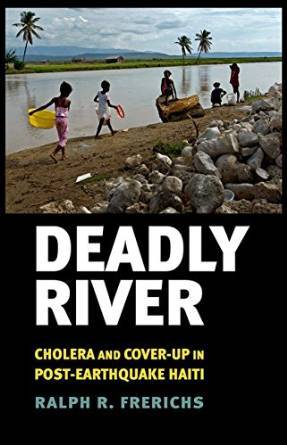
With a subtitle like 'Cholera and Cover-Up in Post- Earthquake Haiti' we can see that a complex and distressing tale is about to be revealed. DEADLY RIVER focuses on the humanitarian efforts made in the aftermath of the huge earthquake that struck the poor nation of Haiti, which is about the size of Maryland. Haiti is part of the Caribbean island of Hispaniola, which it shares with Dominican Republic. French doctor Renaud Piarroux arrived to work there, and author Ralph R Frerichs, who had studied cholera, started following his blogs and reports. The result is their collaboration in this book DEADLY RIVER.
In January 2010 an earthquake of 7.0 magnitude hit Haiti not far from the capital. Unlike Asian cities which were regularly damaged by quakes and rebuilt stronger, Port Au Prince was old and weak. Deaths were estimated variously at 80,000 to 230,000 and the communities were devastated. International aid of all kinds swooped in to help in many ways. Nine months later children started dying on the same day as they became ill after drinking from a river, initially thought to be caused by typhoid. Then a large outbreak of cholera was recorded, which stopped volunteer workers (including me) from travelling. This became a full sized epidemic - in a country which had not before had a single case of the ancient Asian disease cholera. Turmoil followed both in politics and on the streets as hospitals were overwhelmed.
Renaud Piarroux had studied diseases and worked in many countries and actually managed to eliminate cholera from an African island when with Medecins du Monde. The Haitian government asked him to step in and search for the origins of the disease. Generally it was known that cholera is waterborne and can live in bay organisms but a harmful strain can be transmitted through sewage and contaminated water. Piarroux also had to find a way to protect the ten million inhabitants from further outbreaks.
The source of the disease was found to be Nepalese troops stationed as part of a United Nations peacekeeping effort. The strain of cholera was found to be the same as that in a previous outbreak in the Himalayan country Nepal. Piarroux claims that obstacles were put in his path by UN staff, who issued contradictory reports. Clean water and good sanitation are an unaffordable dream for many people living on the island, especially with patchy rebuilding efforts. While cholera subsided during the dry season it returned when the rain flushed contaminants into the leaking water network. By 2015 the germs were still reappearing and had infected about one in twenty Haitians, mostly the poor and vulnerable.
Emerging diseases such as Ebola and Zika are on our news screens with sad regularity so I felt that advances should be made, and lessons learned, from the work of tracing and conquering cholera. Only by sending in experienced staff to work on the ground can this be done. I have also read about 'disaster capitalism' in Haiti and other lands; this shows how money can be made from soaking up aid funds to supply goods, services and trained people when and where needed. When something goes wrong, the rich and powerful do not want to be blamed or made to pay compensation.
DEADLY RIVER is a sobering story of epidemiology and scientific detective work. This will intrigue anyone working in or studying the medical field, as well as city planners, aid workers, charity supporters and travellers, and those interested in geopolitics. Journalists will be interested in the fact that the Nepalese connection was first made publicly by Jonathan Katz in an online version of 'La Presse', a Canadian newspaper, while Sebastian Walker televised a report containing quite the opposite of UN statements, documenting poor sanitary conditions around the Nepalese camp. Deborah Pasmantier also put the pieces together and published widely on the net. Their investigative journalism is reproduced for us.
We can also see just how poor this island's population is while raising enough rice to sustain itself. Indeed the rice paddies were a major factor in the spread, making DEADLY RIVER quite a different story to a book I had read on cholera in London. No NGO (non government organisation) could resolve the problem without working with the local government and infrastructure providers. The history of cholera which may have been with humans for ten thousand years in South Asia is also well drawn. Ralph R. Frerichs and Renaud Piarroux have provided us a tragic tale to remember and food for thought. You won't want to read this while eating, and you will certainly remember to wash your hands before making a sandwich.
Frerichs’s narrative highlights how the
world’s wealthy nations, nongovernmental agencies, and
international institutions respond when their interests
clash with the needs of the world’s most vulnerable people.
The story poses big social questions and offers insights not
only on how to eliminate cholera in Haiti but also how
nations, NGOs, and international organizations such as the
UN and CDC deal with catastrophic infectious disease epidemics.
No excerpt available.













 © 2003-2026