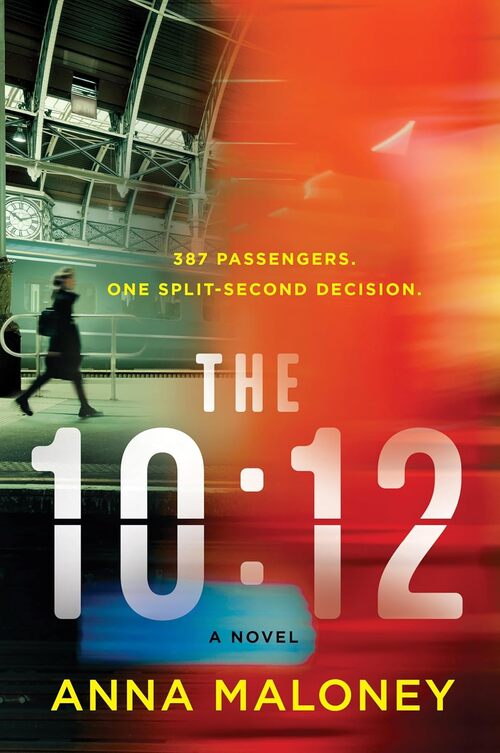
10:12 by Anna Maloney is her debut title. She has
previously written for television. 10:12 is set on a moving
train that is hijacked, and the passengers fight to save
lives after one of the hijackers is accidentally killed by a
passenger defending herself.
The central character, Claire, is on a train home to
London from Manchester after visiting family there. She has
received some disturbing news before boarding the train, and
all she wants is a quiet seat to process what happened at
her sister-in-law's. Soon after the train leaves, Claire
comes across a young man who is clearly out of his mind and
looks like he’s high on something. Later, Claire
learns he is high on drugs and is one of the hijackers. She
kills him while defending herself when he points a gun at
her. Once he is killed, Claire finally realizes what
she's done and what is happening on the train as she meets
other passengers who understand the threat and want to
investigate the extent of the threat.
Slowly, a team of people comes together and starts
clearing each coach, coming up with strategies to identify
the hijacker in the coaches ahead and information they can
glean from one of the captured hijackers. Gradually, more
people join Claire, and together they clear coaches as they
move toward the driver's cabin. Along the way, they capture
more hijackers, witness deaths, and face arguments and
opposition about how the self-appointed saviors might be
endangering everyone rather than saving them. All the while,
fear and uncertainty linger as to what will happen next. To
some, especially the team working to safeguard their fellow
passengers, the moment is thrilling, with adrenaline running
high, and their only goal is to move people toward the safe
coaches and get a hold of the hijackers to resolve the
situation without any further killings. When the climax
arrives, events unfold chaotically and quickly. Later, when
we meet the survivors, it feels like a lifetime has
passed.
While the first half on the train thrills with high
emotions, the second half is anticlimactic; the tables turn,
and the saviors are deemed largely criminal rather than
heroes, given their actions on the train. Such is the irony
of the legal system: hijackers are defended while those who
worked to save their fellow passengers are branded
criminals. Acting as vigilantes in the heat of the moment to
defend themselves and others when outside help seemed
impossible as the events took place. This act of doing what
seemed necessary in the moment is later portrayed as
unnecessary during the trial, prompting readers to question
whether it was better to remain silent and in fear of dying
rather than standing up for oneself and others. The irony of
the legal system, as reflected in the trial where some are
forgiven and some are made the villains despite their
actions, reflects a flawed justice system.
As expected, there’s a lot of high-tension drama
and emotions experienced while the train is in motion, and a
lot of reflection with plenty of moments of what-ifs and
only-ifs when the whole incident is later processed,
especially during the trial. Ultimately, the story explores
irony as it unfolds in a high-drama situation and later in
its quiet aftermath.
A twisty, high-stakes thriller in the breathless, page-turning style of Ruth Ware, Lisa Jewell, and Claire Douglas, in which nothing is as it seems and saving the day is only the beginning.
Claire Fitzroy was on the way home to London when her train from Manchester was hijacked by a group of armed men. In one terrifying moment she faced the starkest of choices: to passively stand back or act and fight back—knowing that with either choice, she could die.
With nothing to lose, the middle-aged art lecturer gathered and led a squad of passengers who, against all odds, overcame the hijackers and saved hundreds of lives. But what at first looks like heroism may play out very differently in the courts of law and public opinion. Especially when you have the blood of two men on your hands.
Opinions are heated and divided. Was she a selfless and quick-thinking hero? Or an attention-seeking vigilante and unrepentant murderer? Until now Claire has remained silent. Now, she’s finally speaking out about what happened that morning on the 10:12.
But is it the whole story?
EXCERPT
2
Out of Sight
Coach J
10:35
How do you know someone’s dead? In Patrick Harbour’s case, there was no need to try and find a pulse; his fatal injuries were obvious. As was the blood. The young woman with the pierced nose and the shaven-headed wiry man started towards him, but quickly stopped. There were screams and sobbing, topped by Cokehead yelling. I could see his gun hand was shaking. Then another man, squeezed into a shiny black jacket which made him look like a club bouncer, appeared at the far door from the coach further up the train and called out in a loud and firm voice. ‘Sit down and shut up, everyone. Now! And you,’ he said to Cokehead, ‘get their phones.’
Black Jacket appeared to be in his thirties, tougher looking
than Cokehead, with a woollen grey beanie pulled low on his head and a black backpack strapped on tightly. He glanced at the dead man then threw an annoyed scowl at the shooter, shook his head and muttered furiously. His brown-skinned face was battered, like a boxer’s, and muscles strained at his jacket sleeves. The carriage was quiet, although my ears and probably every- one else’s were still ringing with the noise of the gunshot. It was hard to take in what had just happened. It didn’t seem real.
Did Cokehead really murder a man just to steal some phones? Tucking myself back against the wall as far as I could, I peered through the gaps between bags and cases undetected.
Why didn’t I sit back down with everyone else? There wasn’t time to think about it and make a considered decision. It just felt safer to be out of sight, however long that might last.
Black Jacket surveyed the carriage. In his right hand was a long, thick, scary-looking knife. His cool demeanour was terrifying. He came down the aisle and I shrank back even further, searching for the passenger emergency stop handle to alert the driver, then realised it was in the carriage – if I went for it, I would be clearly visible to the man with the knife.
‘Pull the blinds down,’ he said, loud and clear, in what seemed like a Manc accent. Passengers began to fumble and do as he commanded, and as they did, the world was shut out, detaching us further from normality.
Whereas the first hijacker was a bundle of nerves, Black Jacket looked at the passengers with detached disdain. ‘This man’s dead cos he did something stupid, OK? Didn’t need to happen. Do as we say, and you’ll be fine. We’re not here to hurt yer, all right?’
An odd thing to say when someone’s been shot dead and the man speaking has a large knife in his hand.
People kept their heads down while Black Jacket started pick- ing up phones and putting them in a plastic bag he produced from his pocket. He handed another bag to Cokehead to do the same. There was the occasional whimper and people kept glan- cing at the body. I caught a glimpse of a sprawled leg, dark blood spreading across the floor and stepped back without thinking, which accidentally opened the automatic vestibule door. But as luck would have it another train went past in the opposite direction at that exact moment, and no one noticed the noise, so I slipped through, then tried the door to the out-of-service end carriage, thinking it might be a good place to hide – but it was locked so I ducked back into the toilet. I had to ring the police. It turns out that it’s not easy to use a phone when your hands are shaking. I locked the door behind me as quietly as possible, trying not to think of a gunshot blowing it open, and sat on the toilet, lid down, bag on lap and pulled out my phone. Focus, focus, I remember telling myself. I tried to recall the text number for the Transport Police thinking it might be quick and direct – the ‘See it. Say it. Sorted.’ one – but couldn’t. How’s anyone supposed to remember that when they need it? Instead, I dialled 999 and after what seemed like an age, but I learned later was only twelve seconds, got through to the police.
Can you speak up?
No. Listen. There are at least two armed men on the 10:12 train from Manchester to London. They’ve shot one man dead already. In the second to last carriage, J.
What’s your name please, caller?
Claire Fitzroy.
And your address?
Fuck my address. There’s a madman with a gun. More than one. Do something. They’re…
Where are you right now, are you safe?
No! I’m in the toilet. Not safe. No one’s safe!
Please try and stay calm.
Please try and fucking do something. Shit. They’re at the door.
I hung up. I could hear someone outside the toilet. The handle was being shaken.
‘Open the door!’
I slipped my phone under a ledge over the sink. ‘Sorry. I’m on the toilet. I’m sick.’
I tried to make my voice sound weak. Which turned out not to be that difficult.
‘Open the door!’
Banging and scraping noises made me realise he was trying to smash the lock. There was nowhere to hide. I raised the toilet seat lid and sat down again, bag on lap. Bent over, my hair hung down about my head. Holding my breath, thoughts of my children almost paralysed me. Would I ever see them again? I pushed the thoughts away and concentrated on slowly breathing out. The door opened and he came in. I saw his black trainers. Cokehead. I hoped he’d see an old lady, bent over and sobbing, her grey hair covering her face.
‘Please, I’m not well.’
‘Give me your phone, bitch.’ ‘I don’t…’
He moved closer. I could smell the laundry detergent on his clothes and briefly, madly, wondered if his mum did his washing. He grabbed me under the chin and lifted my face. As he looked into my eyes, I brought the kitchen knife up and out of my bag and held the point against his neck. Could I get him to back off ? He frowned: a strange nanosecond of intimacy where I noticed one of his brown eyes had a slight squint. He was lifting the gun, when, suddenly, the train jolted, his head jerked forward and the tip of the knife pierced his throat. The blade was sharper than I had imagined. Dropping the gun, he tried to grab it, and I tried to pull it away, but somehow, in the struggle, the knife slipped across his throat. Arterial blood sprayed out as I stood up and backed away to avoid it. His hands moved to his neck, the blood escaping between his fingers, and he looked at me, surprised, then swayed to one side. I think I muttered an apology as I gently helped him sit down on the ground, resting his head and back against the wall while trying not to get covered in blood.
As I moved back, the blood continued to spurt from his throat through his fingers and onto the floor. His bloodied hands slipped down. There was a gurgling noise coming from his mouth. He was dying. I couldn’t see any signs that he was in pain, he just looked shocked, then vacant, his mouth slackening as he slid to the floor. Ducking down, I tried to use his jacket to stop the blood. Then looked at him again.
I started the morning as someone upset that her marriage might be over. And now I was someone who had accidentally killed a man.










 © 2003-2026