1909, and the city is crowded. Thrilled spectators line
the streets of New York for parades to celebrate the three
hundredth anniversary of the discovery of the Hudson River.
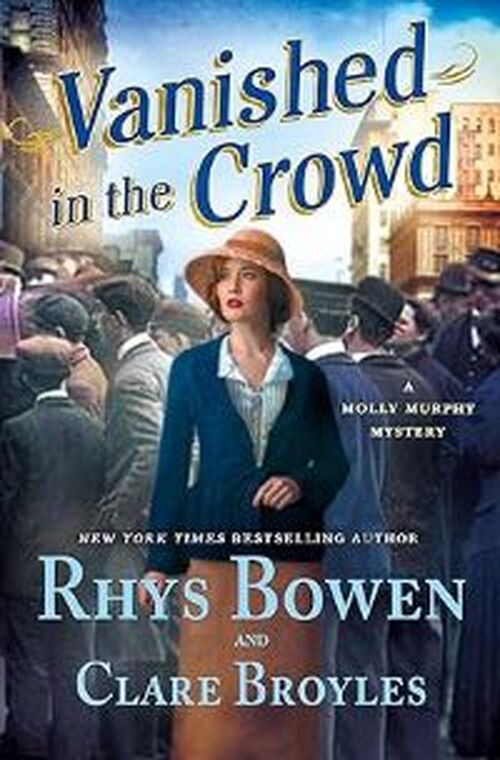
VANISHED IN THE CROWD looks at the status of women at that
time, working hard and getting little credit.
Our detective Molly Murphy Sullivan stars in the latest
of the series by Rhys Bowen and Clare Broyles. If you have
not read any, they are standalones, and the recurring cast
is small. The details in a historical mystery by Rhys Bowen
are always excellent, but I associate her more with the
English country manor. New York is the province of her
daughter Clare Broyles.
On this occasion, while she copes with her three young
children, the house, and the lack of a job, Molly also has
no funds. Her husband started work in the newly formed
Federal Bureau of Investigation and has yet to be paid. As
Daniel Sullivan is a former policeman, he is not badly off
and is sure the money will come through; meanwhile, he is
responsible for the security of visiting dignitaries. Molly
accepts a detective job from her friends Augusta and Sidney,
two slightly scandalous ladies.
A female scientist, Mrs Willa Parker, was supposed to
come to stay and has not arrived, so the ladies are
concerned. Her husband sets a Pinkerton agent to find his
wife, but of course, it’s possible Willa is hiding
from her spouse. Molly learns that the Parkers were a
research team until they married, whereupon Willa’s
name disappeared from papers about polio although she still
did a great deal of work. To investigate, Molly in turn has
to hire a young woman to mind her children and do some
housework. We see that men hired men and women hired
women.
At this time the right to vote was becoming important, as
wealthy women were highly educated, but it seems to be on
every page of the story, perhaps too often for the reader.
Other interests of the time include electric street lights,
and during the parades, an airplane flown over the city by
one of the Wright Brothers. The spectacular episodes are
worth reading by themselves, and we get a mystery too.
VANISHED IN THE CROWD will reward the fan of historical
settings and women amateur sleuths. In particular, I imagine
New York readers will enjoy seeing their city over the
several days of celebration.
In the latest in the New York Times bestselling series from Rhys Bowen and Clare Broyles, retired detective Molly Murphy Sullivan investigates the disappearance of a female scientist
New York is busier than ever as two million visitors come to the city to witness the Hudson‑Fulton celebration in 1909, marking the 300th anniversary of Henry Hudson's discovery of the Hudson River. Parades, exhibitions, carnivals, and a marvelous display of the wonders of the latest invention‑‑electricity‑‑across the city make for two straight weeks of celebrations, which Molly and her family, along with their friends Sid and Gus, are excited to enjoy. But Molly is secretly dealing with financial troubles. She is too proud to ask her friends for a loan, but when they want to hire her as a detective she jumps at the chance.
Sid and Gus are hosting fellow Vassar graduates to take part in one of the parades but one of the women, a brilliant scientist, never shows up. It seems nobody knows where she is, including her husband. Is she trying to run away from her life or is it something more sinister? Why have the Vassar women really come to New York City? When Daniel asks Molly to spy on her friends and find out just what they are planning she finds her loyalties horribly divided. Then the parade turns deadly and only Molly has the tools to find out the truth.
EXCERPT
As I turned into Patchin Place a man was walking up the alley to Sid and Gus’ door. I hurried forward, hoping it was our friend Ryan, a playwright and charmer who made any occasion more lively. But it wasn’t Ryan. The man standing at their front door wore a black wool suit with a soft fedora. I looked at him with some curiosity, I confess, as he rang the bell, but decided to mind my own business as I walked up my own front steps. I had just put my shopping bags down in the kitchen and gone back to properly close the door when I heard shouting.
“I know she’s in there. Open the door.” The man pounded on Sid and Gus’s front door so violently I thought he might make a dent. I waited, peering out of my door, wondering if anyone would appear from their house. Then, as he pounded again, I decided to take the matter in hand.
“Excuse me,” I said, crossing the little place. “I am a friend of this house. Could I ask who you are looking for?”
“I’m looking for my wife,” the man turned and fixed me with an unpleasant stare. “She told me she was coming to stay with her friend Mrs. Walcott.”
“Miss,” I corrected. “You must be Mr. Parker.”
“Dr. Parker,” he corrected me automatically.
“Dr. Parker,” I went on, “I spoke to Miss Walcott last night and she was very concerned that your wife hadn’t arrived yet. In fact,” the thought came to me as I spoke. “Miss Walcott was planning on calling on some friends this morning to ask if anyone in their group had seen your wife. If you come back this afternoon she may have some news for you.”
“I had never heard of this lady until weeks ago,” he said accusingly, stepping back to get a view of the upper windows. “How do I know my wife isn’t here? Look, there is someone in the window upstairs.” It was true the curtain had moved. Someone must be home. The thought occurred to me that I would not put it past Sid and Gus to hide a wife from a belligerent husband. But they had seem worried as to her whereabouts as well. He resumed his pounding on the door. “Willa! Willa, come down here this instant. I order you!”
Just then the door flew open and Gus’ cousin Prudence stepped out. “What on earth is the meaning of this racket?” She fixed us both with a frosty stare.
“I’m looking for my wife,” the man took a step backwards. Aunt Prudence was a commanding presence. “And she was supposed to be staying with the Walcott person here.”
Prudence stepped forward again, causing the man to step back onto the pavement. She pulled herself up to her full height and looked down at him. “If you have been so careless as to lose your wife,” she said, “it is not the concern of this respectable household led by Miss Augusta Walcott, of the Boston Walcotts,” she said in ringing tones. “Miss Walcott,” she continued, “ is not at home presently. She has presently gone out. I am the only person present,” The man was shocked into silence and stood, his mouth gaping slightly. Prudence was not ready to give up the battle yet. “Would you like to search me,” she continued, “to see if I have hidden your wife somewhere on my person?” And she held her impressive arms wide. All of the bluster went out of the man. He took his hat off and gave a small bow.
“I’m terribly sorry,” he said in a soft voice. “I’m just very worried about my wife. We have a little boy at home and he is missing his mother. What do I tell him?”
“I’m sure Miss Walcott will do everything she can to help,” I said, softening at the mention of a child. “She is not a kidnapper, I can assure you. Are you sure that your wife came to New York?” I asked.
“I took her to the train station, myself,” he said, clearly making an effort to be calm. “She was supposed to telephone when she arrived.”
“I promise you, I will inform my cousin of your visit as soon as she arrives,” Prudence said stiffly, still holding her arms out as if blocking Dr. Parker physically from the door. “She will be in touch with you with any information that she has obtained.”
“Will you be staying on in the city, Dr. Parker?” I asked, “Or returning to Philadelphia?”
“Staying on, of course, until I locate my wife.” He snapped out the words.
“Where are you staying then?” I asked. “How shall we know where to locate you with a message?”
“I don’t know yet,” the man wiped his eyes tiredly. “It seems that every hotel in the city is full. I have some acquaintances among the professors at NYU. I’ll see if one of them can put me up.” That explained his appearance. The ill‑fitting thick suit and soft hat were the mark of an academic of some sort. I remembered that we had been told he was a scientist. “I will come back this afternoon to see if Miss Walcott has any news for me.” He raised his hat, gave a stiff little bow in Prudence’s direction and walked off down Patchin Place toward the Jefferson Market building.










 © 2003-2026