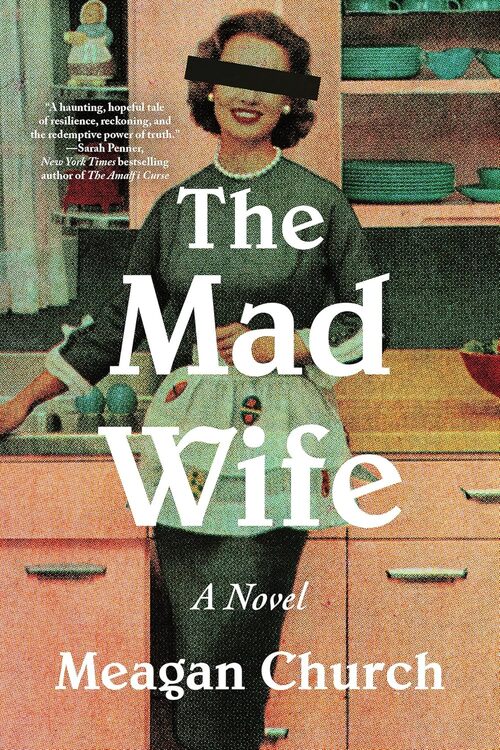
Lulu Mayfield’s gelatin salads are always the talk of any neighborhood soiree. She is a diligent housekeeper with enviable cooking chops. To top it off, she has a doting husband and sweet little boy. Lulu’s got a great community of friends and lives in an idyllic neighborhood. On the surface, she’s got it all. But beneath the polished veneer, her thoughts and obsessions run far darker than anyone realizes. Her incessant focus on calculating how many of those green loyalty stamps she needs to buy the next hot household good? Innocent enough. But her strong desire not to have a second child anytime soon, and her fixation on the strange couple that has moved in across the street? Those are a greater cause for worry. In Meagan Church’s THE MAD WIFE, we follow Lulu as she slogs through the trenches of what appears to be pre-partum depression and the horrors of her post-partum circumstances and very non-existent control over their outcome.
Church fairly disclaims that THE MAD WIFE is a heavy read and acknowledges that every interested reader may not be in the right headspace to tackle it. It’s important to thoughtfully acknowledge and reflect upon this foreword before digging into the book, because it is by no means a light or fun read. (Trigger warnings are listed at the end to help some readers determine fit.) Rather, it is a biting commentary on health management practices women endured not that many decades ago. THE MAD WIFE is designed to make you think, make you mad, and incite you to action. Given that, Lulu is not always the most likable or sympathetic protagonist, and the main plotline’s pace is not always the most pulse-pounding.
Readers who aren’t deterred by a more somber and heart-wrenching topic will find that Church intentionally lays a foundation for us to understand Lulu’s mindset. Lulu’s psyche slowly erodes as her obsessions magnify and shapeshift. Most of THE MAD WIFE is spent exploring this, and the shocking, unpredictable twists and turns start coming during the last quarter of the novel. Given Church’s care to slowly unravel Lulu’s innermost thoughts and struggles, the ending feels far more rushed and surface-level by comparison. Some readers may feel frustrated that one major plotline related to the strange neighbors wasn’t wrapped up in a very meaningful manner, or question how another major character’s growth and compassion developed. The ending feels unrealistically tidy, given the messiness of trauma that otherwise wallops Lulu throughout the rest of the novel.
On the whole, THE MAD WIFE is a simmering, slow-burning read for women’s literary fans interested in immersing themselves in an unfortunate time in history for both women’s rights and healthcare.
Trigger warnings follow below.
***
Trigger warnings include: mental health, suicide, child death, and medical misdiagnosis.
From bestselling author Meagan Church comes a haunting exploration of identity, motherhood, and the suffocating grip of societal expectations that will leave you questioning the lives we build—and the lies we live.
They called it hysteria. She called it survival.
Lulu Mayfield has spent the last five years molding herself into the perfect 1950s housewife. Despite the tragic memories that haunt her and the weight of exhausting expectations, she keeps her husband happy, her household running, and her gelatin salads the talk of the neighborhood. But after she gives birth to her second child, Lulu's carefully crafted life begins to unravel.
When a new neighbor, Bitsy, moves in, Lulu suspects that something darker lurks behind the woman's constant smile. As her fixation on Bitsy deepens, Lulu is drawn into a web of unsettling truths that threaten to expose the cracks in her own life. The more she uncovers about Bitsy, the more she questions everything she thought she knew—and soon, others begin questioning her sanity. But is Lulu truly losing her mind? Or is she on the verge of discovering a reality too terrifying to accept?
In the vein of The Bell Jar and The Hours, The Mad Wife weaves domestic drama with psychological suspense, so poignant and immersive, you won't want to put it down.










 © 2003-2026