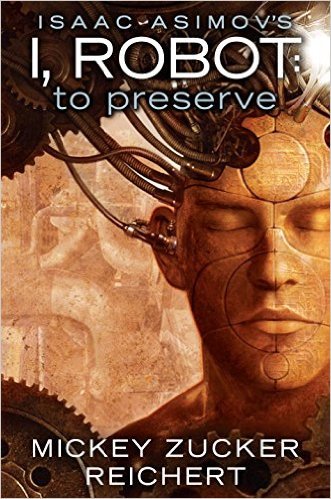
Dr. Susan Calvin's life has been hell for the past two years: her father and her fiancé were both murdered because of her father's involvement with The United States Robots and Mechanical Men Inc. Susan only aspires to an uneventful life, working at her chosen profession, but it was not to be in the near future. Emergency alarms go off at the hospital where Susan works, she rushes to the premises, only to see a colleague has been murdered, and Nate has been arrested. Nate, her friend in need, Nate, the humanoid positronic robot that almost no one knows is a lowly worker at the hospital. Nate is indistinguishable from humans, and he is only one of two of his kind remaining... Susan knows Nate cannot be the killer; it's against his programming. The first law of robotics states that "A robot may not injure a human being or, through inaction, allow a human being to come to harm"; it's immutable. Nate cannot lie either, but he cannot say for sure if he did it. Then the doctor who designed and programmed Nate's brain is held accountable for the murder. Susan must help her friends, but her boss is adamant in his refusal to let her have some free time, and Susan quits.
Occasional SciFi readers, such as myself, need not fear that their eyes are going to glaze over: Mickey Zucker Reichert is clear and succinct in relating technical stuff, as well as the events from the previous books, and her imagining of a New York City in 2037 is entirely believable. A feeling of authenticity permeates I, ROBOT: TO PRESERVE. Whether the hospital environment, the police work, the robots, everything feels real. The characters all ring true, and Susan is a heroine anyone can relate to. The author strikes the perfect balance between suspense and SciFi, with an added pinch of romance thrown in.
I, ROBOT: TO PRESERVE is a terribly exciting story. It grabs you from the opening chapter and never lets go. What I felt really distinguishes ISAAC ASIMOV'S I, ROBOT: TO PRESERVE from a lot of what is out there is the exceptional quality of the writing: the richness of the vocabulary, flawless syntax (and not one four letter curse word in the whole book!). I was reminded of John Le Carre in the sense of an author's complete mastery of her writing skills. The story flows seamlessly, every character possesses its own unique voice, every detail is crystal clear, all the while keeping the reader completely engrossed in the story. My only regret is not having known about the two previous books. The legacy of the great Isaac Asimov is safe while in the extremely capable hands of Mickey Zucker Reichert; one can only hope for more.
No excerpt available.






 © 2003-2026