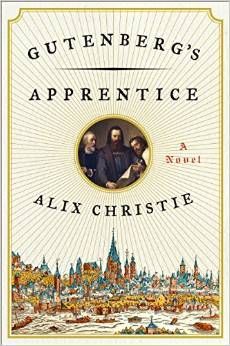
Peter Schoeffer is more than disappointed by his foster father's decree that he leave the work he has been doing in Paris to return home to Mainz. Peter had been on the brink of success as a scribe but now finds himself instead a lowly apprentice to Johann Gutenberg, helping create the printing press. However, Peter soon finds himself torn between his work for Gutenberg and his loyalty to his foster father and Gutenberg's benefactor, Johann Fust.
As a book lover, I truly appreciate the invention of the printing press and so I was very excited about the prospect of reading GUTENBERG'S APPRENTICE. However, the wealth of historical detail is a bit overwhelming to someone not as familiar with the time period and I found myself researching the history in order to better appreciate Alix Christie's story.
Alix Christie sheds light on some of the darker aspects surrounding the invention of the printing press. I love the vivid depictions of the scribes and their meticulous attention to getting every letter and word perfectly correct. In fact, the descriptions made me realize some of the art we have lost by gaining the volume of literature we have as a result of Gutenberg's press.
GUTENBERG'S APPRENTICE is a carefully researched story that clearly conveys the politics surrounding the invention of the printing press. While the details are quite thorough, the characters themselves are not as appealing and this may detract some from fully appreciating the scope of GUTENBERG'S APPRENTICE. Readers looking to deepen the knowledge they already have regarding the printing press will probably best appreciate the intricate complexity of Alix Christie's tale.
No excerpt available.













 © 2003-2026