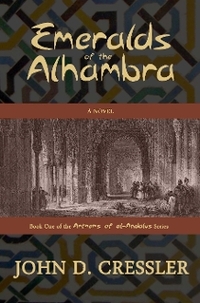
EMERALDS OF THE ALHAMBRA is a sweeping love story that brings a Christian knight and a Sufi Muslim princess together against all odds. Sir William Chandon fought valiantly against the Moors at the battle of Jaén, but it was not enough. The Moors recaptured the city they'd lost to the Christians over a hundred years ago. Chandon is sent to the Alhambra as a war prize for the Sultan. Such a well- known and powerful knight will make a useful pawn in the precarious balance of power. Intent on influencing Chandon's view of Muslims, the Sultan treats Chandon as an honored guest. He even assigns Chandon a tutor to learn Arabic; the beautiful and intelligent Layla al-Khatib, daughter of the Grand Vizier to the Sultan. Chandon and Layla quickly look past the differences of their language, culture, and religions to find a love greater than any they'd ever known. But can these lovers defy the expectations of a world divided by religious differences?
The political scope of EMERALDS OF THE ALHAMBRA is very broad as it encompasses most of Europe and parts of Africa and the Middle East. The Castilian Civil War (1367-1369) created uneasy alliances as all sides vie for power inside the fertile lands of Spain. The wealth of Granada and the Spanish Moors was greatly needed by King Pedro of Castile to maintain his throne against his half-brother. But the alliance with 'infidels' creates an even greater threat; the Roman Catholic Church. I have to say that this is a lot of information to keep track of, but one of my favorite parts of this book was the handy reference pages. There is a character list, an alliance list, maps, pictures of the Alhambra, a glossary of terms, a pronunciation guide, and a historical primer. Without these quick and easily followed references, the large-scale political maneuverings would be slightly overwhelming.
Author John D. Cressler spends a lot of time detailing the architecture and history of the Alhambra. As someone who's been to the Alhambra, I cannot begin to express how beautiful it is. It is without a doubt one of the most awe- inspiring sights I have been privileged to see. Reading about it, just doesn't capture the sheer majesty, but Cressler is gracious enough to include pictures. I was constantly flipping between his written passages of detail and the pictures at the back of the book.
Written in third person, present tense, EMERALDS OF THE ALHAMBRA is quick and visual. For those who read screenplays, Cressler's style will feel familiar and is easily adjusted to. If on the other hand, you're a reader who reads mainly the more traditional third person past, this verb tense will take some adjustment. There are positives; immediate action and detailed setting from a more cinematic viewpoint.
There is much I love about EMERALDS OF THE ALHAMBRA, the historical detail and the expansive views of multiple empires that are represented. When reading this book keep an open mind about the different religions that the author portrays. He does appear to sympathize with the Muslim religion and other religions are more stereotypical in their representation.
All that said, Chandon and Layla's love is the heart of the story and their struggle to love each other openly and without shame or judgment is one of beauty and sadness. Even though EMERALDS OF THE ALHAMBRA takes place over six hundred years ago, it is still culturally relevant for our society. Read with a deep interest in history, an open and tolerant mind, and box of tissues for the sweeping end.
For hundreds of years, Christians, Muslims and Jews
lived together in peace, sharing languages and customs, and
embracing a level of tolerance and mutual respect unheard of
today. Working together, these three peoples spawned one of
the great intellectual and cultural flowerings of history in
medieval Spain.
Historical novel Emeralds of the Alhambra reawakens this
remarkable era via the relationship between William Chandon,
a wounded Christian knight brought to the Sultan's court in
Granada, and the strong–willed Layla al–Khatib,
who is on a quest to become the first female Sufi Muslim
mystic in a male–dominated society. As Chandon's
influence at court grows, he becomes trapped between his
forbidden love for Layla, his Christian heritage, the
demands of chivalry, and political expediency. Chandon must
make a choice between love and honor, war and peace, life
and death, a choice which ultimately will seal Granada's
fate as the last surviving stronghold of Muslim Spain.
The novel is set in Granada at the resplendent Alhambra
Palace during the Castilian Civil War (1367–1369), a
time when Muslims took up their swords to fight alongside
Christians. Emeralds of the Alhambra is the first book in
the Anthems of al–Andalus series.
EXCERPT
Slash of Crimson
A steady, warm drizzle falls through the night, ending
just after daybreak, slaking the thirst of the magical
garden. The lush terraced earth exhales, refreshed and
jubilant. The cypress roots sense their opportunity and
begin anew to worm vertically into the softened soil. Their
coffers bulging, the wind–tilled reflecting pools
offer a warm welcome to their long–lost cousins. The
gray and purple marbled sky has split open in several rough
patches, the sun's streaky yellow rays brazenly stretching
through down to the earth, brushed in with egg yokes. The
bird–gossip is boisterous, bawdy, an avian shouting
match almost deafening in its enthusiasm. All is dark, damp
and new. Glistening. Beads of sweat cling stubbornly to the
canary rose petals and ruby cannas lilies, who luxuriate in
the humid air, resisting the urge to dog–shake them to
the ground.
Aisha's leisurely crunch upon the pea gravel path is
echoed by Musa and Yazdan. The two bodyguards walk to either
side of her, a half pace behind, as if she is their worry.
Their eyes gauge the fog–tinged landscape, sweeping
the garden for any hints of mischief, signs of danger.
Aisha's eyes lazily track about as she day–dreams. An
especially generous buffer of thirty paces separates the
three chaperones from their charges, ample space to enable
the cacophony of fountain splash and birdsong to render the
lovers' conversation private.
To their left are rose beds in voluptuous full bloom,
dozens of interspersed red, yellow, white and pink blossoms.
A pleasing musky, spicy, citrus scent hangs heavy in the
moist air. To their right a head–high, sculpted
cypress hedge lines the gravel path, marked by periodic
keyhole–shaped privacy niches.
They walk deeper into the Partal Gardens, listening to
the birdsong and basking in the garden's simple harmony.
Chandon is the first to break the silence.
"Your father told me that we may ride together on
Wednesday. Provided, of course, our favorite twosome
accompanies us." He grins.
She answers with a smile. "Yes, he mentioned it last
night. That will be fun. I miss my riding. Before my Sufi
training began, I used to roam the Vega several times a week."
"The Vega is a wonderful place to ride. Blue is a fine
stallion, fast and proud. I have never ridden his equal."
"He was one of my father's favorites. He has ancient
Arabian blood lines, you know, one of the finest Andalusians
in the kingdom. However, I must warn you, sir, that my Afán
has never been bested."
He laughs. "We shall see, my Lady, we shall see. Your
Afán has yet to challenge Blue." He offers a coy, mock
frown. "I am afraid for poor Musa and Yazdan. I suspect
their stallions will not be able to keep up with us." They
share a knowing look, simultaneously grin, stroll on in silence.









 © 2003-2026