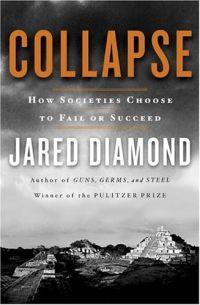
The follow up to his previous work, Guns, Germs & Steel, Diamond focuses in COLLAPSE not on how and why societies develop, but how they fall apart. His thesis being that environmental change is primary cause of societal collapse, and often times those changes are caused by the society itself.
As with Guns, Germs & Steel, COLLAPSE is an explanation of a thesis along with numerous examples from human history. In his prior work his meticulous style occasionally bordered on the pedantic, in this book it becomes downright horrific. The book reduces to a series of disaster stories, describing and analyzing how entire civilizations fall apart. The stories are compelling, in the same way that train wrecks are. By the time you get to his discussion of modern civilization you are almost scared to see what he has to say.
COLLAPSE is as good a read, if not better than, Guns, Germs & Steel. It is not a happy book however. Some history books are great for curling up in a chair with a glass of scotch - by the end of COLLAPSE, you will be sucking gin straight from the bottle. It's fascinating, compelling, depressing and enlightening, all at the same time.
In his million-copy bestseller Guns, Germs, and Steel,
Jared Diamond examined how and why Western civilizations
developed the
technologies and immunities that allowed them to dominate
much of the
world. Now in this brilliant companion volume, Diamond
probes the other
side of the equation: What caused some of the great
civilizations of
the past to collapse into ruin, and what can we learn from
their fates?
As in Guns, Germs, and Steel, Diamond weaves an
all-encompassing global thesis through a series of fascinating
historical-cultural narratives. Moving from the Polynesian
cultures on
Easter Island to the flourishing American civilizations of
the Anasazi
and the Maya and finally to the doomed Viking colony on
Greenland,
Diamond traces the fundamental pattern of catastrophe.
Environmental
damage, climate change, rapid population growth, and unwise
political
choices were all factors in the demise of these societies,
but other
societies found solutions and persisted. Similar problems
face us today
and have already brought disaster to Rwanda and Haiti, even
as China
and Australia are trying to cope in innovative ways. Despite
our own
society’s apparently inexhaustible wealth and unrivaled
political
power, ominous warning signs have begun to emerge even in
ecologically
robust areas like Montana.
Brilliant, illuminating,
and immensely absorbing, Collapse
is destined to take its place as one of the essential books
of our
time, raising the urgent question: How can our world best avoid
committing ecological suicide?













 © 2003-2026