
Purchase
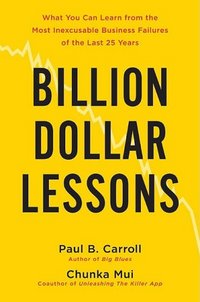
What You Can Learn From The Most Inexcusable Business Failures Of The Last 25 Years
Portfolio Hardcover
September 2008
On Sale: September 11, 2008
310 pages
ISBN: 1591842190
EAN: 9781591842194
Hardcover
Add to Wish List
Non-Fiction
Welcome to Business Failure 101
In the 1960s, IBM CEO Tom Watson called an executive into his office after his venture lost $10 million. Watson asked the man if he knew why he’d been called in. The man said he assumed he was being fired. Watson told him, “Fired? Hell, I spent $10 million educating you. I just want to be sure you learned the right lessons.”
In Billion-Dollar Lessons, Paul Carroll and Chunka Mui draw on research into more than 750 business failures to reveal the misguided tactics that mire companies again and again. There are thousands of books about successful companies but virtually none about the lessons to be learned from those that crash and burn.
Lesson One: The Cold Hard Facts
Between 1981 and 2006, 423 major publicly held U.S. companies with combined assets totaling $1.5 trillion filed for bankruptcy. Hundreds more took huge write-offs, discontinued major operations, or were acquired under duress. Again and again, companies follow the same wrong-headed strategies that brought down businesses in the past. The sub-prime mortgage crisis that cost companies tens of billions of dollars in 2007 and 2008 echoes the ill-conceived strategies that pushed Green Tree Financial and Conseco into bankruptcy years earlier. Tom Watson’s executive’s $10 million lesson seems cheap by comparison.
Lesson Two: Failure Patterns
Carroll and Mui found that the number one cause of failure was misguided strategy—not sloppy execution, poor leadership, or bad luck. These strategic errors fall into seven categories, including:
* Pursuing nonexistent synergies: Quaker Oats’ purchase of Snapple was supposed to capitalize on distribution synergies but instead led to a $1.7 billion write-off.
* Moving into an “adjacent” market that isn’t really adjacent: Avon decided its “culture of caring” qualified it to operate retirement homes. Subsequent write-offs totaled $545 million.
* Buying more problems than efficiencies through misguided consolidation: Despite pioneering the discount department store years before Sam Walton came along, Ames Department Stores flubbed consolidation efforts, landing in bankruptcy twice before eventually liquidating.
Lesson Three: Avoid Making the Same Mistakes
But there’s light at the end of the tunnel: Billion-Dollar Lessons provides proven methods that managers, boards, and even investors can adopt to avoid making the same mistakes. While there’s no way to guarantee success, this book draws on vivid, off-the-beaten-track examples to help you avoid failure by showing you how to thoroughly assess potentially disastrous strategies before they bring your company down.
Required Reading
Think of Billion-Dollar Lessons as the flip side of Good to Great, but just as eye- opening and essential as that business classic. There’s enormous value in learning from companies that lost millions (if not billions) in pursuit of strategies that led to spectacular flameouts. Everyone makes mistakes, but why make the same mistakes over and over?
 Media BuzzMarketplace - PRI - October 23, 2008
| 









 © 2003-2026