
Purchase
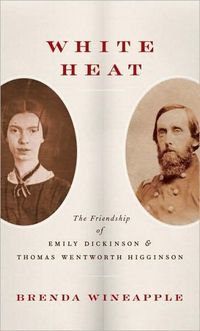
The Friendship of Emily Dickinson and Thomas Wentworth Higginson
Knopf
August 2008
On Sale: August 12, 2008
432 pages
ISBN: 1400044014
EAN: 9781400044016
Hardcover
Add to Wish List
Non-Fiction History
The first book to portray one of the most remarkable friendships in American letters, that of Emily Dickinson— recluse, poet—and Thomas Wentworth Higginson, minister, literary figure, active abolitionist. Their friendship began in 1862. The Civil War was raging. Dickinson was thirty-one; Higginson, thirty-eight. A former pastor at the Free Church of Worcester, Massachusetts, he wrote often for the cultural magazine of the day, The Atlantic Monthly—on gymnastics, women’s rights, and slavery. His article “Letter to a Young Contributor” gave advice to readers who wanted to write for the magazine and offered tips on how to submit one’s work (“use black ink, good pens, white paper”). Among the letters Higginson received in response was one scrawled in looping, difficult handwriting. Four poems were enclosed in a smaller envelope. He deciphered the scribble: “Are you too deeply occupied to say if my Verse is alive?” Higginson read the poems. The writing was unique, uncategorizable. It was clear to him that this was “a wholly new and original poetic genius,” and the memory of that moment stayed with him when he wrote about it thirty years later. Emily Dickinson’s question inaugurated one of the least likely correspondences in American letters—between a man who ran guns to Kansas, backed John Brown, and would soon command the first Union regiment of black soldiers, and the eremitic, elusive poet who cannily told him she did not cross her “Father’s ground to any House or town.” For the next quarter century, until her death in 1886, Dickinson sent Higginson dazzling poems, almost one hundred of them—many of them her best. Their metrical forms were unusual, their punctuation unpredictable, their images elliptical, innovative, unsentimental. Poetry torn up by the roots, Higginson later said, that “gives the sudden transitions.” Dickinson was a genius of the faux-naïf variety, reclusive to be sure but more savvy than one might imagine, more self- conscious and sly, and certainly aware of her outsize talent. “Dare you see a Soul at the ‘White Heat’?” she wondered. She dared, and he did. In this shimmering, revelatory work, Brenda Wineapple re- creates the extraordinary, delicate friendship that led to the publication of Dickinson’s poetry. And though she and Higginson met face-to-face only twice (he had never met anyone “who drained my nerve power so much,” he said), their friendship reveals much about Dickinson, throwing light onto both the darkened door of the poet’s imagination and a corner of the noisy century that she and Colonel Higginson shared. White Heat is about poetry, politics, and love; it is, as well, a story of seclusion and engagement, isolation and activism—and the way they were related—in the roiling America of the nineteenth century.
 Media BuzzFresh Air - NPR - December 17, 2008
Diane Rehm Show - NPR - November 27, 2008
Diane Rehm Show - NPR - October 27, 2008
Fresh Air - NPR - September 3, 2008
| 





 © 2003-2026