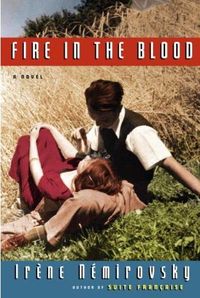
Here is a missing piece of the remarkable posthumous legacy of Irène Némirovsky, author of the internationally acclaimed Suite Française.
Written in 1941, the manuscript of Fire in the Blood was entrusted in pieces to family and a friend when the author was sent to her death at Auschwitz. The novel—only now assembled in its entirety—teems with the intertwined lives of an insular French village in the years before the war, when “peace” was less important as a political state than as a coveted personal condition: the untroubled pinnacle of happiness.
At the center of the tale is Silvio: in his younger years he fled the boredom of the village and made a life of travel and adventure. Now he’s returned, living in a farmer’s hovel in the middle of the woods, and, much to his family’s chagrin, perfectly content with his solitude.
But when he attends the wedding of his favorite young cousin—“she has the thing that, when I was young, I used to value most in women: she has fire”—Silvio begins to be drawn back into the complicated life of this small town. As his narration unfolds, we are given an intimate picture of the loves and infidelities, the scandals, the youthful ardor and regrets of age that tie Silvio to the long-guarded secrets of the past.
Némirovsky wrote with a crystalline understanding of the pretensions and protections of society, and of the varied workings of the human heart, in language as evocative of a vanished era as of the emotional and moral ambiguities in her characters’ lives. All of which was evident in Suite Française—and abundantly evident again in this powerful, passionate novel.













 © 2003-2026