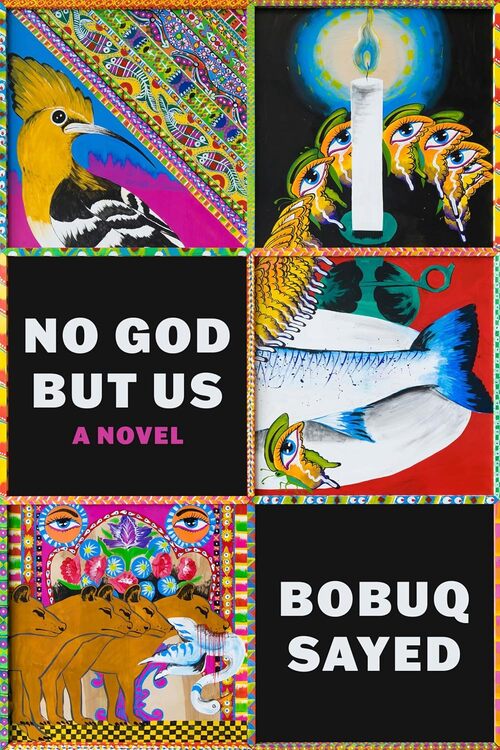
No God but Us is the debut novel by Bobuq
Sayed. The author is Australian-born, of Afghan origin,
and is now based in New York. The author has been writing
for almost a decade, and this is their debut fiction
novel.
The story follows two Afghan men who have left their
country by force or by choice and are now in Turkey,
awaiting a future where they can be themselves, love freely,
and reunite with their families, who are dispersed in other
countries. We follow Mansur, who flees Iran after being
threatened with exposure by a family member. Mansur reaches
Turkey with the help of a young man he has fallen in love
with. Once in Turkey, Mansur faces a different struggle: he
is still wary of being open about his sexuality but not as
closeted as he was in his homeland. He befriends members of
a support group for the LGBTQ community who also help him
navigate the asylum process to Europe. The road to Europe is
filled with compromises and struggle for Mansur, as he loses
hope day by day of reuniting with the boy he left in Iran,
whose memory haunts him daily.
We also meet Delbar, the American-born son of immigrants
in a Washington suburb who is outed by his nosy, overactive
community. He flees to Turkey with his aunt, who provides
him with a safe place and a supportive community. However,
with the upcoming elections and the threat to his
aunt’s stay in the country, his future in Turkey
becomes uncertain. Delbar, unburdened by financial struggle,
immerses himself in university life where his aunt works.
As time passes, both struggle to find their place in this
displaced world, separated from their families
When Delbar and Mansur's paths cross, Delbar is drawn to
the stoic, mysterious Mansur. As time goes on, they are both
struggling to find their place in this new displace world
away from home and their beloved family members. As the
story progresses, their paths diverge, and their fates
unfold differently. The ending of their stories is both sad
and abrupt; it was unavoidable but reflects how
relationships shape one's future and place in society. The
story illuminates how people are forced to leave their
families and homelands because of their sexuality. Sometimes
this opens a new world and creates a new family, but often,
as shown here, it is a tale of survival and the hardships
they endure simply to survive and find a place they can call
home.
A story of belonging, survival, and yearning for a
forbidden love; yet even in places where such love is
possible, the struggle to be oneself remains profound. If
this interests you, do pick up a copy of No God, But
Us, a title that plays on language and punctuation to
reflect a world where every person struggles simply to
survive.
In this seductive, provocative debut, two gay Afghan men—cast out of their respective countries of birth by circumstances beyond their control—collide in Istanbul, a city that will test their willingness to sacrifice everything for the ones they love.
When Delbar—a hapless twenty‑something with dreams of becoming a drag queen—is spectacularly outed, he flees the insular immigrant‑dense suburbs of Washington, DC to seek refuge with his sympathetic aunt in Istanbul. There, he discovers a vibrant community of dissidents, sex workers, activists, poets, and heretics. Among them are Leif and his boyfriend, Mansur, with whom Delbar quickly develops a blazing fascination.
But Mansur also nurses a wounded heart, having left his own family, and his first love, behind in Iran. This time, Mansur’s learned not to dream bigger than his own survival. He’ll keep a low profile, work hard to send money back, and remain faithful to Leif—at least until his refugee status is granted.
When riot police descend on attendees of the annual Istanbul Pride march, Mansur and Delbar are thrust into dangerous proximity. With the country surging into authoritarianism, each person must ask themselves: what constitutes a life well‑lived, and how high is the price of freedom?
Told through the alternating viewpoints of Delbar and Mansur, Bobuq Sayed’s debut is a story of borders and boundaries transgressed, and a deeply engrossing exploration of what it means to make a home at the margins of society. At once an immigrant family saga, a thwarted love story, and a searing portrait of politics made intimately personal, No God but Us is an ambitious introduction to a bold new voice.
EXCERPT
Dana
2023: The Hour Approaches
It was the hour of the Maintenance Shag, and Dana had to hurry home. In spite of her best efforts, the morning was getting away from her, and she had much work to do in the house before she could flop down in front of her husband in choice underwear (i.e., those that hadn’t gotten gray and saggy in the wash), the door to their bedroom carefully bolted, and say, Ravish me, honey.
People in their forties—in her case, thirty‑nine, but she was close enough—were supposed to ravish their partners still, after sixteen years of marriage, weren’t they? Popular media didn’t shed much light on such bedroom maneuvers; it was more interested in people in their twenties and early thirties, tops. But they had to, surely? And, more important, how often should they endeavor toward such ravishment? Their gimlet‑eyed marriage counselor—or rather, the IG marriage therapist whose advice they could access for free (all they could afford given their household’s straitened purse strings)—had suggested that for couples in their age bracket (old, beaten‑down millennials) who’d “been together for some time,” once every two weeks would be appropriate to “maintain the fire”—although fire was certainly optimistic phrasing at this stage, at least in Dana’s unbiased, unprofessional opinion.
So here they were, headed for their third scheduled biweekly ravishment.
But first, tomatoes. Dana stood blinking in the ugly white light of the big‑box retailer in front of shelves of jarred and canned tomatoes: paste, whole, pureed, stewed, diced. Which type of tomato went in Bolognese? Her phone was dead and she couldn’t check. She wasn’t a cook; almost everything she made came from a box. And the food had to be home‑cooked today, because Shobana, her daughter Bex’s close friend and possible love interest, was coming over for dinner—a first for Bex, who so far had preferred to keep her friends confined to the Cheng‑Smileys’ gaming den / basement, and out of the house before 6 p.m.
It was deeply destabilizing to her that sixteen‑year‑old Bex might have a love interest—Bex was a child. It felt like only yesterday they had been watching cartoons together on Saturdays and discussing the merits of being a mermaid versus a fairy princess (Bex was firmly Camp Mermaid—she was part nautical, that one), and not too long ago she’d been a sweet toddler who called Dana “Mummy,” which always made Dana think, somewhat incongruously, of Prince Harry. The adorable way Bex had puckered her lips around the consonants made her heart ache with nostalgia.
The simple joy gave way to something else, something dimmer. For reasons she couldn’t quite articulate, everything was shot through with anxiety these days, even the good emotions and memories. Or maybe the truth is, you’re anxious because you’ve forgotten how to be around them.
Her fingers flickered back and forth between the diced and pureed
options, the varietals:
Napoli, Roma
DOP San Marzano
Santorini, too
Just words in a haiku to Dana, albeit ones with real‑world consequences that, to Bex at least, were life and death. Her mother had to impress Shobana, whose mother, Selvi, was some fancy litigator and amateur chef on top of being a single mom, or else. Bex only used italics when it was a matter of life and death (i.e., her mother’s).
If Bex killed Dana—Dana closed her eyes and sighed. She couldn’t begin to imagine the chaos that would unravel. Not that she actually thought her daughter would murder her, but hypothetically speaking, if she did decide to off Dana, where would that leave Nigel? How would he cope? Just yesterday morning, she’d caught him—when he thought she wasn’t looking—eating around a piece of bread she knew was moldy. She hadn’t had the chance to toss it out before he put it in his maw, probably because Bex was screaming and Emmie had jammed a fork into Gill’s curls and Dana was coming in to break up that fight after a dreadful night shift, but should it really be on her to make sure he took care of himself? What happened to Old Nigel, her can‑do‑any‑ thing man? Or was Nigel, in his infinite stubbornness, trying to prove a point—to himself and, by extension, to her? That he would endure. That he was a survivor, by eating moldy bread in spite of his allergies. Or was it because they were at the end of the month and money was tight? Even so, there was no need for such frugality, such stoicism, such acts of false heroism, really—not yet, even though they flirted with the danger of financial ruin on the daily these days. All they needed was a major accident, to be honest. He should not have been so cavalier around mold—unless this was some kind of statement, a slow, passive‑aggressive flirtation with death?
Maybe this was on her for marrying a man named Nigel. Nigel: a name one either grew into or dragged through adulthood like roadkill. And to think, back in the early days of their courtship, she had cried that name out in passion—heat in every syllable. Nigel. It was almost unthinkable now. Because there was nothing about the name that should inflame one’s loins. Yet, somehow, once upon a time in Dana’s life, “Nigel” had been spicy.
Once upon a time, Nigel had been her everything. They had been so happy. So close. So in sync. But now—
Dana grabbed two cans of each type of tomato on offer, threw them in her cart, and started making her way home. The kids would be home from soccer practice in exactly two and a half hours, and the small window of opportunity to maintain matrimonial status quo in the Cheng‑Smiley household would be over for the weekend. She had to hurry; her ravishment awaited.










 © 2003-2026