Having previously been sent on deep dives into Google
Images by reading historical fiction based on real persons,
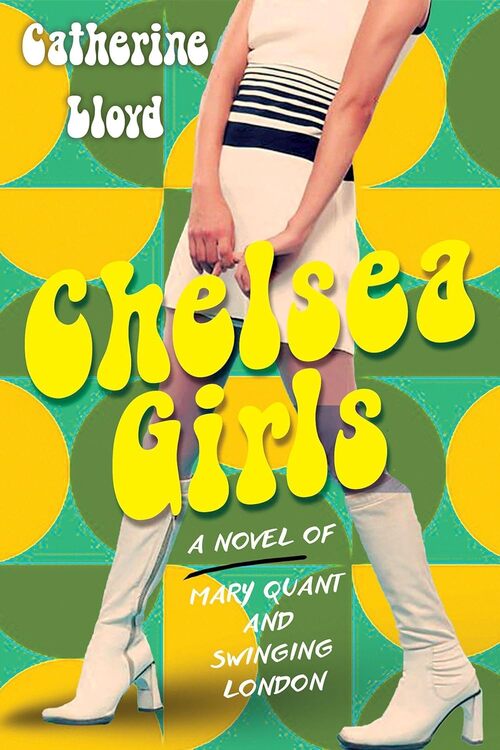
I found it happening again. CHELSEA GIRLS looks at fashion
in London. Mary Quant was a self-made fashion designer, and
her iconic designs and clothing lines changed life for many
during the 1960s and 1970s. Indeed, some of the bold
patterns of flowers crop up regularly on the clothing
rails.
The fascinating tale is told not through Mary's eyes,
which is a slight let-down, but through those of three
fictional women. Chrissie Walker, a fellow student at
Goldsmiths arts college, becomes her first friend and
employee. Chrissie soon comes to resent that Mary’s
bold designs take off, making clothes lighter, brighter, and
easier to move in, with cute accessories. I felt this was
overstated, as there was nothing to stop Chrissie from
making clothes and selling them to Mary for her shop; it was
selling out of items every day, and she started by sourcing
from many women.
Alexander Plunket Greene, Mary’s partner, was a
driving force behind her business, and he invested with a
lawyer-photographer in a building on King’s Road where
their shop Bazaar opened. This area was dingy at the time,
and Chrissie was nervous about walking there after dark. But
Alexander opened a jazz club and restaurant, so the
socialites soon flocked to that area by night, making Bazaar
stay open later to catch custom.
The socialites were essential to the economics of the
trade. Reluctant debutante Daphne, determined not to be the
china figurine her mother intended her to be, went to work
modelling Mary’s clothes. She gives us the customer
and model side of the picture, and introduces us to well-
known photographers, the model Twiggy, and musicians
including the Beatles.
Fern, a Cockney girl, also takes to being a model,
representing the ordinary working miss who swoons at the
Beatles and aspires to own a few Mary Quant separates. She
has no idea what JC Penney is, but nor does anyone in
London. The clothing store from the US has to work hard to
get Mary Quant’s attention, then launches Fern across
the States with an extended modelling tour.
This outline demonstrates for us the economics of the
industry at the time, and the difficulties of scaling up.
For instance, Mary is buying men’s clothing materials
to make pinafores at one point. Later, she is asked by a
manufacturer to reduce the number of buttons on a dress, as
one less would be a substantial saving over thousands of
items. The position of women is demonstrably changing.
Sadly, all three girls – Fern is sixteen at first
– have issues with strict or unsupportive parents, who
had survived the war, worked hard, and could not see fashion
as anything but frivolous and perhaps tarty. Well, Mary
Quant was awarded an OBE, and later, though it’s not
mentioned, was made a Dame, the female equivalent of a
knighthood. Mary Quant passed away in 2023.
Catherine Lloyd has previously written a couple of series
of murder mysteries, which may be what gave her the
confidence to invent the young women we meet as types,
rather than concentrate on one actual personage. Her CHELSEA
GIRLS will not replace a memoir but evoke the era, the
changes, and the excitement of the swinging sixties. The
online photos can’t really explain the shock people
felt at seeing young women in mini-skirts.
A glamorous and revealing biographical novel for readers of Renee Rosen, Allison Pataki, and Fiona Davis, starring one of Swinging London’s defining figures, Mary Quant, who made history with the miniskirt, slashed hemlines, and transformed more than fashion, for herself, for her friends, and for a generation.
Post‑war London is a city in flux, with burned‑out buildings serving as vivid reminders of the past. But beneath those scars is a sense of resurging optimism. Chrissie Walker, a new student at Goldsmiths arts college, feels it keenly. So does Mary Quant, the auburn‑haired classmate who becomes Chrissie’s best friend.
Like Chrissie, Mary wants more from life than to nab a husband and settle down. Though shy, Mary shows her daring in subtle ways, including her home‑sewn clothes. Designed to run and move in, her outfits inspire Chrissie and others to reinvent their own style. They also catch the eye of charismatic fellow student Alexander Plunket Greene, who becomes Mary’s partner and helps fund the opening of Bazaar, a King’s Road shop that marks the beginning of an empire.
Dresses with ever‑rising hemlines, skinny‑rib sweaters and Peter Pan collars, boldly patterned tights and scarves—Mary Quant’s “Chelsea look” becomes a sensation among socialites, working‑class girls, and everyone in between. As the miniskirt becomes a global phenomenon, Mary Quant ignites a fashion revolution that transforms everyone in its orbit—including Chrissie, who must reconcile her own ambitions with her friend’s fame, debutante Daphne, whose life opens up in unexpected ways, and Fern, an aspiring model who will become an icon.
In the years that follow, each will deal with the public and personal challenges faced by unconventional women willing to break the rules—and in the process, transform the world.








 © 2003-2026