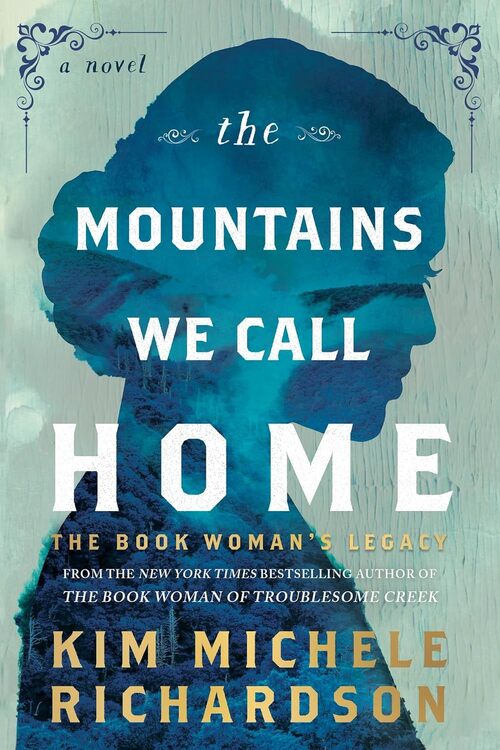
The title is a misnomer, as we don’t see many
mountains in this historical women’s fiction. THE
MOUNTAINS WE CALL HOME refers to the rugged life for cabin
dwellers in Kentucky, caught between a meagre farm and mine
work. However, having found out all about this 1930s life in
the previous two books, we now explore the wider Kentucky of
the 1950s.
To understand this story properly, you’ll need to
have read at least THE BOOK WOMAN OF TROUBLESOME CREEK. We
meet again with the primary character, stuck in a
women’s prison. Cussy Lovett, a determined Packhorse
Librarian bringing books to the hill dwellers, earned a
respectable living and raised her status. She carries a
blood condition that has the effect of making her skin blue.
While her people were technically white, the jealous laws of
her day forbade her to marry someone white or, presumably,
someone who wasn’t white – it is confusing to
think about. When a fine man married Cussy, willing to
support her and the orphaned blue girl Honey she had
adopted, the couple was arrested. Cussy picks up her story,
which was partly told by Honey in the second book, The Book
Woman’s Daughter.
The work is quite troubling and can be hard to read in
one go. Continued examples of neglect, despair, and cruelty
to women inmates will make the reader want to roll up her
sleeves and sort out the situation. Clean water, soap,
disinfectant, and bandages could not have been hard to come
by, yet the men’s prison gets a budget increase while
we’re told the women’s prison is on a shrinking
and meagre budget. The geriatric women prisoners – I
know – have bedsores. You’d have to wonder what
was going through people’s heads to keep these women
in jail.
Cussy turns out to be a ray of hope, bringing literacy to
the trapped women so they can read letters from family.
Later in the story, we get to walk around the fine streets
of Louisville and explore the good works of a Carnegie
Library which serves all people who want to read. Anyone who
values books, literacy, voting, and proper representation
will appreciate the story we are being told. Cussy, showing
us both sides of the picture, sees a harmful aspect to life
that hadn’t really troubled her, for all the
superstition and prejudice she knew on the mountains. THE
MOUNTAINS WE CALL HOME concludes this family’s unusual
tale and reminds us how far we have come, with an
encyclopedia in our phone and an entire library in a small
tablet. Kim Michele Richardson has far too few mules in this
tale, but otherwise, she provides a worthy conclusion.
Meticulously researched and richly detailed with a new cast of absorbing and complex characters, this beautifully rendered, authentic Kentucky tale is gritty and heartbreaking and infused with hope, spirit, and courage known only to those with no way out.
No excerpt available.








 © 2003-2026