THISTLEMARSH Hall is the ancestral home of Mouse Dunne,
who is a Great War nurse. On her grandfather’s death,
she is given leave to return and see to the estate. In this
version of Great Britain, the faerie used to be around quite
a lot, living parallel lives and advising, at times, the
rulers. Now they are absent. The large rambling house in
quiet countryside used to be Faerie- blessed, though
that’s always a dangerous state of affairs.
Mouse, as she’s nicknamed, is the daughter of a
gardener and the lady of the hall. Her parents were
disowned, but Mouse spent a lot of time here. She knows what
it’s like to be an outsider everywhere. The villagers
at nearby Tithe used to have to pay dues to the Faerie King,
so they’re probably glad he’s gone. Thistlemarsh
Hall will be ceded to Mouse as her brother is mentally
disturbed from shell shock. But she has to meet conditions,
or her horrid cousin Carlyle will inherit. Even a war nurse
has to be chaperoned, etc. and the gothic feel increases
throughout the story.
A Faerie statue hidden in the woods comes to life, and
handsome, sly Thornwood offers Mouse a bargain. You
don’t bargain with the Fae, of course. She knows this
very well, and a book of legends assures her they
can’t be trusted. Thornwood can use magic to repair
and clean the crumbling structure and its furnishings, to
meet the conditions. They have a month. Much against her
better judgement, Mouse agrees. Given Mouse does not even
like the place much, servants are already proving impossible
to hire, and the war is foremost in everyone’s minds,
it’s hard for me to understand her motivations. If
Carlyle got the house, he would saddle himself with immense
debt, or else pull it down and rebuild, which might be for
the best. Maybe Mouse is already falling under
enchantment.
The rest of the spooky tale by Moorea Corrigan follows
the frantic efforts to restore the house, against the
remnants of spells and the passage of time. I thought the
cast list was too short, and while it expands near the end,
almost everyone is a Fae, so they follow a set of
characteristics. I also wanted to know more about the wider
world and how the Fae had affected it – Mouse at first
regrets their leaving, but decides later that they would not
have been helpful on battlefields. They are too selfish and
self-obsessed. Could Thornwood be an exception? This might
be classed as a romantasy, but it’s not all that
romantic, with constant mentions of sharp teeth, glamours
and Wild Hunts. Still, handsome is as handsome does.
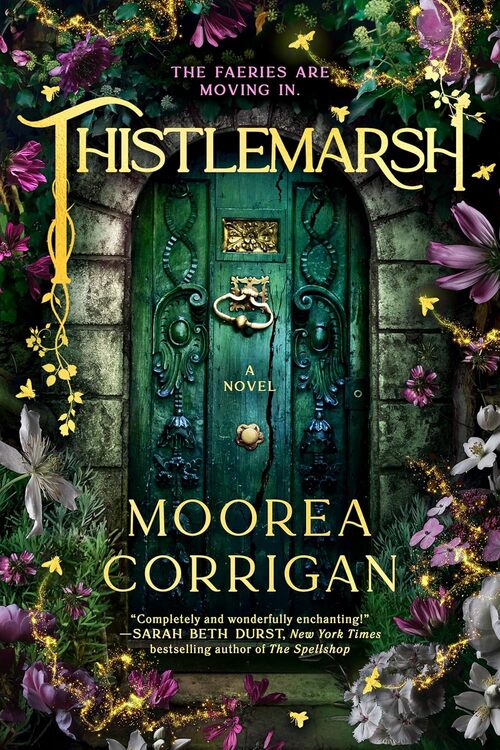
THISTLEMARSH by Moorea Corrigan will be a useful addition to
bookshelves with stories of the Fae.
Faeries disappeared over one hundred years ago, as suddenly as slipping through a doorway. It was only the very foolish, or the very determined, who held out hope for their return.
Welcome to Thistlemarsh—a ramshackle estate where an impoverished orphan and a beguiling Faerie collide in an enchanting novel of love, revenge, and ruin.
In the wake of World War I, the world is a decidedly unmagical place for Mouse Dunne. She once dreamed of becoming a Faerie anthropologist, but with one telegram, her world shattered. At the Battle of the Somme, her cousin’s body disappeared into the mud, and her brother was left with debilitating shell shock. It was time, she knew, to put aside childish dreams.
When Mouse receives news that her uncle has left her the Faerie-blessed Thistlemarsh Hall, a dilapidated manor in the English countryside, she must leave her brother’s side and return to her childhood home to claim her birthright. But there is a catch in her uncle’s offer: If Mouse does not rehabilitate the crumbling house in one month’s time, she will forfeit her inheritance and any hope of caring for her brother.
It quickly becomes clear it’s impossible to repair the manor in the allotted time, until a mysterious Faerie appears with a proposition. He offers to restore Thistlemarsh...for a price. Mouse knows better than to trust a Faerie—especially one so insufferably handsome and arrogant—but she is out of options. There are dark and magical forces at work in the house, and Mouse must confront the ghosts of her past and the secrets of her heart or lose Thistlemarsh, and herself, in the process.







 © 2003-2026