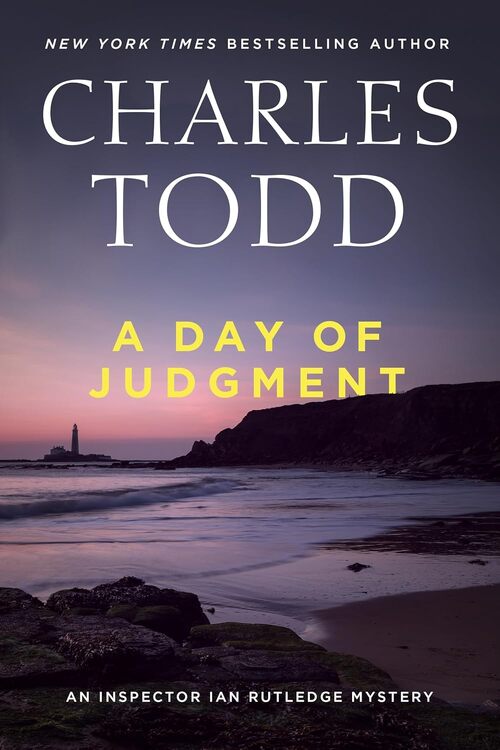
Inspector Ian Rutledge of Scotland Yard takes up his
twenty-fifth case, which occurs during a warm July of 1921.
A DAY OF JUDGEMENT is the first in the series I have read.
The setting shortly after the ending of the Great War is
memorable, as emotions are bitter and losses keenly felt.
Where England meets lowland Scotland on the eastern side
is the Northumberland coastline and the Farne Islands,
including a monastery on the Holy Island of Lindisfarne. We
learn that a boatsman washed up on the tide at a fishing
village. Rutledge is sent by his superiors – driving
up in his Rolls-Royce – because of the proximity to
Lindisfarne. The Anglican Church holds a political sway and
general respect.
Rutledge served in the trench warfare and, like many men,
came home shattered mentally. The author has provided a
ghostly figment of imagination, which Rutledge carries with
him, called Hamish, who makes irascible comments. I suspect
this was a great idea in book one, and by now, the author
can’t dispose of the disembodied voice.
There are few police in the remote area, and the
fishermen stick together and keep order. They also tend to
drink a lot. Rutledge stands out like the proverbial sore
thumb. The story describes each village, inn, church and
rectory as though describing archival photographs, with the
difference that Rutledge then walks inside and converses
with the inhabitants. I found a few Americanisms, such as
calling the ground floor the first floor, but I might have
read a version written to make sense to American readers.
The action is quite ponderous, in a day when the hotel has
the only telephone and newspapers don’t usually reach
the shops. The inspector keeps returning to the hotel to
pick up messages, and he drives from one village to the
next, getting a grand day out in a small boat for a
change.
The dour locals keep recollecting how the Huns used to
sink fishing boats, calling submarine warfare cowardly. We
understand this is tied to the abrupt death, but as they
won’t trust the outside police officer, it’s
hard to see how Rutledge can make headway. He gets on with
enjoying fresh fish and treacle pudding, while some women
find him a good prospect in a land depleted of fit young
men. Charles Todd was half of a writing duo with his late
mother, Caroline Todd, and now continues the series. A DAY
OF JUDGEMENT makes occasional reference to previous cases
but stands well alone. I would be interested to read the
earlier case files. I suggest this novel might be better in
audiobook, for the mix of accents.
No excerpt available.










 © 2003-2026