Venice, 1710, and the Renaissance have brought wealth,
poverty, and debauchery alongside piety. POINSETTIA GIRL, as
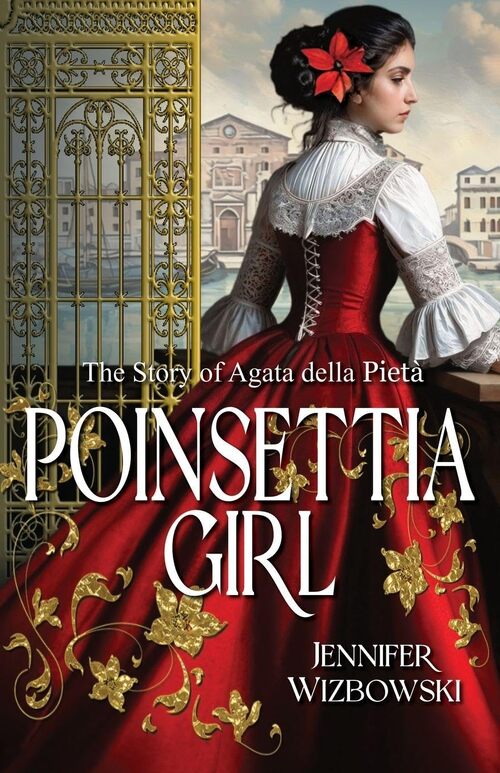
the gorgeous cover shows, features a young soloist singer in
the choir school.
POINSETTIA GIRL is a
fictionalised story of Agata de la Pieta, one of the orphan
girls who became musicians of the Ospedale de la Pieta. This
Orphanage was endowed by the state and the wealthy. Not only
did it save children, but it ensured top-class performers
for Mass and special religious concerts. I’ve
previously enjoyed another story set here, The
Instrumentalist by Harriet Constable, an account of a
violinist who worked alongside Vivaldi. Here we meet the
Maestro. The girls were only allowed to perform music
written especially for the Ospedale, so Vivaldi was kept
busy with compositions.
Either girls were
passed in the gate by unwed mothers, or else they were
brought in later as orphans and assigned to the care of the
Ospedale. While not much is known about Agata, the author
Jennifer Wizbowski has chosen to frame her as coming from a
difficult background. Her father is a dissolute and violent
musician, and her mother dies bearing another child. Fearing
for the little girl’s physical and moral safety, her
loving but elderly Nonna – grandmother – spirits
her away and hands Agata over at the age of ten. The child
does not understand what is happening. This grants us a look
at the watery city of Venice, the Carnevale, women’s
work, and how a funeral was conducted. Once inside the
high walls, all that is lost. Rules, schedules, silence and
prayer fill the days, broken only by music. If girls can
sing or play, they will be trained. If no aptitude arises,
they wash and cook. The only way out seems to be a marriage
proposal – from a wealthy man they can’t have
met, who saw a performance in the church.
With the foundlings Agata shares instructor Elena and
retired singers who now teach, called Discretes. Soloists
get better rooms and treatment, and perform in red and
white, earning the nickname Poinsettia Girls. Agata is going
to have to make choices.
Jennifer Wizbowski
has portrayed a rich city that cared little for its women
and children. Disease and poverty were rife, and the lack of
support drove women without work to less respectable forms
of income. POINSETTIA GIRL was among the highest levels a
poor girl could achieve. I’m delighted that this work
of women’s fiction casts a light on these times. The
detailed novel will be of particular interest to musicians.
Poinsettia Girl is based on the story of Agata de la Pieta, an orphan musician of the Ospedale de la Pieta.
Ten-year-old Agata's world is shaken at the sudden death of her mother. Left only with her egregious father, a working musician in Venice, her ailing grandmother sends her to the well-known orphanage, hidden from everything she's ever known.
Agata auditions for the conservatory style music school where music is both salvation and spectacle. Hidden behind ornate metal grates, adorned with poinsettias in their hair, the singers are veiled in mystery, their ethereal music drawing noble audiences, including gilded young men who see them as treasures-not only for their sound but as coveted marriage prizes.
Just as she reaches the height of her musical journey, a marriage proposal from someone outside the audience tempts her with the promise of a new life-a return to the old neighborhood she's longed for and a home she barely remembers. Torn between the music that has defined her and the hope of belonging to a family, Agata must confront the most profound question of her life: is her purpose rooted in the music that shaped her, or in the love that might free her?










 © 2003-2026