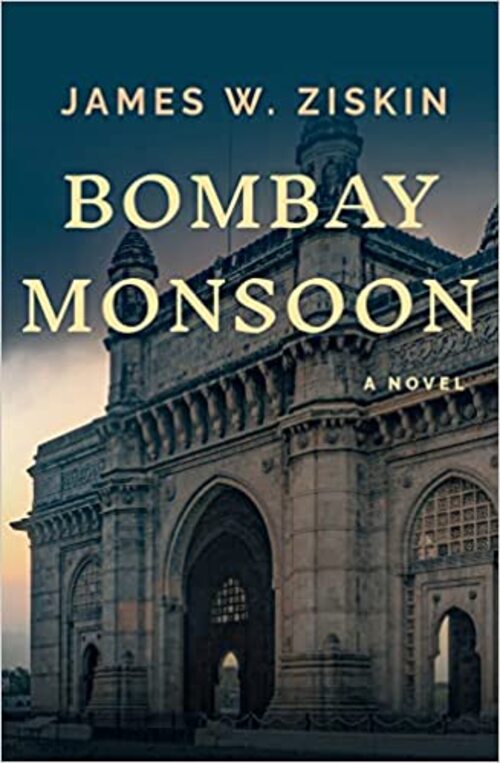
1975 seems like a long time ago. Danny Jacobs, an American journalist who has survived conflict zones, arrives in Bombay, India. He is reporting for a news agency, UNI, in this historical crime story, BOMBAY MONSOON, which looks at culture clash and the effects of an internal turmoil referred to as the Emergency.
Danny has picked up a personal interview with a scruffy terrorist. Shortly afterwards, Prime Minister Indira Gandhi declared a state of emergency because the courts ruled her 1971 election was illegal. The journalists have no power or transport, can’t leave the country and every word they wire back to New York is checked by a censor. This state of affairs was to last 21 months, but nobody knew that at the time. Comparisons are drawn with Nixon leaving office when obliged to do so, both among the foreigners and by Indian people conversing with them.
To keep occupied, with his cook-servant Ramu unaccountably jailed for climbing up the apartment building, presumably to thieve, Danny meets people. Mostly, he just drinks, but then he sets eyes on Sushmita, the girlfriend of his neighbour, Willy Smets. The glamorous couple lives in the penthouse of his apartment building, so it’s hard to refuse invites to a party. Danny doesn’t cover himself in glory during this tale, but his interest in Sushmita quickly becomes more than friendly. Gradually, he becomes aware of crimes, but this only develops in the latter part of the book.
Danny tells himself he isn’t prejudiced despite not knowing a word of the languages spoken on the street. By contrast with some others, for instance, a fellow American, trader Russell Harlan, he’s open-minded. As I mentioned, this was 1975, the past being a good excuse for demonstrating bad attitudes. A nicer couple is Harlan and Brigit. The only one really learning about India and speaking a few languages is the resourceful Janice, UNI’s receptionist and the boss Frank’s secretary. The journalists all seem to be male. For sure, it wasn’t considered a respectable job for women, unless covering society and fashion.
James W. Ziskin richly portrays the foods and drinks of the location, the teeming monsoon rain, and wealth side by side with hardship. Ordinary people have little earning power, so by hiring servants, the journalist keeps a family fed. BOMBAY MONSOON doesn’t hesitate to call that city the biggest slum in the world, and we see that at this time, some people were desperate enough to commit a variety of heinous crimes.
The year is 1975. Danny Jacobs is an ambitious, young American journalist who's just arrived in Bombay for a new assignment. He's soon caught up in the chaos of Prime Minister Indira Gandhi's domestic "Emergency."
Willy Smets is Danny's enigmatic expat neighbor. He's a charming man, but with suspicious connections. As a monsoon drenches Bombay, Danny falls hard for Sushmita, Smets's beguiling and clever lover—and the infatuation is mutual.
"The Emergency," a virtual coup by the prime minister, is only the first twist in the high-stakes drama of Danny's new life in India. The assassination of a police officer by a Marxist extremist, as well as Danny's obsession with the inscrutable Sushmita, conspire to put his career—and life—in jeopardy. And, of course, the temptations of Willy Smets's seductive personality sit squarely at the heart of the matter.
Democracy is fragile and the lines of loyalty and betrayal often cross and cannot be untangled.












 © 2003-2026