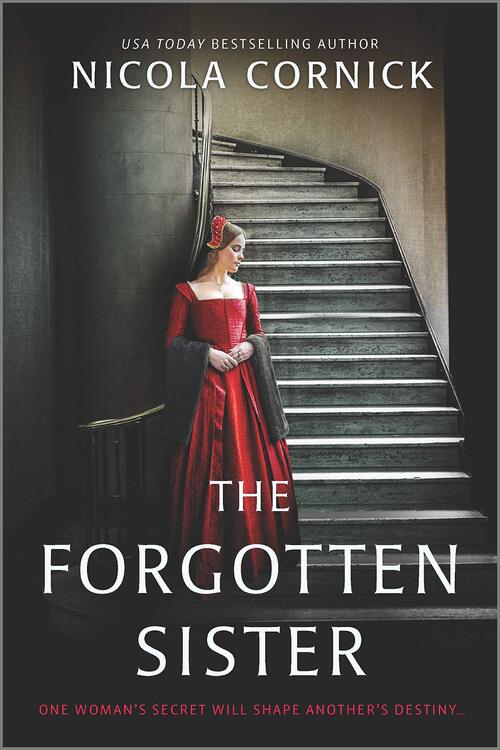
This dual timeline tale presents two women with challenges in and out of their romantic lives. THE FORGOTTEN SISTER starts in modern-day England, with a crass, no-expense-spared wedding, people jumping into swimming pools in their good clothes and all. The bride is upset. The groom is splashing. Our guide, Lizzie Kingdom, is refraining from getting wet, but mostly because she’s afraid of press photos. Her agents would hate them.
To me, Lizzie’s life around vapid self-centred people doing pointless, time-wasting things, is by far the least interesting part of the book. I don’t need to see her spending several pages reading her social media to see what her fans think of her. However, such is her life. She started out in a girl pop band, and is now a children's TV presenter without any relationships. This is to keep her image clean. She does have friends, in particular, the groom mentioned above, Dudley Lester, who is a fading boy band rock star now married to Amelia. In turn, Amelia resents the longtime link between Dudley and Lizzie.
Back in 1560, in a draughty castle on the flat marshy sheep-herding lands of Norfolk, Amy Robsart and her half-sister Anna await the arrival of handsome young Robert Dudley, Earl of Leicester. Anna, the older girl, married respectably last year and this means Amy can set her sights high. As high as an earl. Tudor times are turbulent, and King Henry VIII has been throwing his weight around. Fortunes can be made and lost at the king’s whim. Princess Elizabeth – later to be Queen Elizabeth – considers Robert Dudley a good friend, but she doesn’t want to marry. He might as well wed Amy then, she’s available and well-connected to the wool trade.
You can see how the two sets of characters have similar names, which can sometimes be confusing. Amy Robsart and her husband are real historical figures, and Amy’s tragic death caused a scandal that removed her husband from promotion. In the fiction, not much time passes before Dudley’s wife Amelia dies in a similar manner, throwing the crowd-pleasers into chaos. Young Johnny Robsart, Amelia’s brother, asks Lizzie to help him investigate.
This isn’t a history nor a standard crime story, but undoubtedly, crimes have been committed, and a slight paranormal gift of Lizzie’s to see the past, sheds light further back than expected. If you don’t mind a ghost story in your timeslip tales, Nicola Cornick has provided a densely woven fabric in THE FORGOTTEN SISTER.
In the tradition of the spellbinding historical novels of Philippa Gregory and Kate Morton comes a stunning story based on a real-life Tudor mystery, of a curse that echoes through the centuries and shapes two women’s destinies…
1560: Amy Robsart is trapped in a loveless marriage to Robert Dudley, a member of the court of Queen Elizabeth I. Surrounded by enemies and with nowhere left to turn, Amy hatches a desperate scheme to escape—one with devastating consequences that will echo through the centuries…
Present Day: When Lizzie Kingdom is forced to withdraw from the public eye in a blaze of scandal, it seems her life is over. But she’s about to encounter a young man, Johnny Robsart, whose fate will interlace with hers in the most unexpected of ways. For Johnny is certain that Lizzie is linked to a terrible secret dating back to Tudor times. If Lizzie is brave enough to go in search of the truth, then what she discovers will change the course of their lives forever.
EXCERPT
Chapter 2
Amy: August 1549 Stanfield Manor, Norfolk.
I met Robert Dudley on a night of moonlight, fire and gunpowder.
The wind had a sharp edge to it that evening, summer already turning away towards the chill of autumn. It brought with it the scent of burning from the rebel camp twelve miles to the north. The sky burned too, in shades of red and orange below the dark clouds, so that it was impossible to tell what was fire and what was sunset. They said that there were more than twelve thousand men assembled on Mousehold Heath, more than in the whole of Norwich itself, and Norwich was a great city, second only to London. Among the rebels’ prisoners was my half-brother John Appleyard, taken by our cousin Robert Kett, to help my father ponder whether his loyalty was to his king or to his kin. John’s capture cast a dark shadow over our house but our mother made no plea – it was not in her nature to beg, not even for her children – and father stood firm. He was and always would be the king’s man.
“We will be fifteen for dinner,” mother said when I met her in the hall. The servants were sweeping like madmen, some scattering fresh rushes, others covering the table with the best diamond-patterned linen cloths, the ones that mother generally considered too fine for use. I saw the sparkle of silver: bowls, flagons, knives.
“There is an army of rebels twelve miles away,” I said, staring at the display. “Is it wise to bring out your treasure?”
She gave me the look that said I was pert. I waited for the reproach that would accompany it, the claim that my father had spoiled me, the youngest, his only daughter, and that I would never get myself a husband if I was so forward. Pots and kettles; I got three-quarters of my nature from my mother and well she knew it; from her I had inherited a quick mind and a quick tongue but also the knowledge of when I needed to guard it. Men say that women chatter but they are the ones who so often lack discretion. Women can be as close as the grave.
But mother did not reproach me. Instead her gaze swept over me from head to foot. There was a small frown between her brows; I thought it was because my hair was untidy and put up a hand to smooth it. My appearance was my vanity; I was fair and had no need of the dye. My skin was pale rose and cream and my eyes were wide and blue. I knew I was a beauty. I won’t pretend.
“You are quite right,” mother said, after a moment’s scrutiny, with a wry twist of her lips. “You of all our treasures should be kept safe at a time like this. Unfortunately your father insists that you should attend dinner tonight.”
I gaped at her, not understanding. I had only been referring to the plate and linens. Seeing my confusion, her smile grew, but it was a smile that chilled me in some manner I did not quite understand. It hinted at adult matters and I for all my seventeen years was still a child.
“Your presence has been requested,” she said. “The Earl of Warwick comes at the head of the King’s army. They march against the rebels. He is bringing his captains here to dine with us tonight and take counsel with your father. Two of his sons ride with him.”
My heart gave a tiny leap of excitement which I quickly suppressed out of guilt. The Earl of Warwick was coming here, to my corner of Norfolk, bringing danger and excitement to a place that seldom saw either. It was a curious feeling that took me then, a sense of anticipation tinged with a sadness of something lost; peace, innocence almost. But the rebels had already shattered both peace and innocence when they had risen up against the king’s laws.
“I’m sorry,” I said. “About the king’s army, I mean. It is hard for you, with John a prisoner and family loyalty split.”
She looked startled for a moment and then smiled at me, a proper smile this time, one that lit her tired eyes. “You are a sweet child, Amy,” she said, patting my cheek. Her smile died. “Except that you are not a child any longer, it seems.”
She sighed. “Do you remember Robert Dudley?” She was watching me very closely. I was not sure what she was looking for. “He asked your father if you would be present at dinner tonight. No…” She corrected herself. “He requested that you should be present, which is a different matter entirely.”
Her look made it clear what she thought of the sons of the nobility asking after a gentleman’s daughter. I suppose she imagined that no good could come of it, despite my father’s ambitions.
“I remember him,” I said. I smiled a little at the memory for a picture had come into my mind, a small, obstinate boy, his black hair standing up on end like a cockerel’s crest, a boy whom the other children had mocked because he was as dark as a Spaniard. More cruelly they had called him a traitor’s grandson because the first Dudley of note had been a lawyer who had risen high in old King Henry’s favour and had then fallen from grace when the new King Henry had wanted to sweep his father’s stables clean. It had all happened before I was born, before Robert had been born too, but the ghost of the past had haunted him. People had long memories and cruel tongues, and as a result he was a child full of anger and fierce defiance, seeming all the more impotent because he had been so small and so young. I had secretly pitied Robert even whilst he had sworn he would be a knight one day and kill anyone who slighted his family name.
“When did you meet him?” Mother was like a terrier after a rat when she saw that smile.
“I met him years ago at Kenninghall,” I said. “And once, I think, when the Duchess took us up to London.”
My mother nodded. I felt the tension ease from her a little. Perhaps she believed that no harm could have come of a meeting between children under the auspices of the Duchess of Norfolk.
“You were very young then,” she said. “I wonder why he remembers you?”






 © 2003-2026