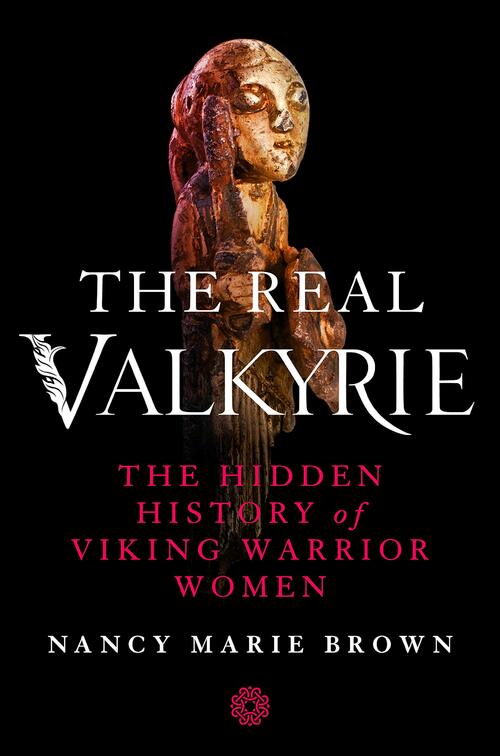
We re-examine Viking society in this compelling non-fiction work which presents THE REAL VALKYRIE. We have good records of female Viking warriors, but few unearthed graves of warriors were considered to be those of females by archaeologists. Men were buried with weapons, women with weaving tools. Until DNA tests on a high-status grave in Birka, Sweden, proved all the assumptions wrong.
We don’t know the name of the lady in Birka, but Nancy Marie Brown pieces together a possible story of her life, and names her Hervor. She was a strong woman buried with weapons, tools, a large boat, a cart and animals. Historians dismissed depictions of women with spears or bows as Valkyries, fictional messengers of the panoply of gods. Looks like some of them were showing actual shield-maids. Checking known history, geography, the Sagas, DNA, isotopes and dental records, as well as the origins of wood, metal and cloth, the author compiles a broad picture of life for women of status.
I kept being reminded of Tolkien’s works, with the Shining Hall like Theoden’s hall, bodies buried with swords in barrows, and horses valued for transport and battle. On a longship, there was no hiding gender, so a woman aboard was known and accepted. Women did make sailcloth and clothing, but so did the men, this being their main way of life. Daughters were used to make marriage alliances, but we see that a woman taken unwillingly as a wife when her husband was murdered, kept calm until she could exact revenge a couple of years later. These were not women you’d want to cross.
THE REAL VALKYRIE shows us much that has been ignored or brushed over in past explanations of Scandinavian history. Women led bold, exciting lives. They travelled, fought and prospered. And sometimes they died of it. Nancy Marie Brown provides her references at the end, and the reader feels strongly encouraged to view this fantastic grave hoard.
In 2017, DNA tests revealed to the collective shock of many scholars that a Viking warrior in a high-status grave in Birka, Sweden was actually a woman. The Real Valkyrie weaves together archaeology, history, and literature to imagine her life and times, showing that Viking women had more power and agency than historians have imagined.
Brown uses science to link the Birka warrior, whom she names Hervor, to Viking trading towns and to their great trade route east to Byzantium and beyond. She imagines her life intersecting with larger-than-life but real women, including Queen Gunnhild Mother-of-Kings, the Viking leader known as The Red Girl, and Queen Olga of Kyiv. Hervor’s short, dramatic life shows that much of what we have taken as truth about women in the Viking Age is based not on data, but on nineteenth-century Victorian biases. Rather than holding the household keys, Viking women in history, law, saga, poetry, and myth carry weapons. These women brag, “As heroes we were widely known--with keen spears we cut blood from bone.” In this compelling narrative Brown brings the world of those valkyries and shield-maids to vivid life.
EXCERPT
Before books, there were stories. In them was distilled the knowledge each generation wished to pass on to the next. Storytelling was (and is) a form of power. It was time-binding: It linked then to now. Told eloquently, at the right time to the right listeners, a story shaped the future. Told often enough, in as many ways as possible, a story became indelible. Such a story is the one told of Eirik Bloodaxe’s great-grandmother, Queen Asa.
The story was still being told when Snorri Sturluson visited Vestfold nearly three hundred years later. As he relays it in Heimskringla, Asa was the only daughter of King Harald Redbeard, who ruled Agdir, Norway’s southernmost kingdom. Gudrod, king of Vestfold and two other kingdoms at the head of Viken, sent messengers to Agdir asking for Asa’s hand. Asa might have preferred to marry Gudrod’s grown son, who was exceedingly handsome and tall, for the Hunting King had already seen one wife to the grave. Or Asa may have been a shield-maid who wished not to marry at all. Whatever the reason, her father refused Gudrod’s suit.
The Hunting King swept down from the north with many ships. He took Agdir by surprise, surrounded the king’s estate, fired the thatched roofs, and turned his Vikings loose to plunder. Fighting against heavy odds, Asa’s father and brother were killed. Asa herself was captured and raped by her father’s murderer. She kept her dignity and contained her rage. When she became pregnant, he made her his queen. When their son, Halfdan the Black, was a year old, she took her revenge.
The Hunting King and his queen were on their autumn progress, sailing from one chieftain’s estate to another, enjoying a harvest feast at each one, dispensing justice, attending rituals, witnessing oaths and boasts, and generally reminding their subjects who was in charge. At Stiflu Sound (a place still unidentified by modern historians), Queen Asa saw her chance. At the end of the quay where they’d moored the royal ship she’d noticed a thicket of trees. That night there’d be no moon.
She posted her errand runner in the thicket. She ran her thumb up the edge of the spear she’d given him and was pleased to see beads of blood well up. He’d whetted it as sharp as her need for vengeance.
If he survived she’d make him rich. He wouldn’t survive. She couldn’t help that. The king’s bodyguard were berserks—his best fighters. She refilled the king’s mead cup and re-entered the tent on the ship, where he slept.
Late at night the king went on land, looking for a woman, as she knew he would. He was very drunk—she’d seen to that. It was very dark. When he reached the thicket, the boy leaped out and ran him through. The Hunting King fell into the water, dead.
So far, the story of Queen Asa is what you’d expect of a Viking queen. She is tough, decisive, unbowed—but still helpless. She has, as sociologists say, no agency. She can plot revenge, but not execute it. She can provide the spear, but not make the thrust. She is reduced to getting her way through “deep-wrought wiles,” in the words of the ninth-century Norwegian poet Thjodolf of Hvin, who preserved Asa’s story for posterity. He called her wicked and the murder foul-play.
Snorri Sturluson didn’t say much more, when he expanded on Thjodolf’s poem in Heimskringla. Yet, for me, the few lines he added change everything.
The next morning the king’s killer, hacked down at the quayside, was seen to be the queen’s errand runner. King Gudrod’s warriors confronted her. Queen Asa, said Snorri, “did not deny it was her plan.” You’d expect her to be executed; instead, Snorri wrote, Asa “at once” took her infant son Halfdan and went south to Agdir. There, she “reigned over the kingdom that her father, Harald Redbeard, had ruled” until Halfdan the Black grew up. “He was eighteen years old when he took over the kingdom.”
Given the length of Snorri’s book, it’s easy to overlook what Queen Asa’s revenge reports about women and power in the Viking Age. At once she proceeded south. She established herself in Agdir as the ruling queen. What does that say about her agency, her ability to act independently?
It says she needed no help from any man. Her father and brother and most of their warriors were dead—or still south in Agdir if they had escaped the Hunting King’s attack. She alone had been captured and kept captive, though queen in name. Her son was an infant. Alone she faced down her dead husband’s warband. Alone she faced down her son’s tall, handsome half-brother. She faced down the chieftain at whose quay they were moored. She not only escaped punishment, she left at once. Regally. Like a warrior queen no one dared cross. She must have taken the royal ship. She must have taken all the ship contained, including its crew, whose sworn oaths she exacted. She returned to the kingdom of her birth and established herself there, ruling Agdir for seventeen years.











 © 2003-2026