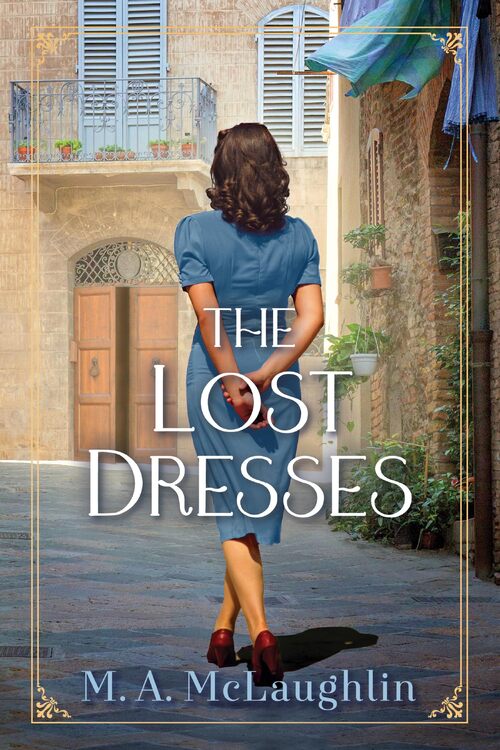
If you ask Google about the poet Christina Rossetti you’ll see a mature woman’s face, sad-looking, and she’s wearing a black dress. This imaginative historical fiction revisits two timelines, as two different women travel to Verona, Italy. One is the young, cheerful Christina, fashionably attired, from an English-Italian literary family. The other is a fabric historian who wants to learn what happened to the poet and THE LOST DRESSES.
Verona, 1947, with bullet holes still in the walls and losses among families. Textile historian Marianne Baxter is contacted by an old school friend and asked to travel to Verona from America to present a museum exhibition. Rufina Roselli discovered a trunk with three fine dresses in a sealed-off room in the museum, which was once a grand palazzo. Due to a letter with them, she knows they belonged to the poet, but nothing more. Marianne is predictably delighted, challenged and determined as she sets to work to learn about her subject and display the clothes to locals and tourists alike. The fabric industry of the region ceased during the war and needs help to re-open.
England and Verona, 1864. Christina Rossetti plans a trip with her family to her parent’s original home after she finds a secret compartment in a box owned by her late father. A pendant in the box and an old book lead her to Verona, where a library is missing a copy of Dante’s Inferno and a family is missing some emeralds. At this point, Christina lives up to her arty image, with poems about goblins, seduction and nature. She does good work, with her worthy sister. But she lacks a real romance, and the Italian trip frees her in spirit. The later timeline asks why, if she found romance, it didn’t last.
Having recently read a book set during the time of walled cities in Italian nation-states, I was expecting lavish sixteenth-century dresses to be the subject. But the author M. A. McLaughlin explains, through her characters, that we only know Renaissance clothes from paintings, as fine fabric got re-used and worn out over the decades. During wartime, much was destroyed, including many artworks and buildings. So even clothes from the 1860s would be remarkable to find unaltered. M. A. McLaughlin not only recreates the poet for us but also her immediate family, who all made their mark on society. THE LOST DRESSES is a tense, slow-burn adventure that casts a shadow on Marianne’s life as she learns of the desperation of war, and the crimes that have not ended. I found the read fascinating and will look out for more from this author.
No excerpt available.





 © 2003-2026