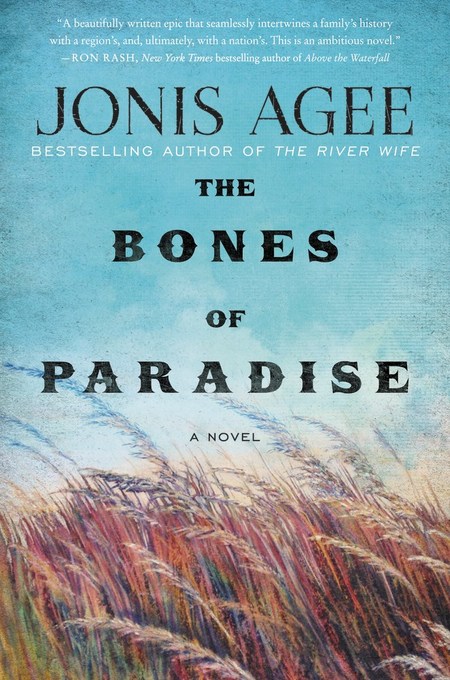
I introduced myself to Jonis Agee with THE BONES of PARADISE and plan to read more. Agee's novel doesn't fit in one genre but encompasses many: historical, mystery, romance, Western, saga. This story has something for everyone, and the lyrical prose makes it even more enjoyable. I found myself wanting to savor the language and alternately wanting to race ahead to find out what happened next.
J. B. Bennett is riding to his father's ranch when he stops at a squeaky windmill near a water tank. What he finds instead is the body of a young Indian girl named Star, and before he can investigate her death more, he is shot dead. There's a lot going on in this story, and I could lose some in the details, so suffice to say J. B.'s wife, Dulcinea, returns from self-exile to hunt down the murderer with her friend and Star's older sister, Rose, J. B.'s father Drum, her two sons, the ranch hands, and a man named Graver, who stumbled onto the bodies. One of the most important characters however, is the land itself.
Agee's characters have depth. It's hard to understand their motivations sometimes, but it is never hard to react to them when reading. She also delves into historical events such as the tragedy of Wounded Knee as the bulk of the story takes place about 10 years after. Wounded Knee impacted many characters' lives, and Agee uses the massacre to anchor her story.
Her descriptions of the land in winter made me shiver, and I could almost feel the perpetual sand blowing in my face. Her greatest trait is her ability with dialogue and relationships: between mother and son; father-in-law and daughter-in-law; mother and ranch hand; Rose and Dulcinea. Whites treated Indians abominably during that time, and Agee brings that to light with action and description stronger than any telling.
It's a story with a lot of ideas, but at its heart are love, survival and redemption. Historical fiction readers who are fans of this time period will enjoy the story. While it has elements of mystery and romance, I hesitate to call it either, but I definitely look forward to reading more of Agee's books.
The award-winning author of TheRiver Wife
returns with a multigenerational family saga set in the
unforgiving Nebraska Sand Hills in the years following the
massacre at Wounded Knee—an ambitious tale of history,
vengeance, race, guilt, betrayal, family, and belonging,
filled with a vivid cast of characters shaped by violence,
love, and a desperate loyalty to the land.
Ten years
after the Seventh Cavalry massacred more than two hundred
Lakota men, women, and children at Wounded Knee, J.B.
Bennett, a white rancher, and Star, a young Native American
woman, are murdered in a remote meadow on J.B.’s land. The
deaths bring together the scattered members of the Bennett
family: J.B.’s cunning and hard father, Drum; his estranged
wife, Dulcinea; and his teenage sons, Cullen and Hayward. As
the mystery of these twin deaths unfolds, the history of the
dysfunctional Bennetts and their damning secrets is
revealed, exposing the conflicted heart of a nation caught
between past and future.
At the center of The
Bones of Paradise are two remarkable women. Dulcinea,
returned after bitter years of self-exile, yearns for
redemption and the courage to mend her broken family and
reclaim the land that is rightfully hers. Rose, scarred by
the terrible slaughters that have decimated and dislocated
her people, struggles to accept the death of her sister,
Star, and refuses to rest until she is avenged.
A
kaleidoscopic portrait of misfits, schemers, chancers, and
dreamers, Jonis Agee’s bold novel is a panorama of America
at the dawn of a new century. A beautiful evocation of this
magnificent, blood-soaked land—its sweeping prairies, seas
of golden grass, and sandy hills, all at the mercy of two
unpredictable and terrifying forces, weather and
lawlessness—and the durable men and women who dared to tame
it. Intimate and epic, The Bones of Paradise is a
remarkable achievement: a mystery, a tragedy, a romance, and
an unflagging exploration of the beauty and brutality,
tenderness and cruelty that defined the settling of the
American West.











 © 2003-2026