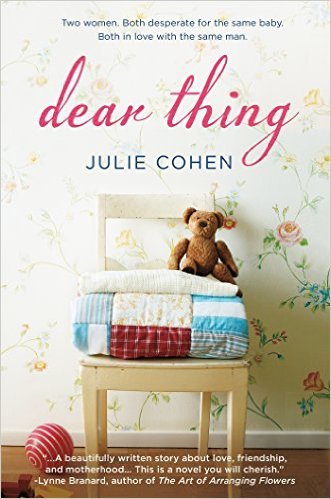
DEAR THING, is the story of Claire, Ben and Thing in which Romily plays a major supporting role. There's Jarvis and Posie, too in the story with a brief yet necessary appearance by Max.
It is a story where after reading you will feel like you've been through the wringer of life. You come out a little bruised yet all spruced up on the other end. The pain and process and twists make you feel like a new person yet the same person. The process of conceiving a new life without results can wreak havoc on a relationship and can be very brutal. When you add heartbreak and heartache of all kinds it is emotionally devastating. There is a thin line between losing everything and having all your prayers come true. DEAR THING, is one such story, of conceiving a little one called Thing, dreamed by Claire and Ben but turned into reality by Romily. But dear Thing, the object of everyone's attention and prayers is only Ben and Claire's. It is first the absence, then the presence of Thing that makes Claire and Ben's life seem similar to that of a roller coaster ride.
And Thing my dear friends in this story is Ben and Claire's baby via Romily. Via Romily may sound like me making fun or light of the character's situation but trust me I am not. Only after you've read the story you will agree that, that's how Romily might also put it across. You see Romily and Ben are old friends but she also has a secret in her heart where Ben is concerned and he is married to Claire, the love of his life. Claire, unfortunately cannot have a baby even after numerous failed attempts and treatments. So you can see how three people coming together to make a baby can create complications. Ben is a great guy whose only fault is his overwhelming desire and passion to be a father. Claire plays a difficult role of the one who fails and faces all the miseries. Then there is Max, the outsider whose presence helps Claire make some tough decisions.
There are difficulties, confusion and frustration all around along with Romily's unique character and how she deals with her life. She, along with her daughter Posie, bring a much needed lighter side to this sensitive and tragic tale. I was impressed with Romily all the way, but more so at the end when she fulfills her dream too, after making Ben and Claire's dreams a reality. There is not much of Jarvis initially, he is Posie's dad and when he does come back in their lives he is lovable and appealing to me. DEAR THING is a sensitive and beautiful take on one of life's milestone - having a child.
After years of watching her best friends Ben and Claire
try
for a baby, Romily has offered to give them the one
thing
that they want most.
Romily expects it will be easy
to
be a surrogate. She's already a single mother, and she
has
no desire for any more children. But Romily isn't
prepared
for the overwhelming feelings that have taken hold of her
and which threaten to ruin her friendship with Ben and
Claire-and even destroy their marriage.
Now there
are three friends, two mothers and only one baby, and an
impossible decision to make...
Thought-provoking,
heart-rending but ultimately uplifting, Julie Cohen's
Dear Thing is a book you won't be able to put
down,
until you pass it on to your best friends.
EXCERPT
‘Do you have children?’
Claire shifted slightly on Lacey’s sofa to face the woman
who was talking to her. She didn’t know most of the women
in the room. Two of them were from school—Lacey had just
started teaching geography last year, ironically to cover
another teacher’s maternity leave—but the others were
Lacey’s friends or family. All of the guests had been
seated around the room according to birth sign; it was
supposed to help break the ice and help them get to know
each other.
‘No,’ she answered, doing her best to put on a gracious
smile, as she always did when asked this question by
someone who didn’t know. Today, it was a lot easier.
‘No wonder your skin is so gorgeous! All that sleep.’ The
woman leaned forward. She had straightened hair and blue
circles under her eyes. ‘Tell me—do you get to go to
restaurants?’
‘Sometimes.’
The woman let out a long stream of a sigh. ‘Oh, I dream
of restaurants. Ones that have proper cutlery. And menus
that aren’t designed for children to colour in.’
‘I get excited about a bowl of chips at the soft play
centre,’ added the woman on the other side of Claire.
‘Tell me about it,’ said the first one. ‘Do you know how
Paul and I celebrated our wedding anniversary? Tub of
Häagen-Dazs at the cinema during a Disney film.’
‘I forgot about ours,’ called another woman from across
the room. ‘Harry and Abby both had the chicken pox. I
remembered two days later and it hardly seemed worth it.’
‘Does your husband give you flowers?’ the first woman
asked Claire.
‘Er…sometimes.’ There had been a bouquet on the table
when she came downstairs this morning.
‘I got flowers for Valentine’s day last year!’ said the
second woman. ‘Ellie ate them. We had to go to A&E. I
didn’t get flowers this year.’
‘Were they poisonous?’
‘We were mostly worried about the cellophane wrapper. She
didn’t do a poo for three days. I was terrified.’
‘Once, Alfie didn’t do a poo for two weeks. I shovelled
enough puréed prunes into him to choke a horse.’
‘You have all this to come,’ said the first woman to
Lacey. Lacey sat in a flowered armchair in the sunny,
cramped front room of her flat, her hands laced over her
protruding stomach. She smiled as if the idea of
shovelling puréed prunes into a baby’s mouth was just
about the best thing in the entire world.
Claire thought that probably wasn’t too far from wrong.
‘Wine?’ Lacey’s mother, who was a sweet lady with very
red hair, was circulating the room with a bottle of pinot
grigio. Claire shook her head and held up her glass,
already full of mineral water. ‘That’s a beautiful cake
you’ve made,’ Lacey’s mother said. ‘And so delicious.
Aren’t you having any?’
‘Thank you. And no, I don’t really eat cake.’
‘Are you gluten-free?’ asked the first woman. ‘No wonder
you’re so slim. I just look at a piece of bread and I
gain half a stone.’
‘I just try to eat healthily,’ said Claire. ‘But I love
making cakes, so.’
‘What’s the baby going to be called?’ someone asked
Lacey.
‘We’re calling him Billy.’
There was a collective sigh of appreciation.
‘I like the simple names,’ said the first woman. ‘There
are too many trendy names around. There’s a girl at
Alfie’s nursery called Fairybelle.’
The women launched into a discussion of their children’s
names: what they were almost called, what they were glad
they weren’t called, what they would have been called if
they had been born the opposite sex. The woman whose
daughter had eaten the cellophane off her flowers got up
to use the loo and Georgette, the other St Dominick’s
teacher, slipped into the place next to Claire.
‘I’m sorry,’ she murmured. ‘It’s all baby talk.’
‘It’s okay. I’m used to it. Besides, it’s Lacey’s day.
She looks wonderful, doesn’t she?’
They both looked at Lacey. She was generally the sort of
person who didn’t call much attention to herself: a
hiker, a camper, a good teacher.
She looked wonderful.
‘Still,’ said Georgette, ‘I think that people could be a
little bit more sensitive. Not everyone wants to talk
about babies all the time.’
Georgette had two children. Claire remembered when the
youngest had been born; it was about the time Claire
herself had gone through her third and final IVF
treatment that had been allowed on the NHS, before they’d
gone private. Claire had been given an invitation to the
christening, but there was a little hand-written note in
it: I’ll understand if you don’t want to be around
babies.
She hadn’t gone to the christening, not to avoid the
babies but to avoid the understanding.
The women in this room were complaining about their
lives, but underneath they were happy. Claire could
almost smell it, with the nose of an outsider. They
exuded warm yeasty contentment. It was the same way, she
noticed, whenever women with young children got together.
The conversation revolved around little sacrifices or
disasters, about mishaps and made-up worries, but its
function wasn’t to communicate information: it was to
establish relationship. To mark out common ground.
We are mothers. We do battle with nappies and Calpol.
Look upon our offspring, ye mighty, and despair.
The truth was, she would give up anything to be like the
women in this room. She was tired of feeling the sharp
stab of pain every time she passed a playground. That raw
drag of yearning at Christmas. She was tired of feeling
like a failure, once a month, like clockwork.
But that didn’t mean she wanted to talk about it. Or to
be pitied.










 © 2003-2026