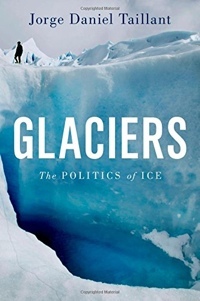
One of our key natural resources is the fresh water locked up in glaciers. This interesting read explains why we now need laws to protect glaciers and the environment around them, as they shrink every year but glacier ice feeds major rivers. The author, Jorge Daniel Taillant, has particularly worked with those studying and protecting the glaciers of the Andes, the world's second highest mountain range. We learn that GLACIERS: POLITICS OF ICE is an apt title as water becomes ever scarcer and more expensive while ice lakes can melt swiftly and flood settled valleys. Taillant founded and works with the non-profit Center For Human Rights And Environment (CEDHA) and has contributed to experts' meetings of the United Nations.
This easily readable book is piled high with fascinating facts, and with equally interesting people. Map references for Google maps are provided, so we can get on our 'net devices and stare at glaciers on the Equator in Africa, among other lands. The Andes range divides Argentina from Chile, and the highest peaks in the chain form national boundaries, plus the principle of seeing which way glacial meltwater runs off the mountain - west or east - to determine which country owns the mountain. When mining for gold and silver threatened to dynamite glaciers in the 2000s, and the company actually did bulldoze through large areas, concerned activists in Argentina organised a group to protest, giving South America a now famous slogan, "Water is worth more than gold." The reasons why mining companies fought laws protecting glaciers are explained.
I learned what a glaciologist told the Secretary for Environment in Argentina - that there are 'rock glaciers' which are rivers of ice under and among soil and rock. Permafrost which moves downhill under its own weight and eventually melts to feed water courses and irrigate dry lands. Because these do not show up as white, they are not generally known but they still contain masses of slowly- released water.
The short documentary film Chasing Ice is cited, which shows a chunk of ice half the size of Manhattan Island breaking off a Greenland glacier and rushing into the sea. Photos of mountain glaciers in this book are sometimes captioned with the words that this glacier has now vanished. Mountains all over the world are losing glacier ice to warming temperatures. So is there any lighter side to the story? Well, did you hear the one about the man jailed for breaking and removing chunks of glacier ice to serve more interesting drinks? We also learn that a vegas system refers to a dry area watered by glacier melt, as in Las Vegas. Air and dust from centuries ago can remain trapped in glacier ice, so scientists can learn about the past.
While some of the information in the book is technical, I enjoy the graphics showing how snow looks when it falls and as it compresses to ice. Some spectacular photos are included. A good tip when viewing satellite images is that glaciers form on north-facing slopes in the Northern Hemisphere and on south-facing slopes in the Southern Hemisphere. So there is plenty for readers of all ages and education levels. Jorge Daniel Taillant emphasises that glaciers in remote places are less relevant for drinking water than glaciers near populated areas. His splendid book GLACIERS: POLITICS OF ICE is a tribute, not only to these ice rivers, but to the people who go out of their way to protect them for the future.
No excerpt available.












 © 2003-2026