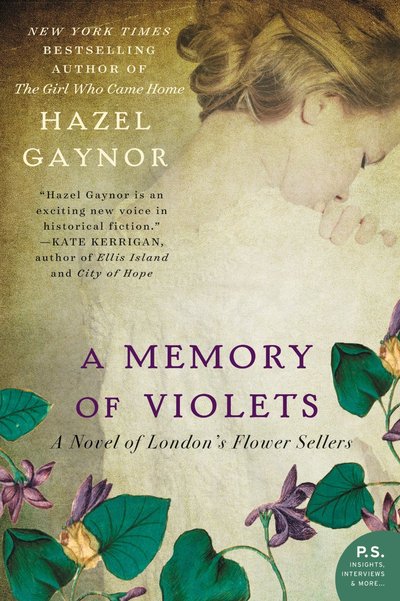
As George Bernard Shaw told us in Pygmalion: The difference between a lady and a flower girl is not how she behaves, but how she's treated. London's flower girls are the subject of this unusual and engaging story, A MEMORY OF VIOLETS, a social study and haunting romance for those who like historical reads.
In 1876 young Florrie Flynn, of Irish London stock, trots along after her mother to buy flowers at Covent Garden. They have to arrive by five in the morning to get the best blooms, then spend the rest of the day and evening selling them. Florrie's new baby sister Rosie is carried in the basket too. Florrie had polio which left her with a weak leg, but she cheerfully cares for blind Rosie. Then cholera takes their mother, and Florrie continues in her stead.
In 1912 Tilly Harper, a young woman from the north, gains the post of housemistress in a training school for flower sellers. She's a solitary girl, who enjoys painting outdoors, and she has worked as a housemaid. A Christian charity has provided a school to take crippled girls off the cold streets and teach them to make silk flowers. Tilly is prepared to work hard, but nothing could have prepared her for life in teeming London.
Tilly finds letters written by Florrie years earlier and by juxtaposing the girls' lives we build up a picture of the times and the hardships. Cold and squalor are ever present for the two flower-girls, and the meal room run by the charity as a fore-runner to the training school is their sole source of warmth and kindness in the bustling city. Unable to work in factories or as maids, the disabled girls have no other hope of earning - except for the one trade they are not prepared to enter. With the city stink, nosegays and buttonholes sell well. But Rosie is snatched by an ill-doer, and desperate Florrie cannot find her. Tilly meanwhile is adapting to working with people with disabilities from disease or factory accidents. Queen Alexandra herself takes an interest. Tilly notices young men for the first time, but would anyone be attracted to her?
I admire Hazel Gaynor for tackling a difficult subject, and one which has largely remained unvisited. The charity run by the Shaw family does not see the afflicted girls as people to be exploited, but to be encouraged and raised up to a better level. Carefully interweaving the stories of Rosie, Florrie and Tilly, A MEMORY OF VIOLETS is a tale to be cherished, which brings turn of the century London to exuberant life. Hazel Gaynor previously wrote The Girl Who Came Home about a survivor of the Titanic, and I believe her works deserve wide attention.
In 1912,
twenty-year-old Tilly Harper leaves the peace and beauty of
her native Lake District for London, to become assistant
housemother at Mr. Shaw’s Home for Watercress and Flower
Girls. For years, the home has cared for London’s flower
girls—orphaned and crippled children living on the grimy
streets and selling posies of violets and watercress to
survive.
Soon after she arrives, Tilly discovers a
diary written by an orphan named Florrie—a young Irish
flower girl who died of a broken heart after she and her
sister, Rosie, were separated. Moved by Florrie’s pain and
all she endured in her brief life, Tilly sets out to
discover what happened to Rosie. But the search will not be
easy. Full of twists and surprises, it leads the caring and
determined young woman into unexpected places, including the
depths of her own heart.
No excerpt available.









 © 2003-2026