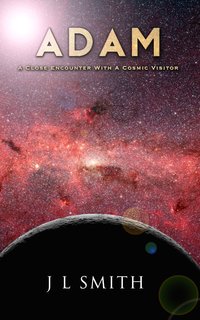
I was highly interested in this story which describes astronomers sighting a cosmic visitor to our Solar System, on a close course to Earth's orbit. ADAM: A CLOSE ENCOUNTER WITH A COSMIC VISITOR is for anyone who follows the interplanetary explorers, Voyager and Cassini. There are diagrams and colour illustrations from the Hubble space telescope to clarify points of the text. Set in a future when a Mars habitat is being planned, this tale indicates the risks of space travel start before we even leave the planet.
Patty and Sid Wilson are the first to spot the incoming object. They operate a giant NASA telescope in the Nevada desert, checking nightly for new asteroids. Adam, as they quaintly name the first new moving body they spot, has a hyperbolic orbit instead of an elliptical one, meaning it's not on a regular track around the solar system. Just passing Saturn, the object is massive enough to perturb the orbit of little moon Phoebe, yet so dark that its low albedo has stopped other observers from seeing it sooner.
The projected path of Adam will take it closer to Earth than the orbit of the Moon. Even if this newcomer doesn't strike Earth, or the Moon, the effect of its passing could alter our climate and cause earthquakes with tsunamis. Can anything be done to avert global disaster? Patty and Sid don't want to cause a panic, but the sooner NASA and the world leaders and scientists know, the sooner they can make plans. Not to mention that some people think Adam may be a spacecraft!
Jack Smith has been a physics teacher, and he introduces plenty of physics and astrophysics concepts, in such a way that teens and adults should be able to grasp the meanings. Some liberties have been taken to carry the story.
In ADAM: A CLOSE ENCOUNTER WITH A COSMIC VISITOR, scientists co-operate, while politicians and generals fear one another, causing inertia. The human race will have to outgrow its childish lack of co-ordination to survive this major hazard. Jack Smith also believes that a colony on Mars is a way the human race can avoid keeping all its eggs in one planetary basket. I love the pictures in this book and I really enjoy the human face to every part of the story. Even astronomers fall in love, and even scientists get the blues.
No excerpt available.










 © 2003-2026