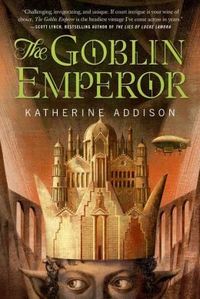
Maia is the fourth son of the emperor, poorly regarded, only from the fourth wife and shuffled off to a rural home to be tutored by Setheris, a man who resents being made to leave his wife at court. Then an airship crash kills the emperor and heirs. Maia is thrust into a position he never expected.
THE GOBLIN EMPEROR is how the people see Maia, though they call him Serenity to his face. The court nobles are elves and servants are goblins, and we gradually realise that Maia is from a token mixed marriage. The contrasts early in the story are amusing as Maia gets proper clothing and instructs the awkward steward about funerals and his coronation. He listened to his lawyer cousin's lessons and knows his only hope is to take control - he's eighteen, friendless and vulnerable. Using the imperial "we" and having everyone prostrate themselves is all good fun, but the life of the ruler contains formality and loneliness. Maia is unconventional from the start. Csevet, a messenger who seems loyal, gets promoted to look after his personal affairs, and Maia is reminded that he must marry... sooner would be wise, rather than later. He's never had anything to do with girls, and now he's the most eligible man in several lands. He can't even dance.
I got into the story quickly and felt sympathetic for Maia; it was also easy to see why Setheris resented being Maia's guardian at the expected dead-end of his career and family life. Labyrinthine court formalities take the place of action but newness, unexpectedness and Maia's learning to cope keep the reader occupied. Then there's the matter of the sabotage conspiracy which killed the last ruler... this adds tension and keeps us guessing.
The difficult part of THE GOBLIN EMPEROR is the names. Lord Deshehar, Varenechibel, Csevet, Setherin, Nedao Vechin, Nemrian, Nurevis, Dachensol Habrobar, just for a few; then we get the longer and similar-sounding place names. I don't know how the author kept them straight and many readers won't try too hard. The occasional steampunk element is more mentioned than present, but it does lift the tale away from normal medieval fantasies. We find Katherine Addison's formal style of writing enjoyably different, and we hope to read more by her, more tales of bridge-building and character growth amid uncertainty such as THE GOBLIN EMPEROR.
No excerpt available.






 © 2003-2026